SC developers give over the limit to Horry candidates through LLCs. It’s all legal
Developers have made contributions to Horry County Council candidates well over the state’s $1,000-per-candidate-per-election-cycle limit, according to newly released campaign finance reports.
Some of those developers have given to the same candidates multiple times through limited liability companies, or LLCs, and using a part of the state ethics law that allows businesses to donate to political campaigns as individuals.
Some experts call it South Carolina’s “LLC loophole.” Others say the practice should end.
“We are one of just a handful of states with a so-called ‘LLC loophole’ in our state campaign finance laws,” Coastal Carolina University politics professor Drew Kurlowski said in an email. “Each organized LLC is a separate ‘individual’ under our laws, with their own campaign donation limit.”
These campaign finance reports — the first major batch ahead of the June 14 primary election — reveal two trends:
▪ Incumbents are largely self-funding their re-election campaigns.
▪ Developers are lining up behind challengers.
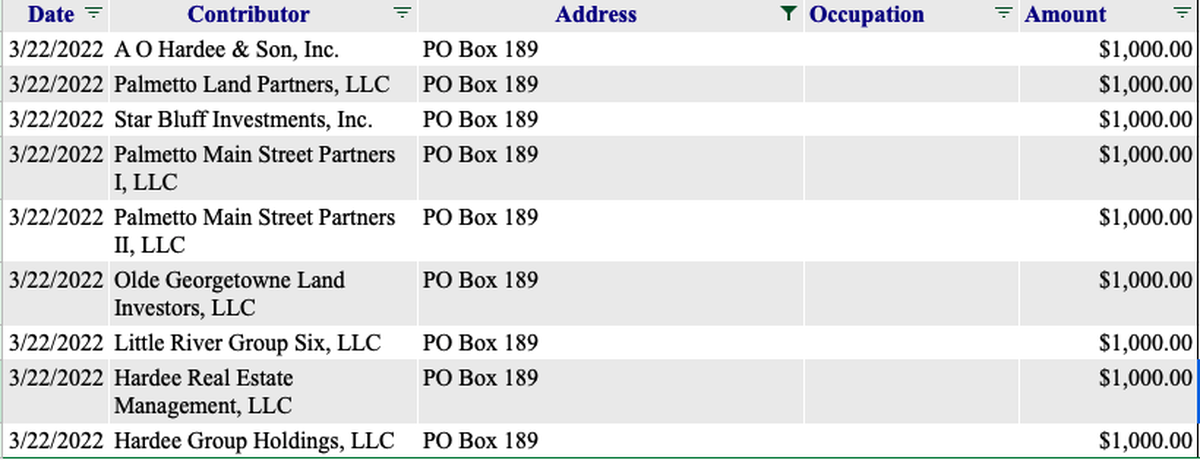
The local campaign finance reports released this week show, for example, that developer Benjy Hardee, of A. O. Hardee & Son, gave $1,000 nine separate times to county council candidate Jenna Dukes, using nine companies tied to his name. Dukes is a pharmacist who’s challenging incumbent council member Harold Worley for his North Myrtle Beach seat.
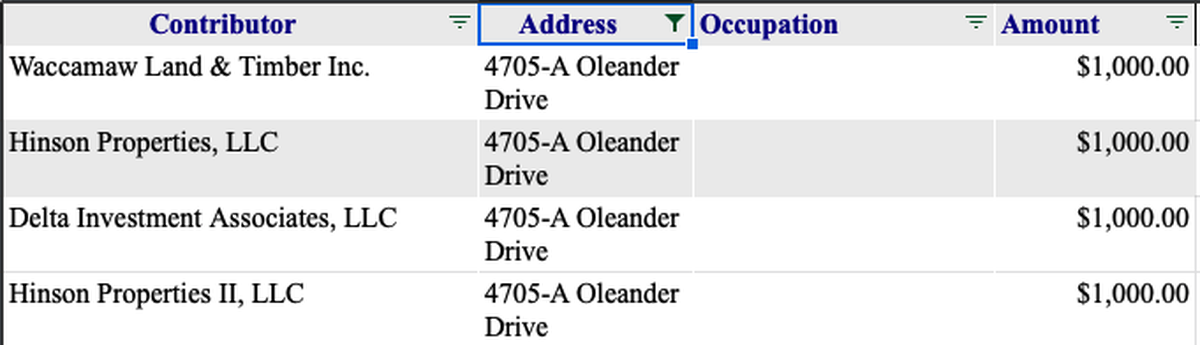
The reports also show developer Keith Hinson, of Waccamaw Land & Timber, gave $1,000 four separate times to Dukes using four companies he’s associated with.
Hinson also gave $1,000 four separate times to Mark Lazarus using four LLCs linked to him. Lazarus is a former Horry County Council chairman who was ousted in 2018 and is running again for the position, against incumbent Chairman Johnny Gardner.
The reports further show that Tony Cox, the vice president of the major developer Burroughs & Chapin, donated $3,000 to Lazarus using companies tied to him and his wife.
Myrtle Beach Mayor Brenda Bethune, too, gave $3,000 to Lazarus using companies she owns.
Lazarus to date has raised nearly $139,000. Dukes has raised nearly $96,000.
Other Horry County candidate fundraising pales in comparison.
The finance reports show that incumbent council member Orton Bellamy has raised only $3,000 — $2,500 of which he contributed himself. Incumbent council member Al Allen, too, has only raised a small amount of cash, all of which he gave himself.
Gardner has only raised $1,500 and his campaign said he would focus on a “grassroots effort” rather than fundraising. Worley said he wouldn’t fundraise at all, and would self-fund as needed. Incumbent council members Bill Howard and Tyler Servant are both fundraising normally and have each raised small amounts from a handful of donors, according to the reports.
Ethics experts said that while the practice of donating the maximum-allowed amount multiple times using separate companies is legal and common, it’s an “unfortunate” pattern in South Carolina.
“It’s inverting the sense of the law in the sense that no one entity should have undue influence in a campaign,” said Lynn Teague of the South Carolina League of Women Voters. “It’s pretty common, there’s nothing rare about this.”
Hinson and Cox did not return phone calls seeking comment for this story.
Hardee, in an interview, said his donations are one way he gives back to the community. He said all of his giving was legal and he was excercising his rights as an American. That’s why he gave to Dukes and Lazarus, among others, he said.
“We follow the law with everything we do, we don’t have any M.O. other than supporting good people,” Hardee said. “We’re good stewards in the community and I’m always supporting good candidates. We give back and we give back to good people.”
Bethune, in a brief interview, said her giving was legal and done in the proper way.
“I don’t make that law but I do adhere to it,” she said of her giving. “And I believe in Mark Lazarus and I believe he’ll do a lot for this county.”
Lazarus defended receiving such donations because “it’s all legally done.”
“I think (developers) want a fair seat at the table, just like the citizens want a fair seat at the table,” he said.
Dukes echoed that sentiment.
“These people are job creators, they need another option so of course they’re going to support me,” she said. “The amount of support I have raised just in Quarter 1 should show that District 1 is ready for a change.”
Worley, who’s on the opposing side of such giving, said it “flies in the face” of the state ethics law.”
“All they’re doing is bypassing the intent of the legislation, the campaign statute,” Worley said. “They’re playing on the edge, they go up to the line. They don’t go over the line, but they go up to the line.”
How the giving happens
The mechanism for giving above the legal limit in South Carolina is fairly simple: An individual incorporates multiple companies and is able to give the maximum amount using each company.
Hardee, for example, gave $1,000 each from companies he owns including A. O. Hardee & Son, Hardee Real Estate Management LLC, Hardee Group Holdings LLC and Palmetto Land Management LLC.
According to state business records, Hardee is listed as the registered agent for each of the nine companies he used to give $9,000 to Dukes. Those business records show Hardee registered each business at a building owned by one of his companies in Little River.
The donations from his companies also share the same post office box address.
Hinson, too, used multiple companies he owns to donate to both Lazarus and Dukes.
Hinson, according to campaign finance records, donated $1,000 four separate times to Lazarus. Three of the companies listed in the records, Waccamaw Land & Timber, Hinson Properties LLC and Hinson Properties II LLC all list Hinson as the registered agent. The fourth company, Delta Investment Associates, lists local attorney Robert “Shep” Guyton as the registered agent, but the donation is tied to a building Hinson owns, according to county property records.
Guyton, in 2019, was fined $33,000 by the State Ethics Commission for improperly using LLCs to donate to political candidates.
Guyton didn’t return a phone call seeking comment for this story.
Hinson gave similarly to Dukes using the companies Delta Investment Associates, Wax Myrtle Partners LLC, Bear Claw LLC and Bear Bone LLC. State business records list Hinson as the agent for both Bear Claw and Bear Bone. Guyton is listed as the agent for the other two firms.
All of the donations are tied to an address linked to Hinson, according to property records.
Cox, vice president of the storied Burroughs & Chapin development firm and an S.C. Department of Transportation commissioner, donated three times to Lazarus, totaling $3,000. One donation came from him personally, another came from the company Cox Land Holding Company LLC, which lists his wife, Marilyn Cox, as the registered agent. The third donation came from Constant Velocity LLC, a firm that lists Guyton the registered agent.
All three donations are tied to the home that Cox and his wife own, property records showed.
Cox didn’t return a phone call seeking comment for this story.
Bethune, the Myrtle Beach mayor, similarly donated to Lazarus three times, totaling $3,000. She donated once personally, a second time under the firm BJ Investment Limited Partnership and a third time under the firm Magnolia Row LLC. BJ Investment Limited Partnership lists a Brenda S. Zilonka — who the mayor confirmed is her — as the registered agent and owns the buildings where Bethune operates the Better Brands distribution facility.
Guyton is listed as the agent for Magnolia Row, which Bethune owns.
Bethune defended her giving and said she is always “cautious” of following the state ethics law. She said she gave so much to Lazarus because she believes he’s the best candidate for council chairman.
A perfectly legal ‘loophole’
Meghan Walker, executive director of the state Ethics Commission, said individuals giving multiple times the allowable limit via companies they own isn’t technically a loophole because the law allows for it.
She noted, however, that companies owned by the same person have to have “separate and distinct business interests” in order for it to be allowed.
In the Guyton case — which ties back to donations in 2008 — the ethics commission ruled that his giving via 14 separate LLCs was unlawful in part because the LLCs “had little to no money of their own” and the money all came from Guyton.
Teague, with the League of Women Voters, and others argued that even if the giving is legal, it goes against the spirit of the law. Teague said even though Gov. Henry McMaster proposed removing that part of the law a decade ago, it’s never happened because state lawmakers won’t go along with it.
“It’s unfortunate but the people who would have to get on board with this are benefiting from corporations’ donations so they’re more than reluctant to stop this,” she said.
She argued that so much giving by individuals indicates that they want their donations to “buy something.”
“No company is handing out money for the fun of it or because they’re nice guys who believe in the political process,” she said. “They’re buying something here.”
Candidates defend donations
Dukes, in an interview, said she was “blown away” by the money she’s raised and argued it was an indication that voters in the North Myrtle Beach area wanted new representation on County Council. She noted that she knows the Hardee family and has crossed paths with the developer because they both own businesses in the same area.
She defended the thousands she received from Hardee.
“I’m gonna be completely honest. Like it or not, that’s the ethics law and if you have a problem with it lobby to change the law,” she said.
She added that numerous people, 111 in total, wanted to donate to her, of which developers like Hardee were only part.
Lazarus made a similar argument, and said the development community includes everyone from high-profile businessmen like Hardee and Hinson to contractors and repair people.
“They need a leader at the table who can mitigate between the development community and the residents, and a lot of residents are part of the development community,” he said.
“Obviously (developers are) making a statement that a lot of things aren’t going the way they want to see things going and they like my leadership.”
This story was originally published April 13, 2022 at 10:14 AM with the headline "SC developers give over the limit to Horry candidates through LLCs. It’s all legal."