
The death chamber doctor’s dilemma: A physician in South Carolina breaks his silence
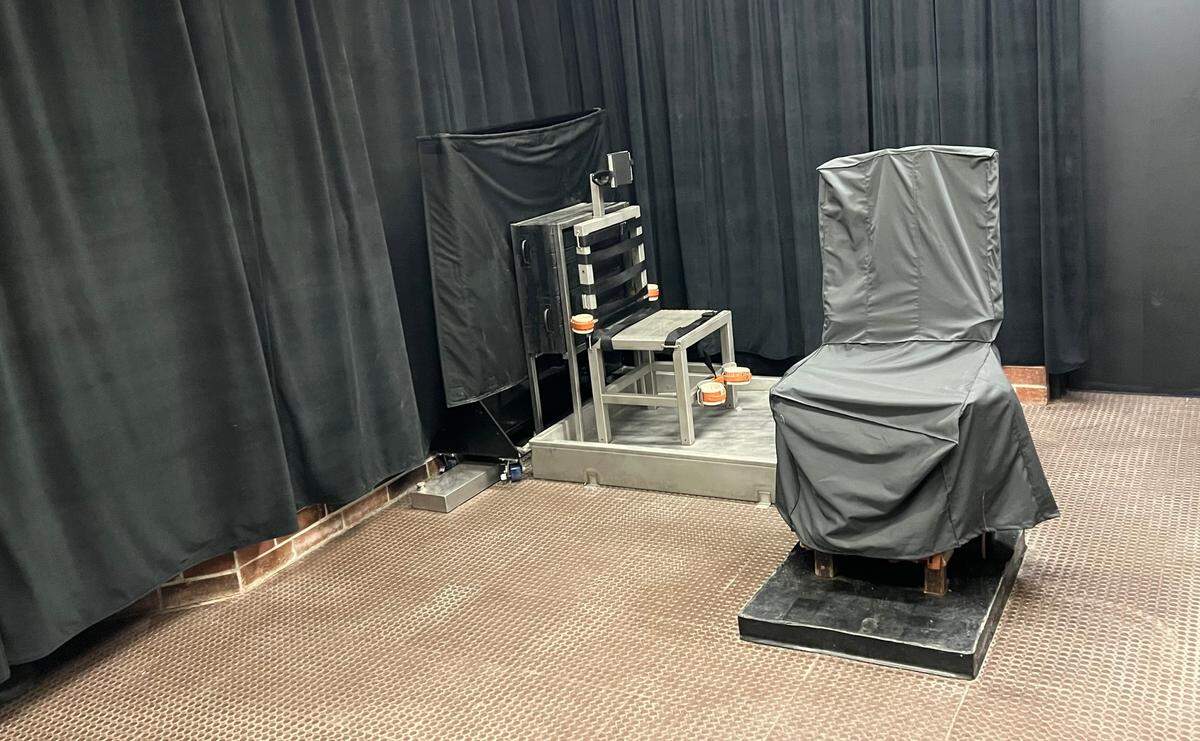
Until the second he saw the warden escort James Terry Roach into South Carolina’s death chamber, the prison doctor’s job had been to keep the man alive.
When Roach had started slitting his wrists after being convicted as a teenager, the doctor had been the one to help ease his pain with medication. Now, the warden was strapping those familiar arms into the electric chair as the physician stood nearby.
And that head, now being topped with a metal helmet? The doctor was well aware it encased a mind slower than most. He had come to know the disability in Roach’s brain better than nearly anyone else over the past decade of their doctor-patient relationship.
Those days of healing were over. Just after 5 a.m. on January 10, 1986, the electrician engaged the circuit breaker and Roach spoke some of his last words out loud to his family: “I love you.” The executioners could press their buttons at any moment.
So the physician stood with the rest of the execution team and prepared to hear his patient die.
He would only hear it happen because he would not look. While 2,300 volts of electricity jerked his patient around in the chair, he’d glue his eyes to the floor. Only after the nurse’s nod would he approach the body, feel for a pulse and listen for a long time through a stethoscope, waiting for the heart to finally stop beating. When the silence in his ears matched the stillness of the room, the doctor would send a nod of his own to the warden. He would sign the death certificate. Then, as the sun began to rise, he’d go straight home and tell nobody what he had done.
The doctor had felt uncomfortable each of the eight times he had been instructed to do this for the state of South Carolina — the worst part of his job as the prison’s medical director, he said. It wasn’t the dying that bothered him. He’d seen plenty of that before.
“Death is death, no matter whether it’s by disease, by homicide, whether it’s state sanctioned or murder. But it’s just, here I am, I’m supposed to be saving people, not killing people,” he said.
Dr. Green Neal has kept his execution experience secret for 37 years. But in March, the South Carolina Department of Corrections announced it was ready to start shooting the condemned to death with a firing squad — and that a doctor’s presence would again be required in the chamber. The state’s first executions since 2011 were scheduled to occur on April 29 and May 13 but were temporarily put on hold by the S.C. Supreme Court last week. When they do happen, the doctor in the death chamber will again be a physician currently working for Corrections, not someone hired from outside, the agency confirmed.
Neal has now decided to tell his story. He is only the second physician in recent history to talk in detail about his execution role with the press.
The silence of his peers is no accident. Doctors like him are stuck in a seemingly impossible predicament: They are required by state protocols to participate in executions even as they are prohibited by their profession from being involved.
Medical ethics, with lives on the line
Across the country, physicians have been told to write prescriptions for drugs used in lethal injections, insert the needles that carry those drugs into people’s veins, and like Neal, inspect and pronounce people dead after the killing is done by other means, like the electric chair.
Each of those actions is considered unethical by national professional societies. The American Medical Association regards any official participation other than the signing of a death certificate as contrary to a doctor’s duty to heal and do no harm. The American College of Correctional Physicians is still more strict. It has stated prison doctors should not be involved in any aspect of the execution process.
Dr. Joel Zivot, an associate professor of anesthesiology and surgery at Emory University School of Medicine, is one of the doctors who identifies with that hard line. He believes governmental use of physicians in the death chamber is a form of theater that’s good for the state’s ability to keep executing but bad for a profession that’s meant to be impartial.
“You’re trying to sanitize killing someone in the way that you can, and your claim is that by doing this, ‘we are not acting with cruelty,’” he said.
It’s also ethically inappropriate, he believes. Just like the physician who removes organs from a donor should not be the same one who first tries to save that patient’s life, it’s an unacceptable conflict of interest to require someone who treats people on death row to later be involved when they’re killed, he suggested. Even if a physician were hired from outside to work in the death chamber, a practice that other states like Georgia have adopted, that’s still a violation of the doctor-patient relationship, he said. Patients must consent to every treatment from medical staff and many on death row do not want to be executed.
That’s the current situation in South Carolina. Two of the people expected to be among those executed soonest, Brad Sigmon and Freddie Owens, do not want to be killed in the state’s 110-year-old electric chair or by firing squad. Their preferred execution method is lethal injection, which was available when they were sentenced but now is not an option. Richard Moore, the man whose execution was scheduled for April, announced on Good Friday that he would rather die by the firing squad than the chair, though he believes both methods violate the state’s constitutional ban on cruel, corporal or unusual punishment.
When a reporter asked whether the doctor who would have been with Moore in the death chamber had treated him before, the agency’s spokeswoman declined to answer, citing health privacy law. In a continuation of its trend of hiding critical information from the public about executions, the agency also declined to allow The State to interview the person currently in charge of medical services at the agency.
A few doctors have publicly departed from their profession’s official ethical line. If something goes wrong in the death chamber, argued Dr. Sandeep Jauhar, a cardiologist and author in The New York Times, wouldn’t it be better if a physician were there to alleviate suffering?
“Participating in executions does not make the doctor the executioner,” Jauhar concluded, “just as providing comfort care to a terminally ill patient does not make the doctor the bearer of the disease.”
Debaters on both sides of the argument agree on one point, however. Almost never do doctors who have worked in death chambers speak publicly like this about their dilemma.
Repressed memories
This is the first time Neal is sharing his story with strangers. It’s also the first time most of his family will hear it. That he was in the room when eight of his patients were executed was a secret he kept even from his brother, the late state representative Joseph Neal, though for 25 years, the politician legislated in the State House less than a mile away from where the doctor worked in the prison.
The silence wasn’t a consequence of animosity. Since they grew up on a farm in Lower Richland’s Hopkins, raised by parents who expected hard work outside and excellence in school, the two were close. Their mother, a teacher, helped Green read the encyclopedia and do mental math while other children were still learning their colors. Their father, a Baptist pastor, also passed on his calling to the boys. As soon as they could drive, the brothers took turns chauffeuring him to church three nights a week as he napped in the back of the car, exhausted from tending to crops but not too tired to guide the community.
It was that foundation of scholarship and service that helped the elder Neal graduate from one of the only Black medical schools in the country in Nashville, pursue a residency in internal medicine and a fellowship in cardiology, then take on a job with Corrections shortly after, in the mid 1970s.
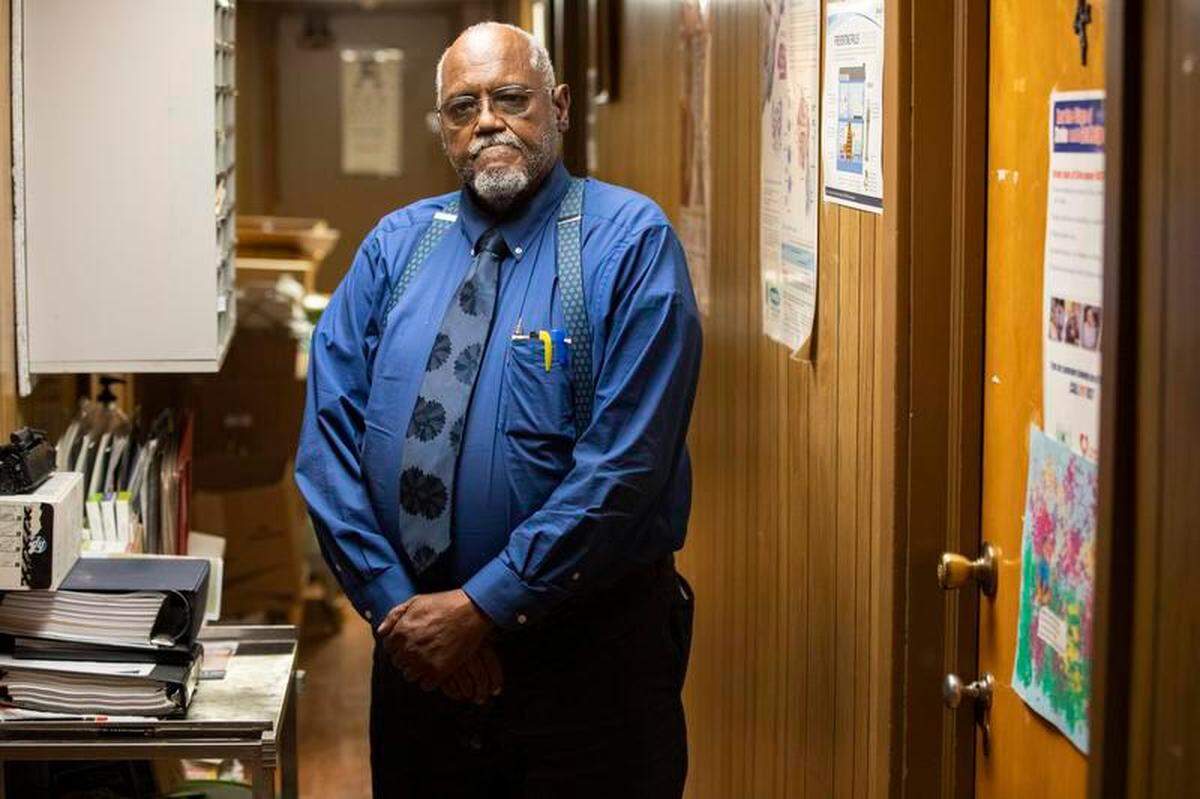
“I wanted inmates to have the same care that we on the street had,” Neal said on a recent Tuesday at his private practice in Columbia. At age 76, he still treats patients there.
Apart from the sign flipped to “closed” that hung crooked in the window that evening, his brick doctor’s office could be confused with any small house in the city. Inside, manila files stuffed with papers popped out of organizers on the walls. Posters in the hallway warned of signs of stroke. A plastic replica of the vertebrae of the human back sat next to the doctor’s desktop computer.
Nothing in the decor indicated this physician was ever a part of South Carolina’s death penalty history.
“I’ve repressed a lot of those memories, not really wanting to dig them up again,” he said.
But for a man thinking deeply out loud about it for the first time in his life, he managed to recall a striking number of details over the course of multiple interviews with a reporter.
Execution tasks hadn’t always been part of his job in the prison, Neal clarified, rocking back and forth on a stool in one of the rooms where he had been treating patients since early morning. When he started seeing people on death row in the now-demolished Central Correctional Institution in downtown Columbia, the state hadn’t executed anyone in 14 years. But by the time the doctor rose in the ranks to become Corrections’ medical director, death chamber responsibilities had become a required part of the managerial role, he said.
.jpg "dr green more 1 (1).jpg")
The first time he was involved with an execution, in 1985, was also the first time the state had conducted one in more than two decades. There was a bit of confusion, he remembered. For one, the people from the funeral parlor who came to collect the body wore oversized gloves.
“I guess they thought he was gonna be hot,” the doctor chuckled softly. “It’s not hot.”
The last patient he saw die was a famous one. To many in South Carolina, the execution of Donald “Pee Wee” Gaskins, a man who had admitted to killing more than 14 people, was something to celebrate. But Neal had been there for all the years when Gaskins was physically at his weakest, like when he went on a hunger strike and when he swallowed a razor blade. On his scheduled night of death, the doctor was there, too.
“The whole time he was in the back, he was negotiating: ‘If y’all don’t kill me, I’ll tell you where more bodies are,’” Neal remembered. “That didn’t work, so that went to his grave with him.”
And then there was the time his work led him to fear for his family. After a reporter revealed Neal’s name in an article about an execution, for weeks, the doctor would pick up the phone and listen to people threatening his life. One caller described details only someone trailing him could have known, like the style of his car, the clothes his kids were wearing and the name of the school where he had dropped them off that morning. To this day, Neal isn’t sure what had made the people harassing him angry.
His race would be part of why he’d keep his role in the death chamber secret all these years.
Beyond black and white
For Black people in South Carolina, the state has long been a dangerous place. Before slavery was abolished, masters could kill the workers they owned and get away with it. After slavery was outlawed, the same thing happened under a different name. The state saw more lynchings of Black people per capita than most other places in the country.
In 1904, a white mob from Dorchester County lynched a Black man for simply knocking on the door of a white woman’s house. Forty years later, police appeased the mob that wanted to lynch 14-year-old George Stinney, Jr., who was accused of brutally murdering two white girls though there was compelling evidence he didn’t do it, with a promise. Wait for the state to kill him instead, they offered, and the government would ensure that all the would-be lynchers received passes to witness the boy be electrocuted in the death chamber.
So the terror continued. Of the people known to have been executed by South Carolina from 1718 through 2011, more than 70% were Black. The count for young people is yet more stark. The state executed at least 22 teenagers in addition to Stinney. Every one of them was Black. None of that is ancient history. Moore, the Black man who was scheduled to be executed this April, was tried for the crime of killing someone white by a jury with not a single Black member on it.
Neal knows the reality in South Carolina well. He grew up in a segregated, rural community and is a descendant of slaves. The death threats he received after the execution were nothing new.
“If you lived here you had to conform,” he said, his arms crossing over a cream, knit cardigan that matched the color of the examination table behind him in one of the patient rooms. “If you acted out you got squished, so I learned to control my emotions way, way back.”
That was the first reason the doctor gave for never telling anyone about what he did in the death chamber. He had been trained since he was young that it was better to go along with tricky situations quietly.
Corrections only reinforced that tendency.
“We never had any counseling, nothing,” the doctor recalled, confirming what other execution team members from South Carolina told The State last year about the dearth of support services provided by the agency to execution workers. “We put it behind us and never mentioned it again.”
There was another reason why he kept his silence: He suspected his brother Joe and his father would have disagreed with what he had done. They believed in life. Yet so did he, Neal underscored. He had always been against the death penalty. Both his faith and his occupation required it.
“I fight for life. My job is not to kill; my job is to save,” he said, before revealing why he worked in the death chamber anyway. “But part of your duty as an official for the state is to carry out the mandate to the court system. So if you’re being paid for it, you need to do what you’ve been paid for. And that’s the way I rationalized it.”
Neal does not believe he participated in the executions, he insisted repeatedly over the interviews in his office. What’s more, he was in the death chamber those eight times for his patients’ protection. If he saw that the workers were abusing his patients at any point leading up to the execution, Neal said, he was one of the only people that had the power to stop it.
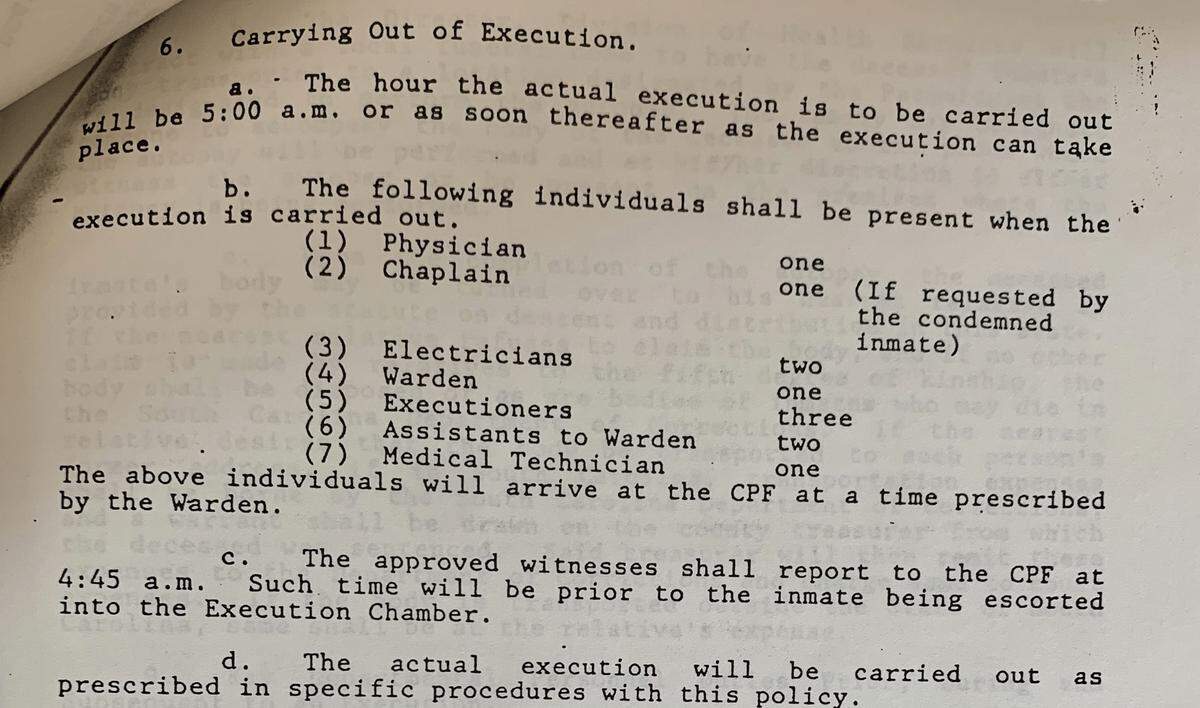
But South Carolina did consider him a critical part of the process. Multiple versions of the state’s execution protocols, drafted during the time Neal was working, confirmed physicians were essential execution team members. In each of the editions that the newspaper reviewed, the physician was the first person named as necessary to be present in the death chamber — even before the electricians, warden or executioners were listed. South Carolina law also mandates that the physician certify the execution.
And David Bruck, a criminal defense attorney who represented Roach and others on South Carolina’s death row, believes it is precisely that kind of denial of accountability that empowers the death penalty.
“Everybody thinks it’s not them,” he told a reporter in March. “Everybody has some delusion that they cling to to justify their participation. And if it wasn’t for that whole network of delusions, it would come to a screeching halt.”
Experts on moral injury see more of a gray area for what doctors like Neal agreed to do on behalf of the government. How the physician dealt with his predicament is typical of the way others in difficult life-and-death situations handle their circumstances, they say.
Dr. Rita Nakashima Brock is a theologian and coordinator of support sessions for people who suffer from moral injury, the distressing aftermath some people experience when they perpetrate, fail to prevent or witness events that contradict deeply held beliefs. She understands why some people stay in difficult jobs and keep silent.
“If they didn’t hold to it and do it to the best of their ability, things could be much worse. Somebody that didn’t do as good a job could wind up doing it,” she reflected. “There’s also the pressure that’s partly compassion for the person being killed.”
Whether you ultimately walk away or not, Brock added, you know that whatever you’re going to do is going to wreck you. But people who are professionals can compartmentalize and hide those secrets for a long time, building an emotional isolation for themselves that can be like an existential solitary confinement.
That description matched some of Neal’s reflections closely. He once wrote a letter to the governor to beg for the life of another of his patients on death row who was intellectually disabled, a Black man called Sylvester Adams. All of the doctors at the prison did the same, he said. When their appeals changed nothing, Neal had to be in the room when his patient died anyway. He’d have loved to not have been involved with any of the eight executions, but that one bothered him most.
“I’ve been taking care of this person, making sure he’s got everything he needs to live, and then we kill him,” he said. Still, like the other times, “I just isolated it in a compartment, locked the door and left it alone.”
Now that compartment is wide open and his brother would likely have been proud.
In 2015, two years before he died, the younger Neal stood in front of the South Carolina House of Representatives and made a case for telling the truth as he urged his fellow politicians to remove the confederate flag from the State House grounds. It would help the state to be honest about its history, he said.
“Not hide it, not erase it, not water it down, but tell the truth about what this state has gone through, what its people have gone through, what significant figures in this state have done,” said the lawmaker. “Let the truth educate us so we don’t make the same mistakes that we made in the past today and tomorrow.”
Soon, South Carolina could again execute more people. Neal has no recommendations for how Corrections should carry those death sentences out, perhaps next by firing squad. The physician’s execution hours are over. He might spend the upcoming day paying a home visit to an elderly patient who can’t make it to his office or organizing an intervention for one suffering from addiction. His focus is now only on extending life.
This time, the duty to do the opposite will fall on a new doctor in the death chamber.
TELL US YOUR STORY
Reporter Chiara Eisner is still covering executions and execution workers. Reach her at 803-814-4464 or eisnerchiara@gmail.com. Your name will not be published without your consent.
This story was originally published April 26, 2022 at 6:00 AM.