La Niña has finally arrived. Here’s what that means for SC weather and snow the rest of winter
After months of forecasts, La Niña has officially developed, meaning drier and warmer weather for the remaining winter months in South Carolina.
Then again, maybe not.
Although the weather pattern has finally formed, it is a weak La Niña, according to the National Weather Service Climate Prediction Center. While La Niña is known to trigger more drought and higher-than-usual temperatures in the Southeast during winter, a weak version may have less of an impact, some weather experts say.
La Niña forecast
According to the latest forecast, La Niña conditions are present and there is a 59% chance of them persisting from February through April. Also, the Climate Prediction Center favors predicting weak La Niña conditions through the early spring.
“Weak La Niña conditions are less likely to result in conventional winter/spring impacts,” the prediction center states.
What is La Niña?
La Niña is the opposite of El Niño. Trade winds are even stronger than usual during La Niña events, pushing warm water toward Asia. Off the west coast of the U.S., upwelling increases, bringing cold, nutrient-rich water to the surface. These cold waters in the Pacific push the jet stream northward.
La Niña winter weather impacts
The effects from La Niña tend to trigger drought conditions in the Southeast, according to the National Oceanic and Atmospheric Administration.
“The dryness over the Southeast is often associated with the Pacific-North American (PNA) climate pattern,” NOAA states. “In the pattern’s negative phase, the general flow of the atmosphere gets “stuck” in a wave train that repeatedly brings higher-than-normal pressure to the North Pacific, lower-than-normal pressure to western Canada, and, farther downstream, higher-than-normal pressure to the Southeast. High pressure generally results in dry skies.”
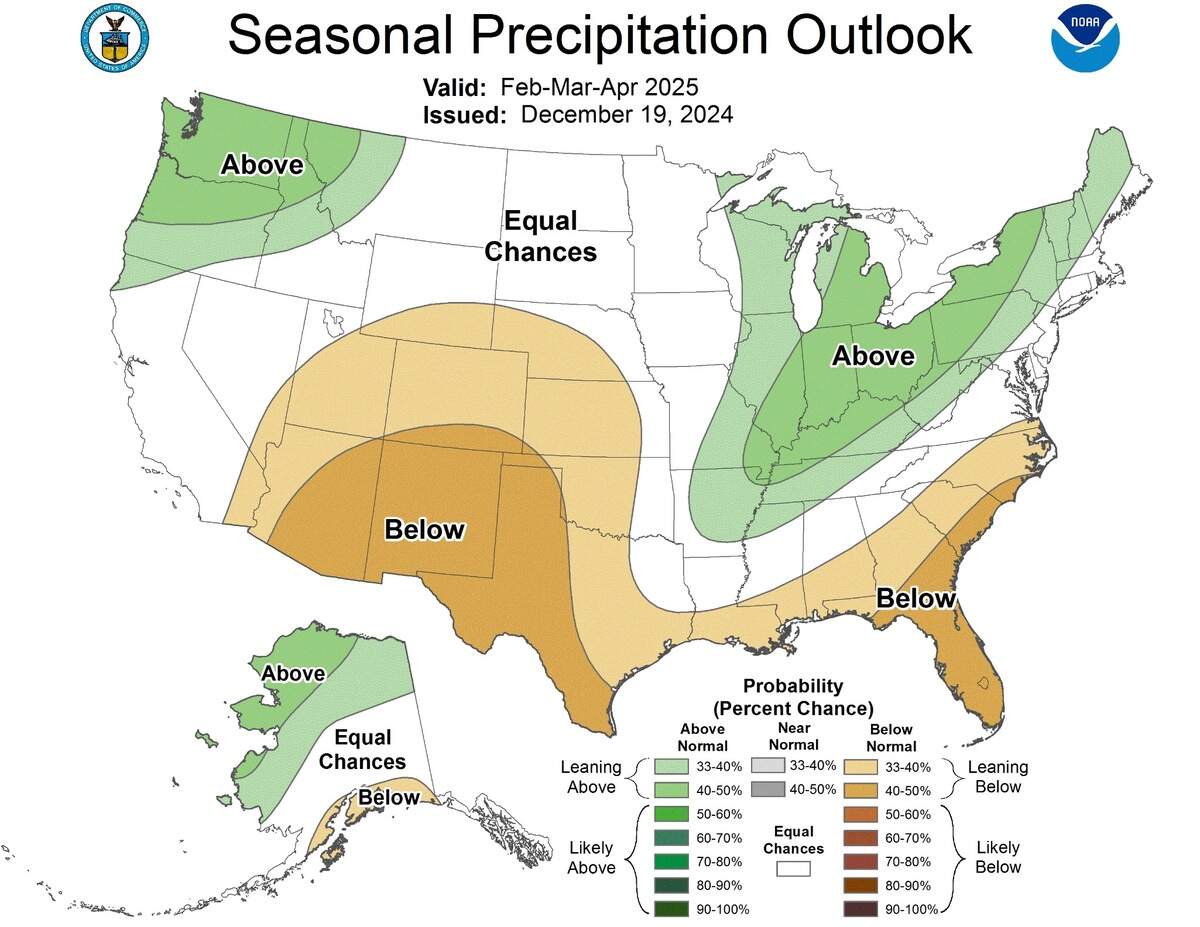
As of Monday, the Climate Prediction Center still had forecasts for above-average temperatures and below-average rainfall in South Carolina from February through April.
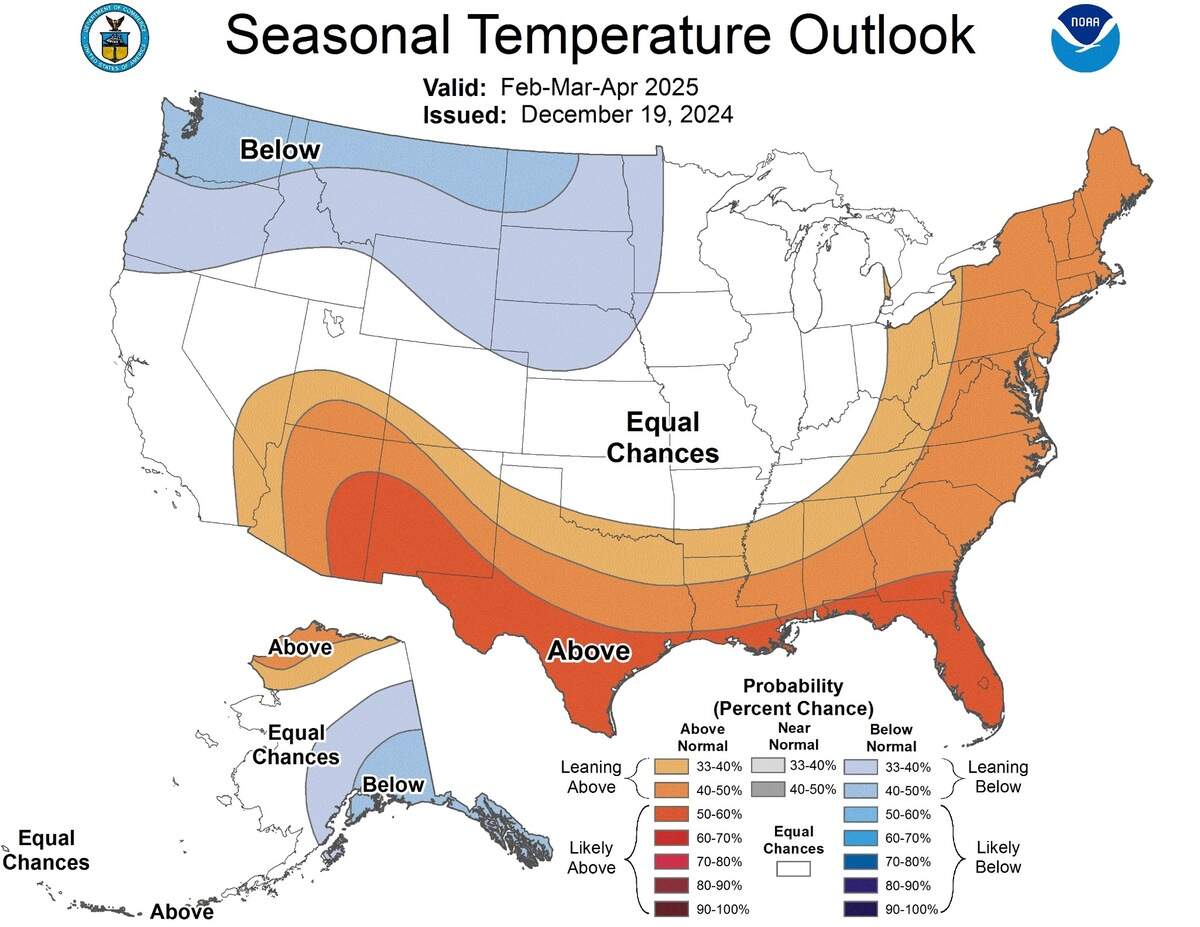
More specifically, there is a 40%-50% chance of above-average temperatures in South Carolina from February through April. And there is a 33%-40% chance of rainfall leaning below normal in most of the state from February through April. The coastal areas have an even higher 40%-50% chance of reduced rainfall.
Snow during weak La Niña
While much of South Carolina got snow and sleet last week, residents shouldn’t expect much more of that this winter.
NOAA meteorologist Tom Di Liberto recently analyzed snowfall trends during weak La Niña events. Liberto found that in the past nine weak La Niña events, the pattern of snowfall was similar to that of all La Niña events, with below-average snowfall in the South.
“The count of how many (out of nine) weak La Niña events had below-average snowfall also showed similar patterns, with some bad news for those in Virginia, Maryland, and Washington, D.C., where every single weak La Niña winter had below-average snow,” he wrote.
This story was originally published January 14, 2025 at 6:00 AM.