
2 SC women play pivotal roles in upcoming historic NASA moon mission
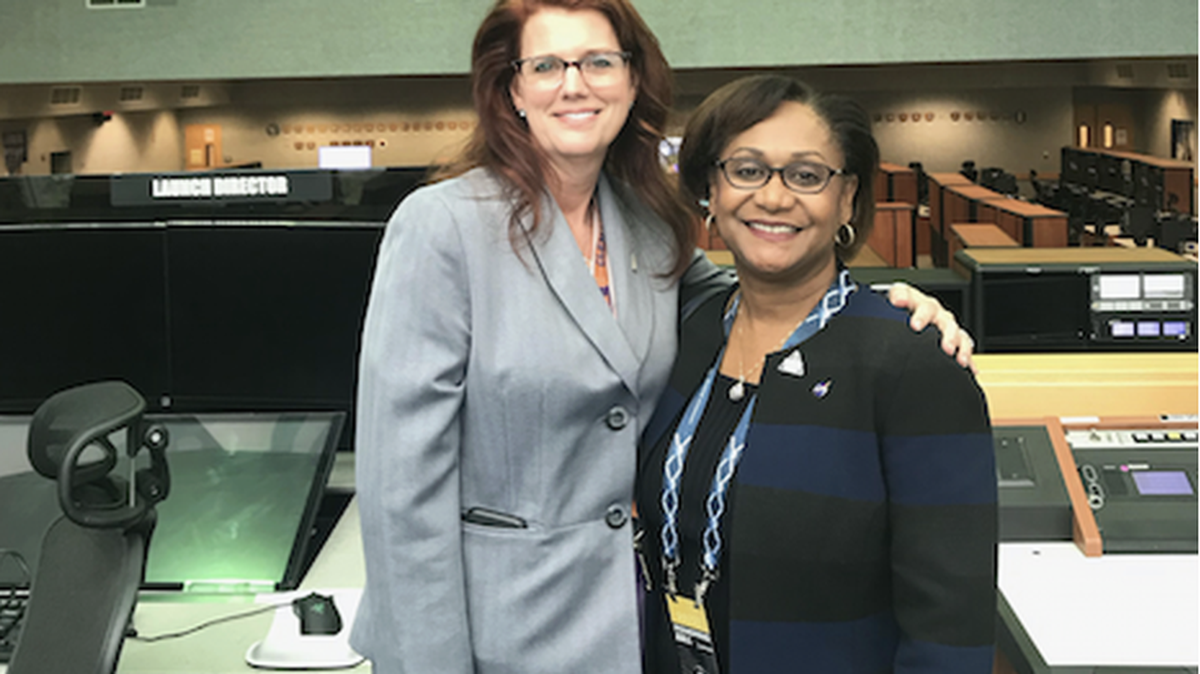
Two Clemson University engineering graduates will be instrumental in the Artemis II space mission expected to launch this week.
Charlie Blackwell-Thompson is the launch director at Kennedy Space Center and Vanessa Wyche is the director of the Johnson Space Center.
In layman’s terms, the Kennedy Space Center is responsible for launching missions and Johnson handles the mission once it’s underway.
The two women were at Clemson in the 1980s at the same time but did not meet until Wyche was in the launch control complex at Kennedy Space Center years ago and she saw a woman wearing a Clemson University lanyard attached to a NASA badge.
It was Blackwell-Thompson.
Both are the first women in their high-profile jobs and often were the first women in the jobs they held before over three decades.
“Nobody is looking at what you look like,” Wyche said. “They’re looking at can you solve the problem.”
And there have been problems to solve to get to a possible liftoff Wednesday.
Helium system failures in the upper stage, persistent liquid hydrogen leaks, erosion on the heat shield. The rocket had to be rolled back from the launch pad to the vehicle assembly building to fix the helium issue.
If all goes well, the launch could come as early as 6:24 p.m. EDT Wednesday with a two-hour launch window. Additional launch opportunities run through April 6.
Artemis II, NASA’s first crewed mission around the moon in 50 years, is manned by astronauts Reid Wiseman, Victor Glover, Christina Koch, and CSA (Canadian Space Agency) astronaut Jeremy Hansen on an approximately 10-day journey.
Both leaders say their careers were shaped by public school teachers.
Blackwell-Thompson
The pivotal conversation for Blackwell-Thompson was with longtime physics teacher at Gaffney High School Doc Wilson. She excelled in his class. Math just made sense to her. It was logical and could be used in a variety of subjects, Blackwell-Thompson said.
Wilson advised her to study engineering.
“What can I do with engineering,” she said.
“What can’t you do?” he answered.
As a senior at Clemson she interviewed for a job testing software at the Kennedy Space Center for contractor McDonnell Douglas. She knew when she walked into the firing floor, which is seen on television during each countdown, she wanted to work there.
She got the job. A month later, in 1988, Space Shuttle Discovery lifted off, representing a return to flight after the Space Shuttle Challenger explosion that killed the seven crew members including Ron McNair, a fellow South Carolinian.
She was new, but she couldn’t help but see the pride and dedication of the team.
Blackwell-Thompson was involved in every shuttle mission after that in one way or another. She remembers driving into the space center on launch mornings and seeing the shuttle lit against the night sky. The service structure had been pulled away and the vehicle could be seen clearly, 4 miles away.
“I’d just take a moment to look at how beautiful that space shuttle looked,” she said.
Wyche
For Wyche, that teacher was Mrs. Lane, a biology teacher at Conway High School. Lane saw a young woman with a curious spirit who liked to fix things. Wyche excelled in biology.
“You can do this as a career,” Wyche remembers Mrs. Lane telling her.
Both Wyche’s parents were educators and education for their four daughters included learning how to fix a car and for their son, cooking lessons.
Her brother was the first in the family to go to Clemson; the others went to the University of South Carolina, Charleston Southern and Benedict College.
Wyche started out in biochemistry but quickly switched to engineering.
“I found the true joy of learning how to solve problems,” she said.
She was one of the few women in engineering at Clemson in the 1980s. Some professors were not used to having women in their classrooms. But Wyche learned the great equalizer was being able to do the work. And hard work was not foreign to her.
She earned a bachelor’s degree and master’s and in 1987 headed for a couple of years to work on medical devices and how they operate at the Food and Drug Administration in Washington, D.C.
She met the man who would become her husband, George Wyche Jr., and they moved to his hometown, Houston.
Blackwell-Thompson
At Kennedy, Blackwell-Thompson said after all the years of the shuttle program, 1981 to 2011, Artemis offered a blank sheet of paper for planning.
“This was the challenge, how do we solve this,” she said. “We don’t want to get stuck in the past.”
One of the things people will notice on launch day is how different the firing room looks — more modern with sleek stations, more technology and fewer people. Where 200-250 people did the work of monitoring the craft, about 100 will be in the firing room.
Blackwell-Thompson was named launch director in 2016 for Artemis I, an uncrewed mission that flew around the moon in 2022. It is ultimately her decision on whether the spacecraft lifts off.
Testing is key.
“You always want to find issues on the ground,” she said.
She said in an interview with The State in 2020 she takes the memory of Columbia with her through every flight. She was on the console that day in 2003 when the craft disintegrated on re-entry, killing seven crew members.
“A really bad day,” she said. “The lessons that you learn you don’t forget.”
Wyche
Wyche was named director of the Johnson Space Center in 2021, previously serving as second in command since 2018,
Wyche went to work for NASA in 1989. Her first job was developing biomedical hardware to fly on the Space Shuttle. She moved into a number of scientific roles over the next decades, including developing hardware for the Russian-Mir Space Station and training astronauts for shuttle missions and to assemble the International Space Station.
Each new job brought her more responsibility.
As director, she works with 11,000 civilian employees as well as overseeing the flights of commercial businesses such as SpaceX.
Johnson Space Center has been responsible for working with Lockheed Martin on the development of the spacecraft for the Artemis project. If all goes as planned, the first woman and next man will land on the moon on a subsequent flight with the goal of developing a base for trips to Mars.
“I can’t tell you how exciting it is,” Wyche said.
Always on her mind is crew safety.
“The loss of Columbia on STS-107 was a difficult time at NASA, especially at the Johnson Space Center, and for me personally,” she said. “I had been involved with the mission for many years as we developed the research and prepared the flight crew to conduct the experiments on the mission. I knew all of the crew members very well.”
She said the risk in spaceflight is immense, and her goal and of the other engineers and scientists is to minimize it as best they can.
“I was a part of the team that supported the accident investigation and implementing changes for us to return to flying space shuttles,” she said.
She left the shuttle program in 2005 to work on what is now called Orion, the spacecraft to be used for Artemis.
“It is designed with a launch abort system that will pull an Orion capsule and its crew to safety from the launch pad through all phases of powered flight. This is a part of learning and instilling design changes to reduce the risk of spaceflight.”
Clemson
Both women make regular visits to Clemson to talk with students and to their hometowns — Wyche is from Conway, Blackwell-Thompson Gaffney — to encourage children to consider careers in science. Both said they still consider South Carolina home.
Wyche said NASA has a $36 million economic impact on South Carolina through vendors working on the Orion spacecraft.
Anand Gramopadhye, dean of Clemson’s College of Engineering, said they are inspirational role models and outstanding ambassadors for the university.
“It is amazing that both are playing critical roles in NASA’s drive to return to the moon and on to Mars,” he said.
This story was originally published March 31, 2026 at 6:00 AM.