
2 SC college students make tech for scientific work on International Space Station. What to know
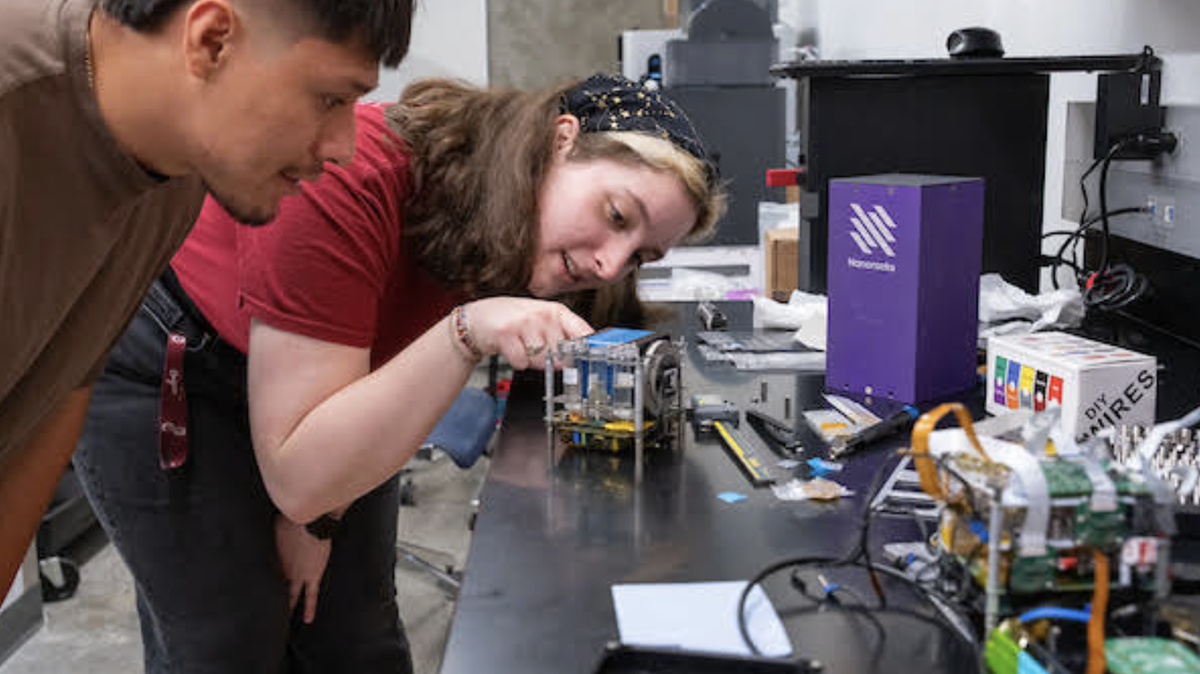
When a resupply mission to the International Space Station lifts off from Kennedy Space Center, two cameras designed by College of Charleston students will be in the payload bay.
The Northrop Grumman Cygnus-24 cargo mission is scheduled to launch on a SpaceX Falcon 9 rocket at 8:51 a.m. April 8.
Astrophysics students Eva Godwin and Gael Gonzalez worked under the supervision of Joe Carson, professor of astrophysics at the College of Charleston and Marcos Díaz, assistant professor of electrical engineering at Universidad de Chile, who also supervised a Chilean student.
They developed a liquid lens-based optical camera to monitor biological specimens and an ultraviolet camera to track activity among young stars.
Gonzalez, who is the first in his family to attend college, told a College of Charleston publication he has been enamored of space since he was a small child listening to his grandmother sing about the moon while they stared into the night sky. He is from Loris.
Gonzalez will graduate in a few weeks and after graduate school hopes to work for NASA.
He said he’s never been to the Kennedy Space Center.
“Now I have the opportunity to actually enter the building and do final integrations before the launch,” he said.
Godwin from York County is majoring in physics and astrophysics and minoring in Japanese studies. She graduated from the Governor’s School for Science and Mathematics and worked as a teacher’s assistant and part-time ESS substitute teacher in the Clover School District.
She intends to enroll in a graduate program as well after she graduates next month.
The cameras they designed will collect data for about six months. The data will be analyzed when it’s all flown back to Earth.
“It’s really cool to be able to tell people that we have this really exciting mission going into space, into the International Space Station, and then later deployed into a lower orbit, and it’s also really cool to say that I have touched something that will be in space,” Godwin said.
Carson said the students were involved from feasibility to fundraising, modeling and testing.
“I think it’s definitely rare to have undergraduate students playing such a central role,” Carson said.