
Afraid of spiders? South Carolina professor says latest ‘spider invasion’ nothing to fear
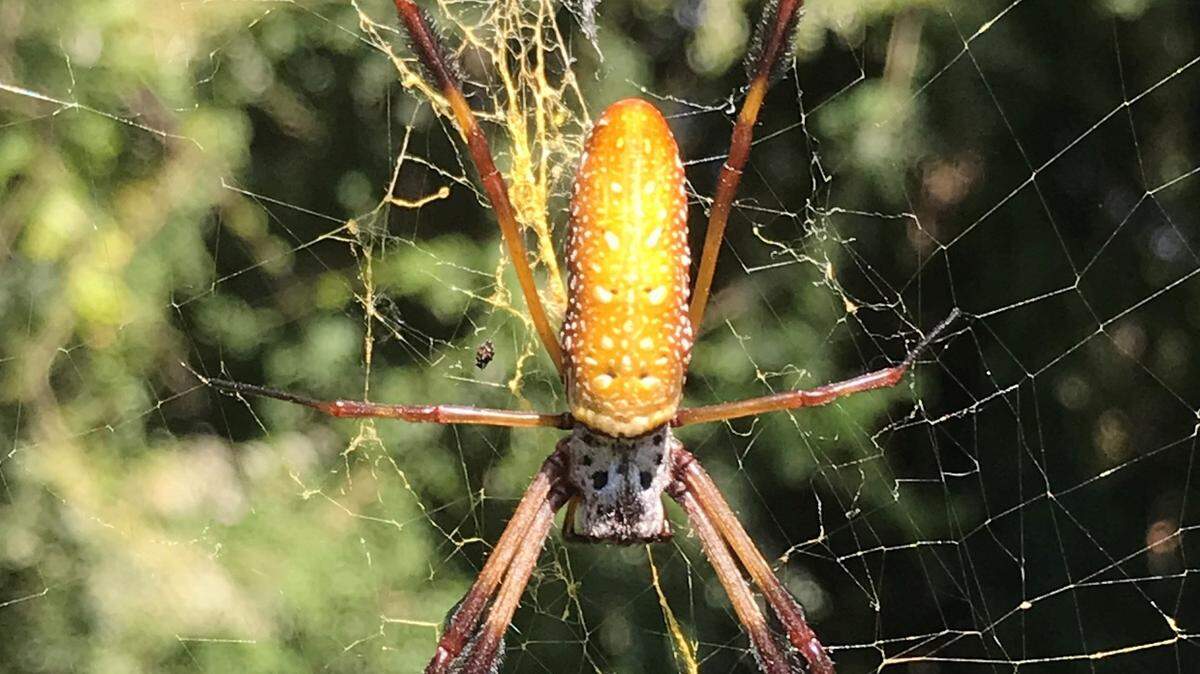
Television and social media stories often detail frightening invasions of gigantic spiders across South Carolina, but current spider invasions are frightening only for the environment.
Many of these stories, however, are based on partial or misinformation to scare people, under the guise of a warning.
The Joro spider, native to Japan and China, has recently received a lot of attention.
The Joros’ bodies are very yellow in color and include a beautiful red on its underside.
Having a body the size of a AAA battery and long legs reaching three inches across if fully extended, they are alarmingly described as palm sized.
While larger than most spiders in South Carolina, however, they are not dangerous in any way.
The Joro spider weaves a large orb web with strong beautiful golden yellow silk protected on both sides of the spiral web by a fairly large tangle of silk.
Called a barrier web, it keeps the spider from being eaten by birds as well as slowing down insects flying by. It makes it difficult for a person or other large animal to have contact with the spider as this warning web allows the spider to escape, normally by crawling high into the web supports.
Walking into the web is not pleasant, but it is not harmful.
The Joro spider rarely walks on the ground, as it would become vulnerable to many predators, serving as a large meal for most.
They should be seen soon in the northern Midlands and will soon reach into the Charlotte area.
These spiders do not bite, and certainly not when “being threatened” like some news reports have claimed. If squeezed in your hand the spider might try to bite, but would have trouble penetrating the skin as it has rather small fangs.
In fact, a global review of spider bites did not find even one reported bite from the Joro or related spiders.
The rare bites of most spiders feel like a small pinprick, not a bee sting meant to get your attention, and the venom of most spiders does not affect humans as it is primarily digestive enzymes.
A common myth is that you might be allergic to the venom of Joro and other spiders. This could only be true if you have been previously bitten, generally several times.
The golden silk spider, often mistakenly called the banana spider, is a close relative of the Joro spider and native to the Lowcountry of South Carolina. It has historically been rare in the Midlands, but the numbers have been increasing and this fall is the most commonly seen large orb weaver.
While the golden silk spider is more bronzish than yellow, they are handsome spiders in their color and silk. The large population of them in the Midlands this fall has created some concern, but the spiders are harmless to people.
The greatest danger is overreacting to their presence.
The Huntsman Spider, which was the original ‘banana spider’ because it could lie flat between bananas, has invaded the Midlands in the past five years. It is a dark spider, mostly active at night, and because it can flatten itself is common on both trees and on buildings. While fairly large, this darkly colored spider is not commonly seen and it has not been reported to bite.
The scary spiders of Halloween have now begun to disappear, but the invasion of spiders that are not native to the Midlands is definitely underway, and expected to increase.
Many social media posts and television shows may try to exaggerate and distort the facts about these spiders, but it is most important to remember that these spiders are almost always harmless and not worthy of our fear.
Instead, watch and appreciate them for their beauty.
Robert Wolff is a Professor of Science and Health Science at South University in Columbia, SC.
This story was originally published November 14, 2021 at 6:00 AM.