
From N.G. Gonzales to Charlie Kirk, America has failed to agree to disagree | Opinion
The assassination of commentator Charlie Kirk should horrify us all.
There is no place for political violence in this or any country, but there is a long, lamentable history of its ugliness.
Each time I see my name and title on The State’s masthead, almost every time I walk into my office in the newsroom and turn on first the light and then my laptop, I think of N.G. Gonzales, the newspaper’s co-founder, its first editor and editorial writer, shot and killed in 1903 for his views.
Thursday, the day after Kirk’s assassination, I drove to Gonzales’ memorial in Columbia. He was fatally shot once in broad daylight. For his views. Like Kirk.
South Carolina Lt. Gov. James Tillman shot Gonzales once with a pistol at the bustling corner of Gervais and Main streets, outside the State House, a place where debate should be encouraged. Where debate should be lively, not deadly.
In an article on the 100th anniversary of what had been called the crime of the century in South Carolina, The State reporter John Monk wrote that a fruit stand vendor was close enough to hear Tillman say, “You will let me alone now.”
Monk reported that as Gonzales lay dying in the hospital, the editor recalled Tillman had said, “I’m taking you at your word.”
There are also two versions of what the gut-shot Gonzales said to Tillman as he bled, the bullet that tore through him lying nearby on the ground.
“Shoot again, you coward,” is one. “Here I am, finish me,” is the other.
Shoot again. Here I am.
Gonzales died four days later. A mountain of a man on Jan. 15. A memory on Jan. 19.
Our fellow citizens
A jury acquitted Tillman after he argued he acted in self-defense because Gonzales appeared to be reaching for a gun. No weapon was found on Gonzales, but it didn’t matter.
Tillman’s lawyers also told the jury that citizens had a duty to seek revenge against editors who criticized them.
That’s abhorrent and absurd. The First Amendment lets journalists publish information — and people express themselves freely — without government censorship, suppression or control.
That was true in 1903 when someone in government killed Gonzales. It’s true now. And it, of course, was true Wednesday when Kirk, co-founder of the conservative youth activist organization Turning Point USA, was killed while speaking at Utah Valley University, the largest public university in Utah.
Is there anything more American than speaking our minds in the public square? Then why do we fail to agree to disagree so often?
Kirk was a lightning rod for controversy because he hewed to views that some people agreed strongly with and other people disagreed strongly with. That was the whole point of Turning Point USA, basically.
“Don’t agree with Charlie?” a post promoting his event in Utah said. “Great, you go to the front of the line. See you there!”
In a statement, former President George W. Bush asked God to bless Kirk and his family and guide America toward civility.
Bush’s statement best encapsulated my thoughts. He said Kirk was “murdered in cold blood while expressing his political views. It happened on a college campus, where the open exchange of opposing ideas should be sacrosanct. Violence and vitriol must be purged from the public square. Members of other political parties are not our enemies; they are our fellow citizens.”
That’s the perspective that’s being lost here. It’s not us vs. them.
It’s we the people.
The same specter
Two years after Gonzales’ assassination, an obelisk was erected along Senate Street at the intersection of Senate and Sumter streets, right across from the South Carolina State House.
It’s said to be placed there so Gonzales could stand constant vigil, an eternal watchdog, ensuring public servants worked on behalf of the public good. It looks like a middle finger pointed at scoundrels.

In the book “Deadly Censorship: Murder, Honor & Freedom of the Press,” James Lowell Underwood wrote, “Tillman blamed Gonzales and his stinging editorials for costing him the governorship and causing his humiliating fourth-place finish in the first 1902 primary.”
Underwood wrote that Tillman thought, in Gonzales’ hands, “freedom of the press had degenerated into a weapon of personal spite.”
Underwood wrote, ”Most of the leading South Carolina newspapers had opposed Tillman in the election, but the unsuccessful candidate focused his ire on Gonzales because his mocking words attacked the very marrow of Tillman’s personality.”
Focused his ire. That’s one way to say shot to kill.
As I wrote this, a manhunt was underway for the person who killed Kirk and the nation’s divided camps were predictably making the comments you’d expect. President Donald Trump has ordered flags lowered to half-staff until Sunday. Millions are trying to lift up Kirk’s wife and children with wings of prayer and prominent people are condemning political violence as an unacceptable act.
Last century, the jurors who let James Tillman walk away after shooting N.G. Gonzales in public didn’t just release him. They unleashed the specter of political violence, empowered others to think that they might do something similar one day.
The same specter now hovers over our nation again.
As it did in 1963. And 1968. And in recent years and months with other horrible shootings.
Somewhere, lunatics lurk.
Against the darkness
Over decades in my career, I have tried to add light, not heat, to all conversations and to help people disagree agreeably. I will keep doing that.
A commitment to that doesn’t mean we don’t disagree. It means we explain why we see things as we do and listen to, and learn, from others.
It’s how we settle on the limits of what’s considered tasteful, acceptable, criminal and seriously punishable, perhaps even by death. It’s how we steer society toward a consensus on where to draw the line in a country where the First and Second Amendment say what they do.
All of this was going through my mind last week when I shared two reader emails with the word “idiot” in them in my weekly newsletter, explained that the word had given me pause and asked subscribers if I should have cut the word.
“Matt, I’m glad you left the word ‘idiot’ in both responses,” one person replied. “Unlike slurs of a racial, ethnic, religious or other type, the word ‘idiot’ is an opinion and therefore most certainly belongs in op-ed articles and responses. I think (I hope, anyway) that most people are intelligent enough to understand that distinction.”
“Keep it up!” another wrote. “Readers might learn something. You might learn something from the responses.”
Where’s the line between civility and censorship in the opinion section that I run?
Where do we draw the line in conversation when talking with one another?
I believe these are vital questions and we need to keep thinking about them. I believe we’re losing civility and our way, becoming dangerously divided, not to mention uncivil. But I also believe we have struggled with this for centuries.
I’ll say it again: The assassination of commentator Charlie Kirk should horrify us all.
There is no place for political violence in this or any country.
The N.G. Gonzales memorial is a constant reminder of that.
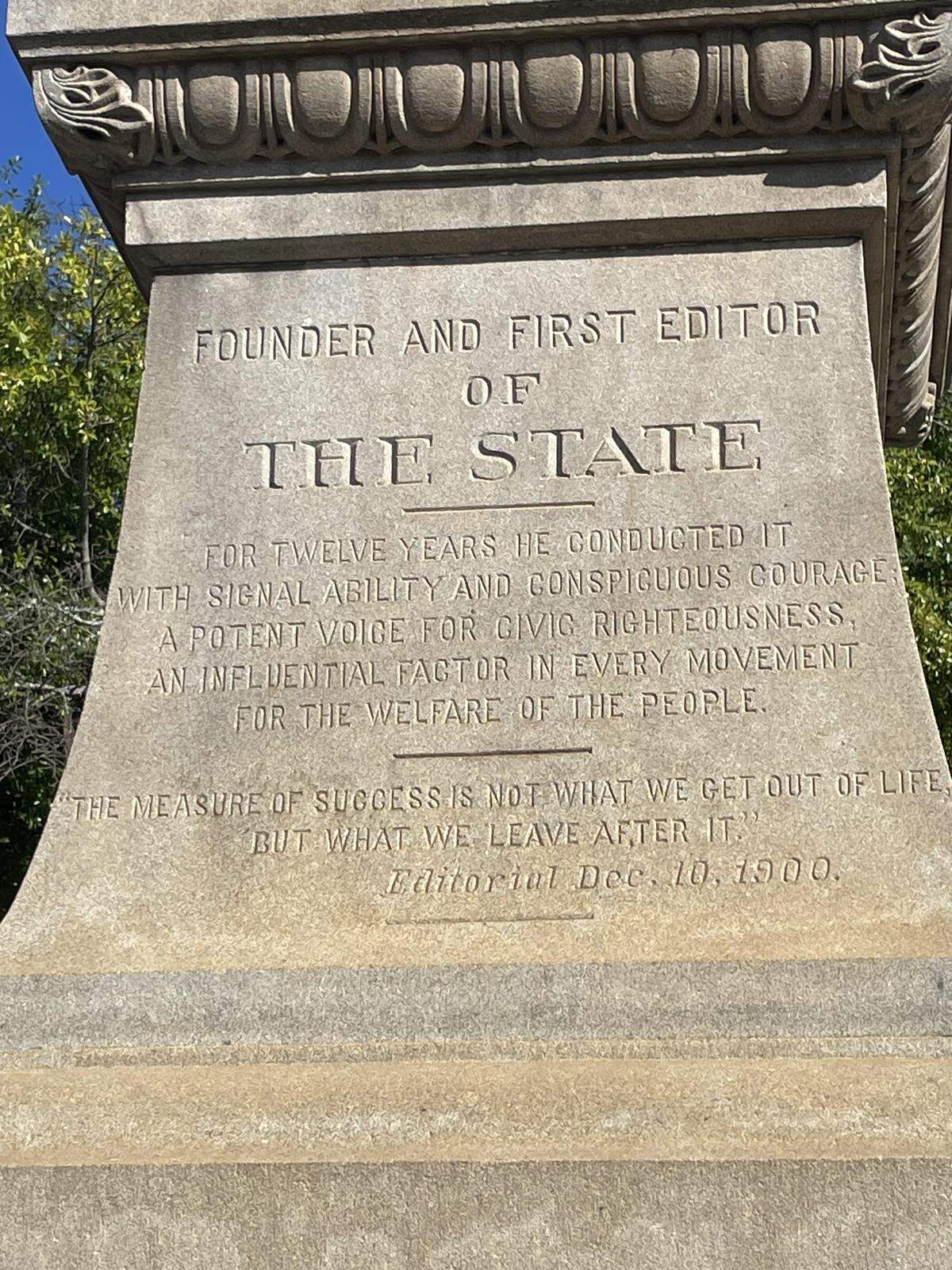
Carved into it, a line from a Dec. 10, 1900, editorial reads: “The measure of success is not what we get out of life, but what we leave after it.”
In my small office a mile away, a light and a laptop will stay on while I occupy it, enlightening devices that I will use, with my head and my heart and my hands, to defend our better angels against the darkness.
Here I am. Thank you, readers, for being here, too.
Matthew T. Hall is McClatchy’s South Carolina opinion editor. Email him at mhall@thestate.com.
This story was originally published September 11, 2025 at 2:00 PM.