Dazed, damp and devastated: Inside Clemson’s historic first-ever victory at UNC
For the briefest of moments on Saturday night, the sound of youthful, jubilant screams echoed through the walls of the Clemson locker room down a long hallway inside the Smith Center. Whatever the sound of the release of 94 years of cursed history, of breaking a streak 59 failures long, that was it.
“It almost felt like winning a (national championship), to break that streak,” Aamir Simms, the Clemson junior, said after his team’s 79-76 overtime victory — the Tigers’ first in Chapel Hill.
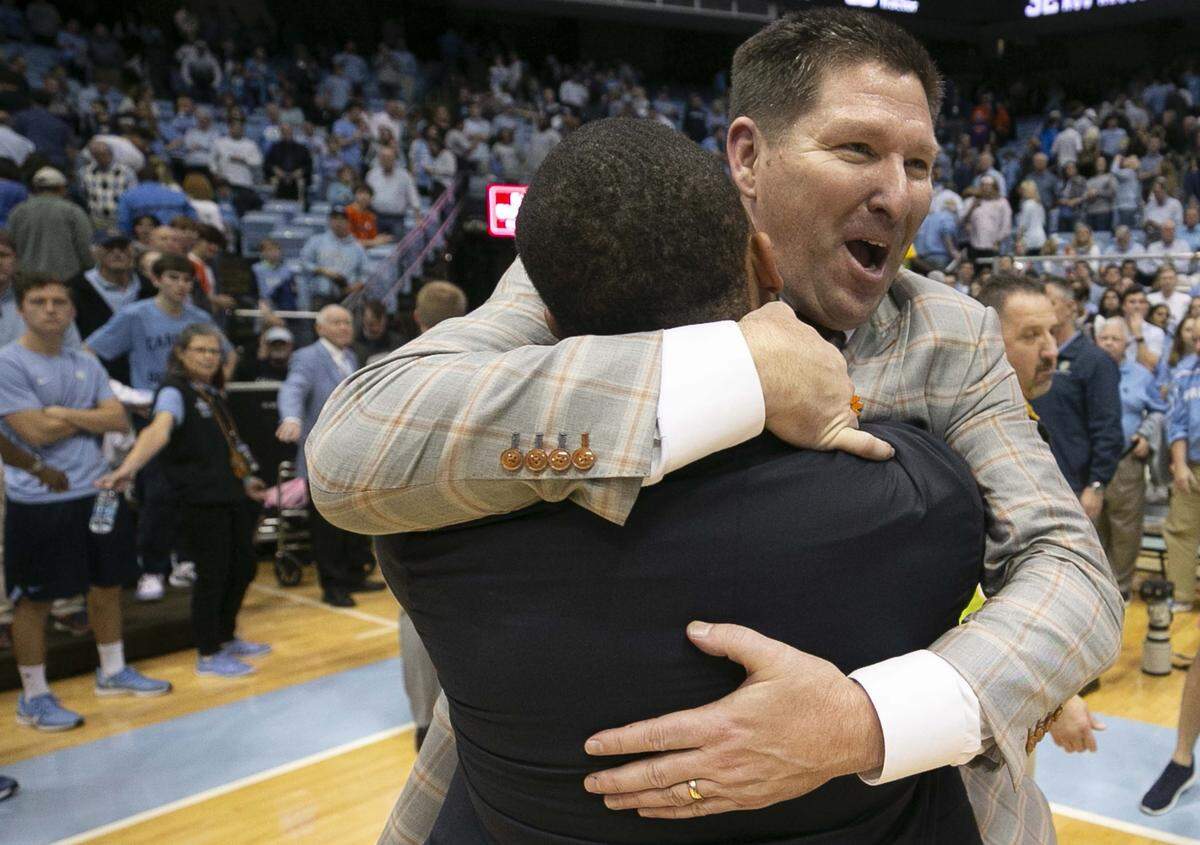
Soon Brad Brownell, the Clemson coach, opened a door and walked out, his hair wet and most of the top half of his suit drenched. Earlier, his players had been waiting to douse him with their water bottles. And soon, after Brownell exited the locker room, his players departed one by one and greeted the family members and friends who were there to share in this improbable moment.
This is what history looked like: a damp head coach doing a radio interview, and players trying to describe something neither they nor anyone else at their school had ever done. Afterward, they walked into a celebration fit for a championship. On the other end of the hall, Roy Williams, the longtime North Carolina coach, looked dazed while he walked into his press conference.
Somewhere during the past 94 years, since a Clemson men’s basketball team first played against North Carolina in Chapel Hill and lost by 30 in 1926, the Tigers’ constant futility in this idyllic college town became perhaps the weirdest streak in major college athletics. Before Saturday, Clemson had played 59 times in Chapel Hill. The Tigers were 0-59.
With two minutes remaining in regulation Saturday, it seemed near certain that they would soon be 0-60. The Tar Heels then led by 10 points. But then the Tigers began making all of their shots and UNC began committing turnovers at an alarming rate, each one accompanied by thousands of nervous gasps and groans, as if the Smith Center crowd knew what was happening.
What was happening was history. Williams, amid the usual questions he receives about the streak whenever Clemson plays in Chapel Hill, has said a version of the same thing for a long time: that the streak will end sometime, as all things end, but that he hopes his team can hold it off for one more game. For the past 16 years of his head-coaching tenure at UNC, the Tar Heels have done that.
Yet when Aamir Simms, the Clemson junior guard, made a 3-pointer to tie the score at 70-70 with 3 seconds left in regulation, the moment felt almost anticlimactic. Fate seemed to ordain Simms’ shot, given the Tar Heels’ implosion during the final minutes. In overtime, the Tigers never trailed.
Simms scored his team’s final two points on a layup with 18 seconds remaining, and then, on the other end, UNC missed two 3-pointers, one of them at the final buzzer. The moment it ended, Simms and his teammates celebrated near mid-court. Simms, who led his team with 20 points, searched for someone to embrace.
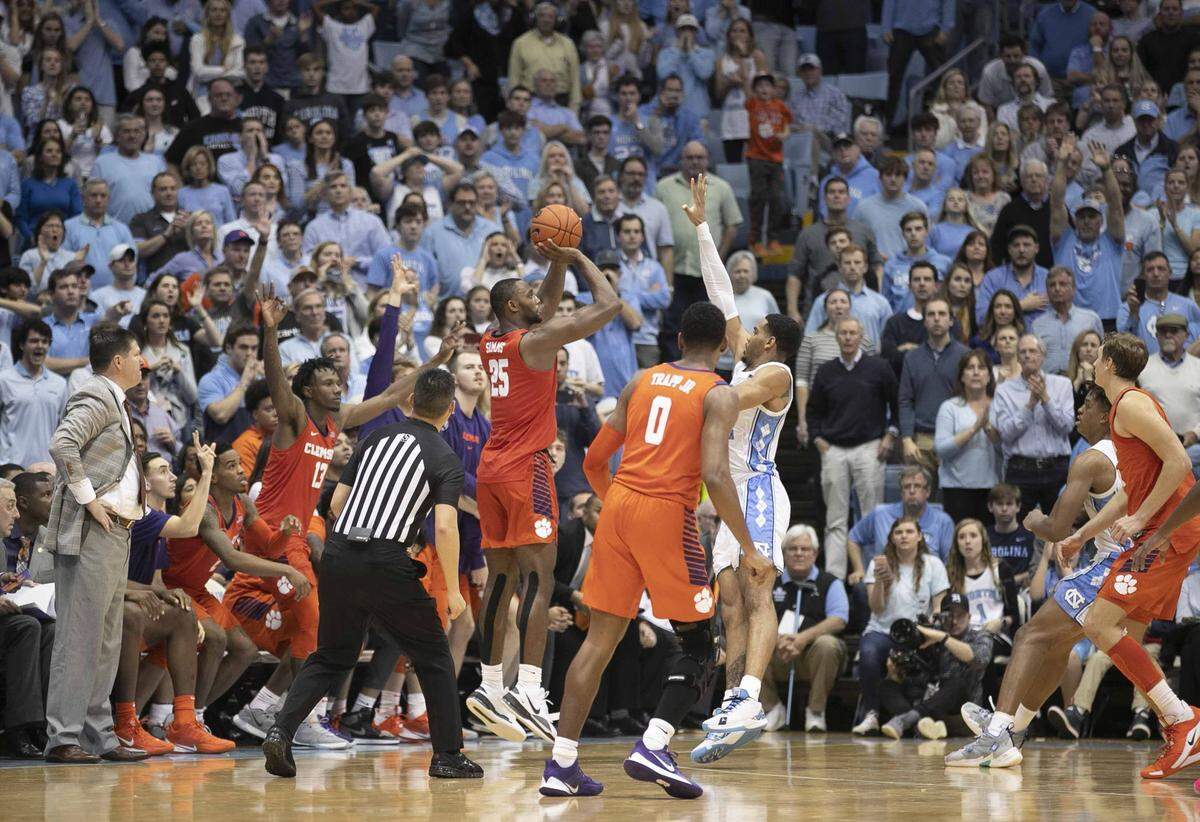
Moments earlier, he’d watched UNC’s final shot attempt in a helpless sort of way. Brandon Robinson, the Tar Heels’ wiry guard, attempted that shot. He’d scored 27 points and often played with the energy of a senior attempting to will a beleaguered team to victory. Robinson had a decent look on that final shot; he released it, rushed, from the left wing.
“My heart stopped,” Simms said, recounting the moment of Robinson’s attempt to tie. “I’m just watching the ball, like in the movies. It’s going in slow motion, I’m just watching it go. And I saw it hit the back rim, all I could think about was to run and find somebody on my team so I could give them a hug. And it was just something that I’ll never forget in my life.”
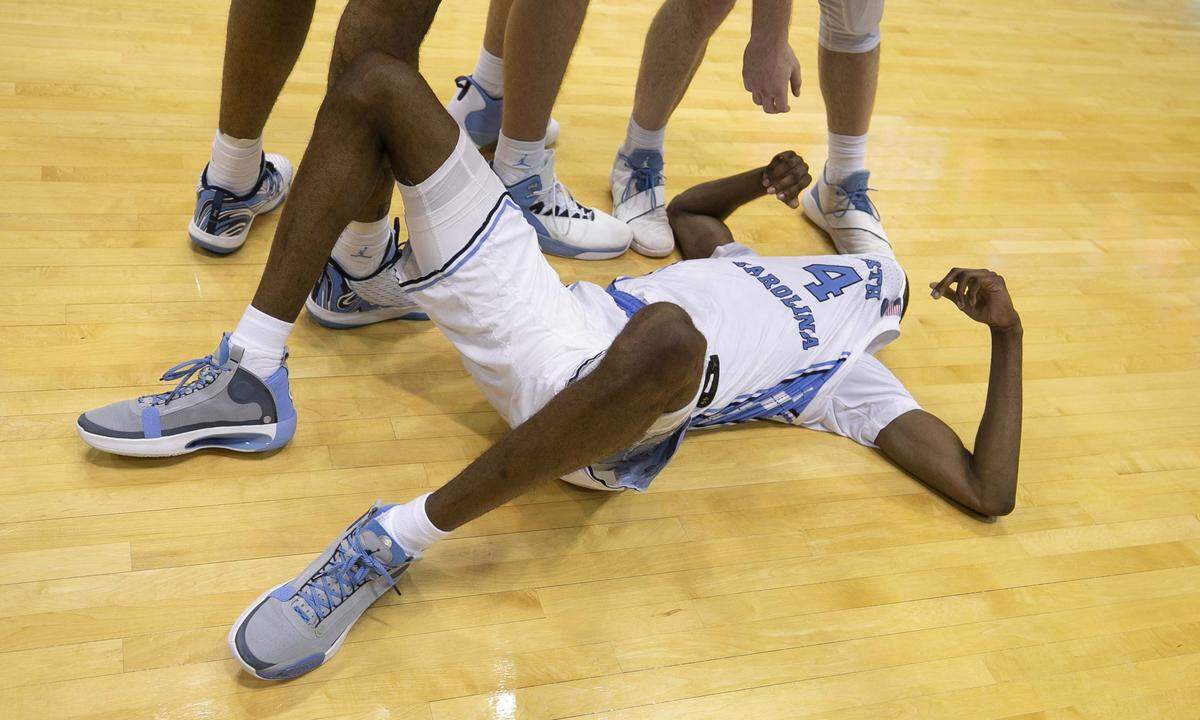
While Clemson celebrated, Robinson crumpled to the floor and lay there, stretched out.
“After the game, I was devastated,” Robinson said.
It has been a devastating kind of season for the Tar Heels, one that has been doomed throughout by injuries and inefficiency on offense and the kind of scoring droughts and shooting woes that are uncharacteristic of Williams’ teams at UNC. It has been the kind of season, then, in which this kind of history — the end of the streak — somehow seems fitting.
Williams recently described this particular team as “the least gifted” one he has coached at UNC. The team’s best player, freshman guard Cole Anthony, has missed the past seven games with a knee injury. Another freshman guard, Anthony Harris, suffered a torn ACL on Dec. 30. And yet another freshman guard, Jeremiah Francis, didn’t play Saturday night.
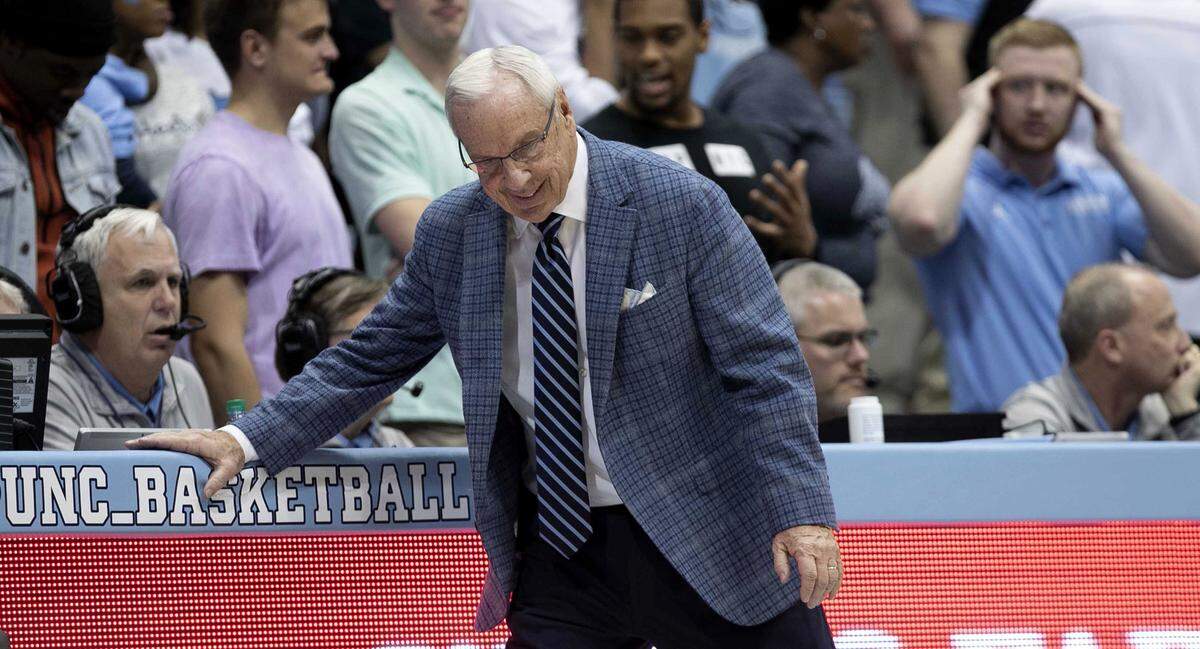
Williams has not made excuses. He has, instead, adopted a tone of despondence. He blamed himself on Saturday night because he said he forgot to tell his players to foul Clemson before Simms’ 3-pointer that sent the game into overtime. Williams then said he told Bubba Cunningham, the UNC athletic director, that Williams should be fired.
“Probably would not be a bad idea,” said Williams, a Hall of Fame coach who, at times, sounds as though he is simply trying to survive what is becoming the most difficult season of his career. “A coach is supposed to help his kids, and I didn’t help them very much.”
Still, for the streak to end, it took Simms making a shot that he might remember more than any other, and it took the Tar Heels suffering through a meltdown in the final moments of regulation. It took a confluence of rare events — a string of unlikely injuries, for instance, and two minutes of especially bad basketball — and even then the Tar Heels still almost prevailed.
Such is the apparent power of the streak. Only the might of UNC’s misfortune this season appears stronger, by comparison. Now, at last, after 59 defeats and 10 decades of futility in Chapel Hill, Clemson players no longer will have to hear about all the losses that came before. At least, maybe they won’t hear about them as often.
“To break the streak, everybody’s been talking to me, being in my ear about that,” John Newman, a Clemson sophomore, said outside of his team’s locker room. “So just to finally end that …”
Brownell said he and his staff “haven’t made a big deal” about the Tigers’ record in Chapel Hill. It’s one of those things that doesn’t need to be acknowledged, necessarily. The players knew about 0-59. Brownell knew about it.
“But it’s not something we talk about all the time — the chance to be the first team to do this ever,” he said Saturday night, after he’d changed out of his wet suit. He still wore the look of a man who’d been soaked, as if by sweat, water or both. In some ways, Brownell seemed unfazed by the moment. He didn’t exhibit outward jubilation as much as he did quiet satisfaction.
For nearly 100 years, men in his position had traveled to Chapel Hill and returned to South Carolina a loser. Brownell had experienced that himself, five times before Saturday.
The first time a Clemson’s men’s basketball team played against North Carolina in Chapel Hill, the game was played in what was called the Indoor Athletic Court, UNC’s homecourt that predated Woolen Gym. Most of their 59 wins against Clemson in Chapel Hill were similarly one-sided to that 30-point victory in 1926.
In all but eight of those 59 victories before Saturday, UNC won by double-digits. Rarely was the streak tested and, when it was, the Tar Heels always prevailed: By one point in 1974; by two in ‘75; by three in 1980; by 10, but in double-overtime, in 2008. The streak began before the Great Depression, grew through World War II, and was already in double digits when the ACC formed in 1954. The streak spanned 16 presidential administrations and four UNC home courts.
It survived the Tar Heels’ 8-20 season in 2002. And then, on Saturday, it was over.
Robinson fell to the floor. His teammates put their hands on their head. Williams walked off the court, head down. Fans slowly filed out of the Smith Center. Some spoke of witnessing history. The Tigers, meanwhile, rushed around the court and it looked for a few moments as if they’d won a championship. Instead, they’d just won one game in one town, after 59 consecutive losses here.
Now there was a sense of relief, Simms said, before pausing: “But the number still looks crazy.”
This story was originally published January 11, 2020 at 11:39 PM with the headline "Dazed, damp and devastated: Inside Clemson’s historic first-ever victory at UNC."