What Dabo Swinney said about Clemson’s NIL situation, viral Notre Dame comments
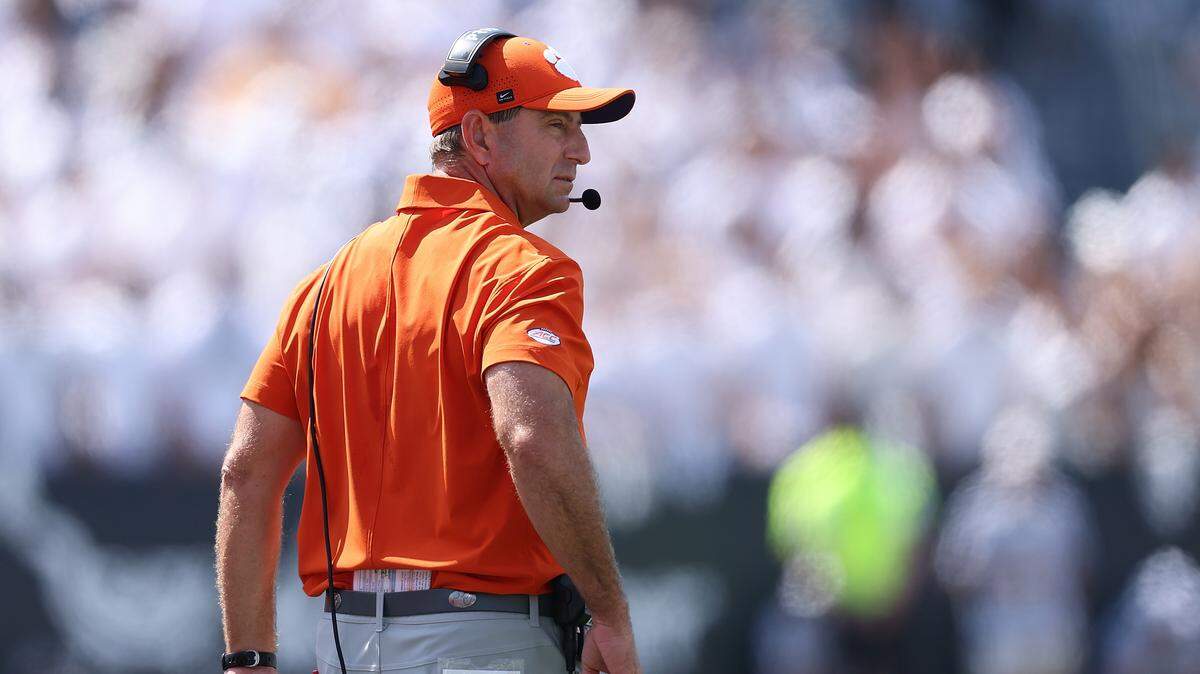
Dabo Swinney has been saying for years that his program has operated at a slight disadvantage when compared with other college football blue bloods.
So he was surprised when a clip of him answering a question about Clemson’s underdog status on ESPN analyst Greg McElroy’s podcast last week went viral and was widely viewed as a dig at Notre Dame’s football program.
Speaking on McElroy’s “Always College Football” podcast on May 4, Swinney was asked about Clemson flying under the radar this offseason and if he used those more modest expectations as motivation.
Swinney answered, in part: “At Clemson, we’ve always gotta have a chip on our shoulder. ... We don’t have some of the things that some of the schools that we’ve played and had to compete with over the years have. It’s just the way it is.”
“But, I mean, we’re 3-1 against Ohio State. We’re 4-2 against Notre Dame. Notre Dame has their own TV station. They make their own rules. They print their own money. They’ve got, like, a money machine in the backyard or something.”
Speaking Monday at the ACC spring meetings, Swinney said he was surprised at the level of pushback he got from Fighting Irish fans and others for that comment.
“I mean, all of the sudden, I’m getting hate mail,” Swinney said. “I wasn’t just making it up. I was asked a question. ... And I was just making the point that we’ve never had the same as this school and this school.”
Swinney continued: “If we just met at the middle field and compared budgets and alumni bases and total revenues, and we compared five-stars and recruiting rankings, we (Clemson) would lose everything. But it’s not just that.”
At a time where the cost of an elite college football roster is skyrocketing — industry sources told The Athletic in March that fielding a top team takes anywhere from $35 million to $40 million — Swinney said the divide still exists at Clemson.
“We may not have a $45 million roster like some teams, but we’ve got enough,” he said Monday. “We’ve just gotta be good with it, and we’ve gotta be strategic.”
Dabo: ‘There was supposed to be a cap’
Swinney’s recent comments, though, are a notable pivot from what he said in November 2024 when Clemson first rolled out its revenue-sharing plan.
The Tigers announced they’d directly pay their athletes the maximum amount of money allowed under the House settlement ($20.5 million in 2025-26). And the vast majority of that money would go straight toward financing Clemson football.
“At Clemson, we’re gonna be as good as anybody out there,” Swinney said at the time, adding of revenue sharing: “It’s going to really, really be a difference-maker.”
So, what’s changed?
Swinney emphasized Monday that Clemson is “incredibly blessed” and he’s not complaining about his program’s financial situation. The Tigers reportedly committed 86% of their rev-share money, or over $17 million, to the football team last year, and those dollars help fund a roster that produced nine NFL Draft picks.
But Swinney said a lack of clarity from the NCAA and the College Sports Commission on additional name, image and likeness (NIL) payments have morphed the college football landscape into “a different sort of ‘have, have not.’”
“The problem is, there was supposed to be a cap,” Swinney said at spring meetings. “But that’s just the floor now. ... I think that’s part of what everybody’s looking forward to, is clarity on where it goes from the NIL standpoint with the CSC.”
The CSC was supposed to create a national “clearinghouse” to approve legitimate, permissible third-party NIL deals for athletes. Those “stackable” dollars could then be added on top of revenue-sharing payments to further compensate players.
But the approval process has been subject to delays, and many schools are building out rosters worths millions more than the anticipated football “cap” (a large portion of a school’s $20.5 million in rev-share money plus select “stackable” deals).
Although the CSC did just win an arbitration case against Nebraska for impermissible NIL deals, true enforcement has been minimal so far.
“There’s nothing that can truly hold everyone back right now,” an anonymous general manager told The Athletic.
Clemson in ‘very good spot’ financially, but gap remains
Swinney said the NIL era from 2021-24, when schools couldn’t directly pay athletes and all had funding had to come from third-party collectives, was “really, really hard” for Clemson because “it’s just hard to raise the money.”
The revenue-sharing era, he said Monday, has given Clemson more of a “competitive chance” in modern-day college football. Swinney believes his program is in “a very good spot” nationally when it comes to roster money available.
Still, he said, a subtle gap remains between Clemson and others.
“We’ve got more than most,” Swinney said. “And we don’t have as much as some people that we have to compete against, but we never have.”
Swinney said that discrepancy doesn’t alarm him, citing Clemson’s strong culture and retention rate in the transfer portal era. He also said college football is more than budgets and recruiting rankings and on-field results are the true indicator.
But the idea of college football turning into a sport where the team with the most money wins is a “concern,” he acknowledged. Swinney said he agreed with former Alabama coach Nick Saban that some sort of “competitive equity” and/or salary cap could help the sport, but he’s not sure what the right model would be.
“And then you want some type of transparency,” Swinney said. “We have no transparency. You have zero transparency, and that’s a problem.”
This story was originally published May 12, 2026 at 12:07 PM.