State of the program: Where does South Carolina baseball stand under Mark Kingston?
The South Carolina dugout stared in horror.
Head coach Mark Kingston, too, looked on in disbelief as Charlotte left fielder Will Butcher clobbered a grand slam deep into the Columbia night — and, with it, dropped South Carolina to 26-25 overall and likely ended USC’s hopes of an at-large NCAA tournament berth in 2022.
Any big-picture assessment of this season must wait, Kingston said after the game.
“I respect that you’re asking that question right now,” Kingston said when queried on what he’d learned about his team this year and where it currently stands. “But I’d rather wait till we get through the season and finish and see how we finish before I start making an overview there.”
South Carolina clung to an outside chance at an at-large postseason bid entering Tuesday’s home finale, but a fifth midweek defeat followed by a series loss to Florida might be too much to overcome.
So where does that leave the USC baseball program after almost four full years under Kingston? Would the university consider a third major-sport coaching change in the last year and a half?
Winning the SEC tournament is the Gamecocks’ last chance to make the NCAAs. One wild week in Hoover, Alabama, and we could have a completely different discussion 10 days from now.
It’s also not a guarantee that South Carolina makes a change at head coach this spring — Kingston’s projected $2.2 million buyout would, at the least, ruffle some feathers at a school that already paid Will Muschamp and Frank Martin almost $16 million combined to not coach in Columbia.
Yet, with the home slate of the 2022 season wrapped up and the Gamecocks poised to miss the NCAA tournament for the fourth time in the last seven full seasons — two of those under Kingston — it’s worth a look at where the program sits in the current lexicon of college baseball.
“A decade ago you would have said, ‘It’s the best program in the country,’ ” D1Baseball co-editor and national writer Aaron Fitt told The State on Tuesday. “Exactly a decade ago, (South Carolina was) coming off those three incredible seasons and, at this point, you just have to acknowledge that it’s fallen considerably from that point.”
Gauging the Mark Kingston era
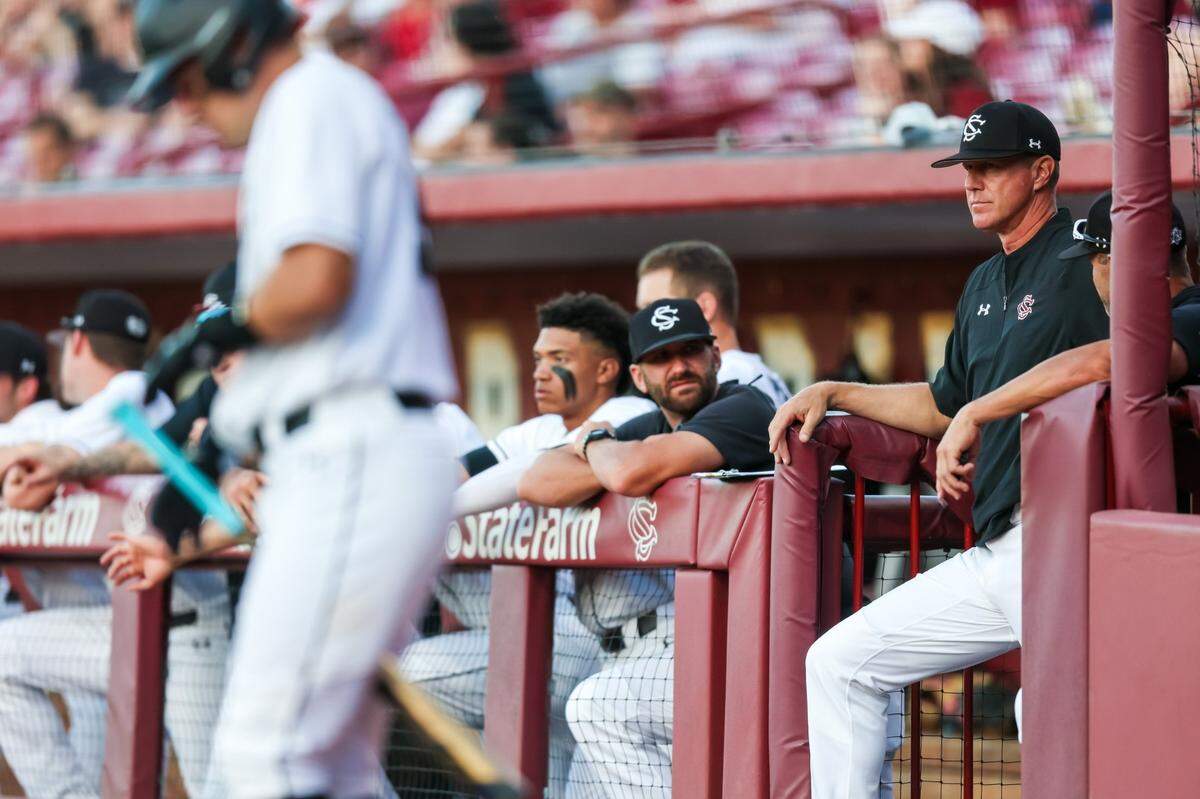
Kingston boasted a proven resume as a head coach who’d steadily climbed college baseball’s ladder when he was hired at South Carolina in July 2017.
He’d previously taken Illinois State (once) and South Florida (twice) to NCAA regional appearances. He twice won the Missouri Valley Conference regular season title while guiding the Redbirds between 2010 and 2014.
His time as an assistant at Miami and Tulane also inspired confidence he could bring a winning pedigree to one of college baseball’s preeminent programs.
“He’s got a Tulane background, a Miami background. He’s coached with a lot of really good coaches. He’s got the respect of a lot of really good coaches,” D1Baseball national writer and editor Kendall Rogers told The State at the time of Kingston’s hiring.
That winning pedigree, though, hasn’t quite resulted in a consistent product during Kingston’s time at South Carolina.
USC has reached one super regional (2018) and one regional (2021) during his time on the job. The Gamecocks entered Saturday with a 26-27 record (12-17 SEC). They have yet to reach the 40-win mark once during Kingston’s tenure. (The Gamecocks were 12-4 in 2020 when the COVID pandemic canceled the season.)
Kingston is also on pace to own two of South Carolina’s three complete seasons with fewer than 30 wins since the Gamecocks joined the SEC in 1992. The only other time it happened? That’d be June Raines’ final season as head coach in 1996 — also the last year the program finished with a losing record. Raines was replaced by Ray Tanner the following year.
Tanner’s squads made the NCAA tournament every season between 2000 and 2013. South Carolina won 40 or more games in each of those years and eclipsed 50 wins on five occasions. Tanner’s teams won two national titles (2010, 2011) and were runners-up twice (2002, 2012).
Even Chad Holbrook’s up-and-down run as head coach (2013-17) included three seasons with 40 or more wins, though the Gamecocks missed the postseason twice in his five years as head coach.
Kingston currently ranks fifth in program history in total wins (137), but his .559 winning percentage is 9 or more points below any of the four men ahead of him — Holbrook (.654), Raines (.667), Tanner (.700) and Bobby Richardson (.706).
Among the myriad issues the Gamecocks have faced over the past five years, persistent problems at the plate have limited USC’s ability to compete in the upper echelon of the SEC.
Kingston came to South Carolina as a renowned hitting guru, but his teams have largely failed to rank near the top of the conference in key offensive categories during his time in Columbia.
The Gamecocks haven’t finished a season ranked better than ninth in the SEC in batting average over Kingston’s three full seasons, and their 2022 output (.267) was dead-last at 14th in the league entering Saturday.
South Carolina had, to its credit, finished no worse than seventh in the conference in homers since 2018, but that, too, has dipped. USC is currently 12th in the league and on track for the lowest home run output of the Kingston era.
This isn’t to say the Gamecocks have been devoid of talent over that span. South Carolina has had 25 players selected in the MLB Draft since 2018, including six players taken in the first five rounds. This year’s ace, Will Sanders, among others, also profiles like an elite draft prospect a year from now.
Even with that talent flowing through Columbia, the Gamecocks are staring at a second missed postseason under Kingston square in the face.
To be clear, South Carolina isn’t guaranteed to miss out on the NCAA tournament this season, but getting there is probably going to take winning this week’s SEC tournament. Losses to Charlotte, Presbyterian, USC-Upstate, Xavier and The Citadel in the midweek — and being swept by rival Clemson — hurt the team’s at-large NCAA chances.
Ten SEC teams have finished the regular season with 15 league wins since 2013. Seven of those squads made the NCAA tournament. The kicker? The teams that made it into the postseason had an RPI of 34 or better, while those that missed it had an average RPI of 61.7.
On Saturday, South Carolina sat 75th in the RPI with one game at Florida remaining.
“The problem is their RPI just isn’t good enough and they haven’t won enough games in nonconference,” Fitt explained prior to the Charlotte loss.
What’s next for South Carolina baseball in 2022?
It’s not known whether USC’s administration would commit to a change in baseball leadership after the season.
South Carolina is fresh off paying massive buyouts to Muschamp ($12.9 million) and Martin ($3 million). Kingston makes $475,000 annually in base salary, but his restructured contract extension through 2025 signed last summer could entail adding more than $2 million to that “I owe you” ledger if he were to be fired before June 30.
There’s also something to be said for what Kingston and his staff have navigated this spring. The Gamecocks lost projected weekend arms Julian Bosnic and James Hicks before the season was three weeks old. They mitigated those losses via an otherworldly transformation by Noah Hall from reliever to starter and leaning on young arms like Eli Jones, Matthew Becker and Aidan Hunter long before they expected to.
That all equated to South Carolina stealing series wins from perennial powers Texas and Vanderbilt and playing themselves, albeit briefly, into NCAA tournament contention.
“The different levels of a program can change from year to year, but you want to be known as a program that the kids fight in it,” Kingston said following an April 29 win over Alabama. “And there’s no question this team, this group of guys is really fighting.”
If there’s an impetus to make a change when the season ends — whenever that time might be — it’s that South Carolina would likely be one of the best jobs available in the SEC and college baseball as a whole this offseason.
Missouri and Kentucky could conceivably look for new coaches, though those gigs are both well below USC in the pecking order of college baseball jobs.
Mike Bianco has probably done enough to remain at Ole Miss after rising to No. 1 in the country and crashing toward the NCAA tournament bubble over the course of this season, while Alabama could theoretically move on from Brad Bohannon after another up-and-down season in Tuscaloosa.
“How many programs out there have won multiple national championships at all, let alone in the last 15 years, have a top-flight facility, tradition, fan base, resources and play in the best conference?” Fitt said. “I mean, (South Carolina) checks all the boxes, really.”
South Carolina is a destination job in most college baseball circles. The facilities are among the best in the game and the fan support rivals that of the most storied programs in college baseball.
All that comes with expectations of competing at the sport’s highest level.
“To the fans: We will embrace your expectations,” Kingston said at his introductory press conference in July 2017. “I know what the expectations are. Coach (Ray) Tanner made sure I know what the expectations are many, many times. We won’t run from the expectations. We’ll run toward the expectations because they’re the same.”
Kingston has never shied away from those aforementioned expectations in Columbia. Really, he’s embraced them. But with the program on the precipice of missing the postseason for the fourth time since 2015, South Carolina’s 2010 and 2011 national titles feel increasingly distant.
Mark Kingston at South Carolina
Final record and postseason finish
▪ 2018: 37-26 (lost on the road in NCAA super regional)
▪ 2019: 28-28 (missed postseason)
▪ 2020: 12-4 (COVID canceled season)
▪ 2021: 34-23 (lost in NCAA regional USC hosted as a 2 seed)
▪ 2022: 26-27 (still in progress)
Total record: 137-108 (55.9%)
Mark Kingston buyout
▪ $2.2 million if dismissed before June 30, 2022;
▪ $1.4 million if dismissed between July 1, 2022 and June 30, 2023;
▪ $800,000 if dismissed between July 1, 2023 and June 30, 2024;
▪ $400,000 if dismissed between July 1, 2024 and June 30, 2025.
This story was originally published May 18, 2022 at 12:37 PM.