
Richard Bell, one-and-done as USC coach: How 1982 season shaped him, players, program
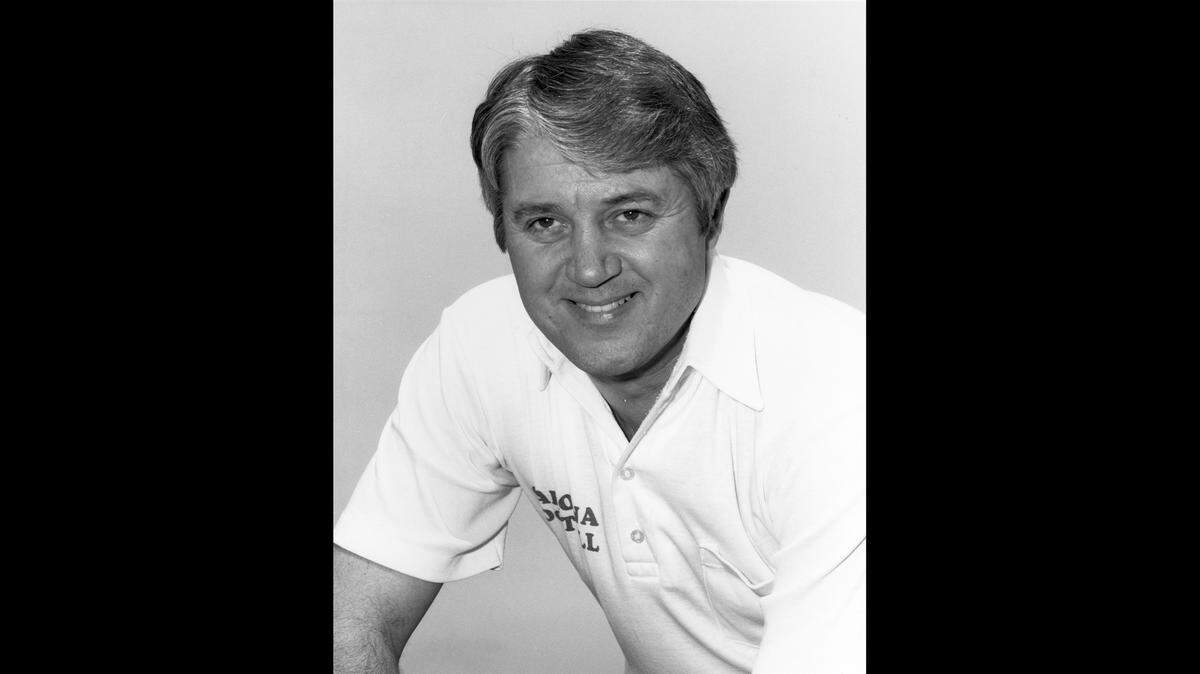
Richard Bell was speaking in his soft-spoken, Arkansas-tinged voice by phone from his home in tiny Bogart, Georgia, a stone’s throw away from Athens, home of the University of Georgia and one of college football’s major hubs. That’s a world Bell knows well.
More than half his life — 42 years — was spent coaching at 10 colleges, from Virginia Military to Georgia and Georgia Tech, West Virginia, Texas Tech and, yes, South Carolina. He’s 82 and retired from his job as defensive coordinator at Bogart’s Prince Avenue Christian School.
His memories of those years in the college ranks are mostly fond ones: of players he enjoyed guiding and instructing, of coaches with whom he formed lifelong friendships, of games won and lost. Even his one season as a head coach — 1982, at USC — brings back moments he still cherishes.
And a few he does not.
So of course, that season is the one he’s asked to discuss. Bell, who retains a strong loyalty to and from former players — including one who now has his old job with the Gamecocks — doesn’t shy away from the on-field failures that marked that 4-7 season; how it ended is another matter.
“It came about on the Sunday (Nov. 21) after the Clemson game,” a 24-6 loss, Bell said. “I was going to meet with the staff” to discuss recruiting and plans for 1983, “but I had to have that meeting with” first-year athletics director Bob Marcum.
Details of that meeting differ depending on whose account you hear. This we know: Bell was informed he needed to fire four offensive coaches (whom he declines to identify) from his staff. The Gamecocks had been woeful on offense, producing just 324 yards per game, and that included three comfortable wins. The passing game was especially bad: just 1,291 yards in 11 games with a 45.6 completion percentage.
So someone had to be fired, except Bell said no.
“One was too many for me,” he said. “(Marcum) wasn’t going to push me into a corner. I was saying how I wanted to build the program, (but it was) entirely different from what he was saying. It wasn’t much of a discussion after that.”
Marcum, 83 and living in a retirement facility in Huntington, West Virginia, paints a different picture.
“(Bell) said four coaches didn’t do the job he expected,” Marcum said, “but he said, ‘I can’t fire them.’ I thought, ‘You’ve got to do something’ (but) he didn’t want to do anything.
“I called the school president (James B. Holderman) and said, ‘I think we’ve got to replace (Bell).’ If the program is bad, and you’re the head coach, you should do something about it.”
And so on Dec. 1, 1982, a year into a four-year, $50,000 per season contract, Bell was out.
In July 1984, Bell, who had sued USC to recoup his remaining three seasons’ salary and also alleged slander and libel by Marcum, walked away with $171,000. Marcum said recently, when asked at trial if Bell deserved to be paid, he said “yes.” (A couple of weeks afterward, Jim Carlen — whom Bell had replaced as coach, and Marcum’s predecessor as athletics director — won $557,000 from USC in his own lawsuit.)
The Carlen era lasted seven seasons, producing a 45-36-1 record, three bowl trips and Heisman Trophy winner George Rogers. Bell’s replacement, Joe Morrison, would coach six seasons (39-28-2) with three bowls, make a run in 1984 at a national championship before finishing 10-2, and spawn USC traditions — notably its “2001” theme — that outlived the coach. Morrison died of a heart attack in February 1989, just as the steroids scandal that likely would’ve ended his tenure was going to court.
In between was the Bell “era.” How often is a coach, especially a first-time head coach, dismissed after a single season?
So 1982 represents the beginning of a “culture change” at USC: from old-school, disciplinarian coaches, a clean-cut image and plain-vanilla uniforms to the advent of Gamecocks “branding”: multiple jersey-helmet-pants combinations, slogans such as “Black Magic,” Morrison’s larger-than-life “Marlboro Man” mystique — and, ultimately, drug revelations from player Tommy Chaikin in Sports Illustrated that resulted in Marcum’s firing in 1989 (though, to be fair, steroids were around, though largely unreported, during Carlen’s regime, too).
Bell’s lone season served mostly as a transition from one era to the other. That, though, didn’t make it any less meaningful for those who took part. Coaches and players remember 1982’s dashed hopes, disappointing losses, but also — for the most part fondly — the man who led them.
From Jim Carlen to Richard Bell
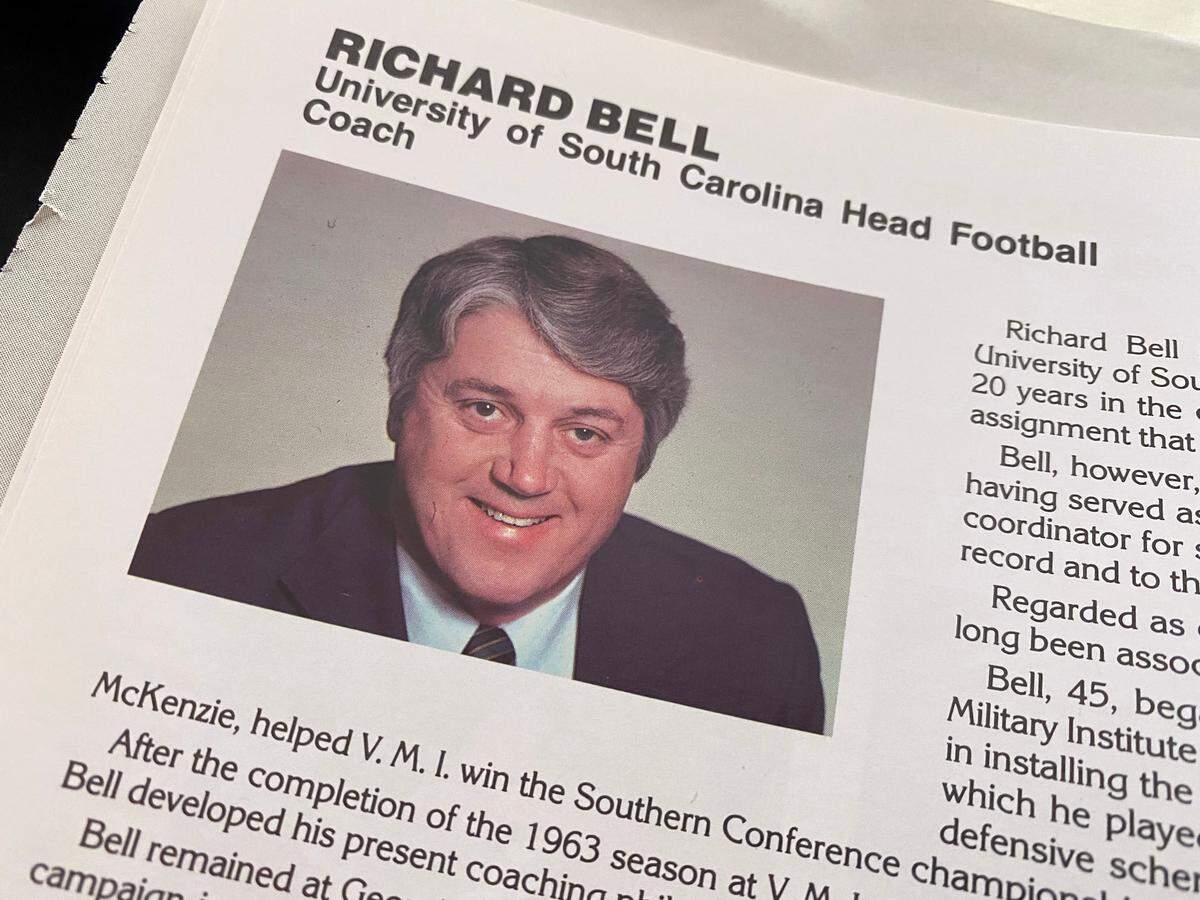
Bell and Carlen met at Georgia Tech in the 1960s as assistants under the legendary Bobby Dodd. Carlen took the top job at West Virginia in 1968, and Bell went along as defensive coordinator, the start of a 15-year relationship that produced turnaround winners for WVU, Texas Tech and, in 1975, brought them to Columbia.
The Gamecocks under Carlen made bowl trips in 1975, 1979 and 1980. But Carlen and Holderman (who resigned in 1990 after revelations of misuse of school funds) were constantly at odds over football revenues. In 1981, USC started 6-3, including a 31-13 upset win at No. 3 North Carolina, but a home loss to Pacific, followed by defeats at Clemson and Hawaii, left Carlen vulnerable.
Larry New, another Carlen assistant who became Bell’s defensive coordinator in 1982, recalled the firing was a done deal before the team returned from Hawaii.
“I think they (Holderman and board members) had already made the decision that as soon as we got back, Jim would be fired,” he said.
“(Carlen) and I were taking off on a recruiting trip for a home visit, and halfway there he told us he got a call that he’d been fired,” said Jerry Sullivan, the Gamecocks’ receivers coach under Carlen and later Bell. “We turned the plane around and went back to Columbia.”
Kicker Mark Fleetwood, now a high school coach in Huntsville, Alabama, heard the news at The Roost athletics dormitory, and “the bottom fell out of my stomach,” he said. “I didn’t get out of the lobby before I was on WIS-TV.”
Ty Rietkovich, a rising junior tight end from Airport High, heard it on his car radio after a 9 a.m. exam. “I was coach Carlen’s first recruit from his (summer) camps; I looked up to him,” he said. “Going 6-6 after George (Rogers’) year shouldn’t have been reason to fire him.”
(Years later as a high school coach, Rietkovich said, he was told Carlen had informed the staff he was going to take the head coach’s job at Kentucky to escape from Holderman. Instead, the Wildcats hired Maryland coach Jerry Claiborne.)
The job of hiring Carlen’s coaching replacement fell to Marcum, newly arrived from Kansas, who initially set his sights on West Virginia’s Don Nehlen, hoping to make a splashy hire. But Nehlen chose to stay put.
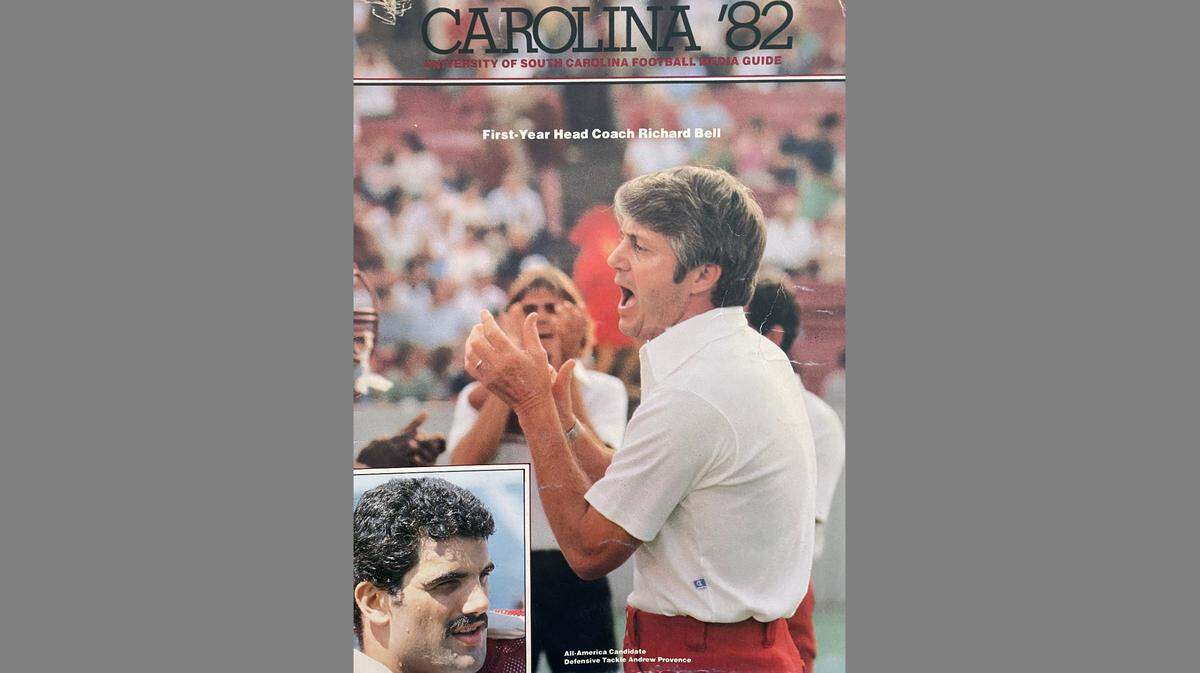
By then it was late December, recruiting was gearing up (USC’s previous staff was still pursuing players, New said) and Marcum needed a head coach. Earlier, Bell had reached out to S.C. Gov. Robert McNair to make known his interest in the job. He also got the backing of his staff mates and players; the rising seniors, led by All-America candidate and defensive tackle Andrew Provence, drafted a letter backing Bell and presented it to Holderman.
“I probably wasn’t the candidate (Marcum) wanted at first,” Bell said. But after Nehlen turned the job down, Marcum invited Bell to talk about his coaching philosophy and potential for the program. “I could tell then, ‘I’ve got a chance to get this thing,’” Bell said. Marcum said a recommendation from Dallas Cowboys vice president for player personnel Gil Brandt, among others, boosted Bell’s bid.
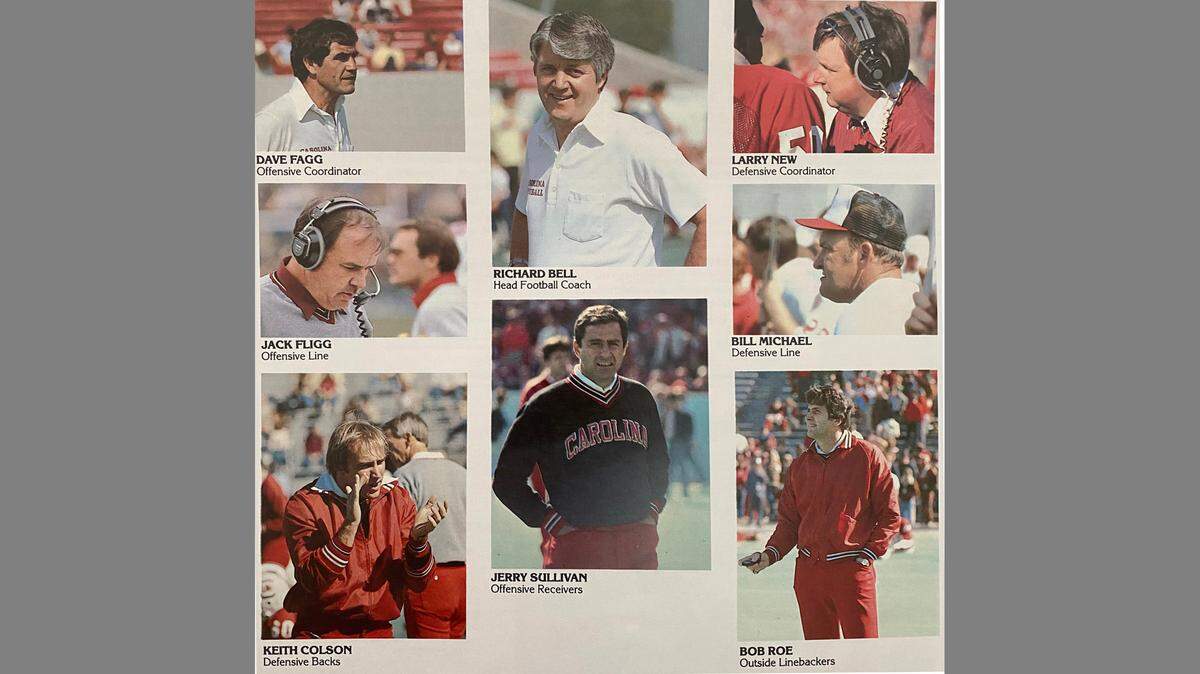
Bell retained New, Sullivan, offensive line coach Jack Fligg, secondary coach Keith Colson (replacing Dale Evans, who would up at North Carolina) and linebackers coach Bob Roe. Added were defensive line coach (and Bell’s former Arkansas teammate) Bill Michael; running backs coach Sam Goodwin, a former assistant coach at S.C. State and Wichita State; and Hawaii assistant Dave Fagg, hired as offensive coordinator and quarterbacks coach.
That last hire would come back to haunt Bell.
Reasons for optimism for USC in 1982
The 1982 season looked challenging but hopeful.
Senior Gordon Beckham, who had engineered the 1981 upset at UNC but didn’t play at Hawaii due to a hand injury, and sophomore Bill Bradshaw would compete at quarterback; talented freshman tailback Thomas Dendy joined veterans Todd Berry and Dominique Blasingame; Ira Hillary, a future NFL player, was the top receiver. The defense was anchored by Provence, linebacker J.D. Fuller and senior defensive back Harry Skipper.
Sullivan — today, at 77, still coaching with the NFL’s Arizona Cardinals — remembered thinking Fagg’s pass-heavy offense wouldn’t fit the personnel.
“(Beckham) was highly recruited, great kid, but marginal passing skills,” he said. “Bradshaw was a running quarterback, very limited. We were trying to put a round peg in a square hole.”
Rusty Russell, a 6-foot-6, 265-pound offensive tackle who later played in the NFL, echoed Sullivan’s words.
“We didn’t have the weapons to run the offense,” he said. “Fagg tried to implement something really fast, but a lot of guys didn’t get the hang of it.”
Beckham, in fact, had come close to quitting football after 1981.
“I’d decided not to play my senior year,” he said. “I’d lost my zest for the game, coming off surgery. But my high school coach in Atlanta told me, ‘Someday when your son wants to quit, you’ll have to live with it,’ and that hit me like a 2-by-4.”
The biggest plus was USC’s schedule, with eight home games. Georgia, LSU, Florida State and defending national champion Clemson would all be favored, but the Gamecocks looked to have the edge in five of their first six games and vs. Navy, all at Williams-Brice Stadium.
Among those first six games were Duke, which USC had beaten three straight times (1979-81), and in-state Division I-AA foe Furman, which hadn’t beaten the Gamecocks since 1949.
“I was excited about the chances we had, “Bell said. “We had a good staff, good players. ... I’d made up my mind if the job was offered, no question I was going to stay. It was a dream come true, something I’d been working for all those years.”
The ‘death knell’ and ‘backbreaker’ for Bell
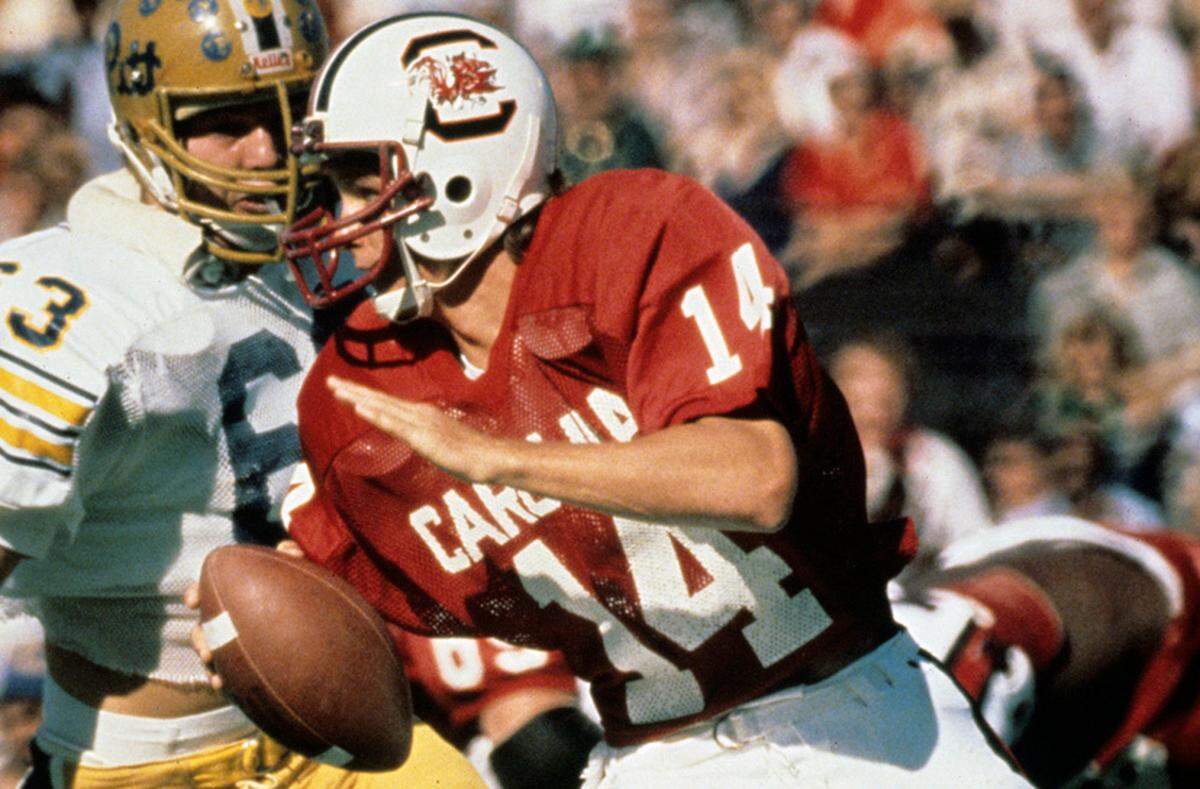
USC’s 1982 home opener was against the team that likely cost Carlen his job: Pacific, a 22-21 upset winner in 1981. The Gamecocks won, 41-6, but the game was close until Skipper ignited his team with a 100-yard fumble return.
“That turned the tide,” said Skipper, now a coach in his hometown of Baxley, Georgia and, in 1983, a Canadian Football League rookie all-star with 10 interceptions.
The way USC won, though, indicated problems, mostly on offense.
“Games like that, them knocking on the door ... that shouldn’t be happening, but it was,” Skipper said. “We couldn’t move the ball.”
Bradshaw, starting ahead of Beckham, felt out of sync.
“I was more a running/veer quarterback, but they brought Dave Fagg in and went to a more pro-style, drop-back passing game,” he said. “Any time you change offenses, it takes time to get used to (the new one). ... We weren’t very good, put it that way.”
The Gamecocks beat Richmond, 30-10, but then Duke, with quarterback Ben Bennett and its young offensive coordinator Steve Spurrier, built an early 14-0 lead and iced the 31-17 upset with a 33-yard interception return for a touchdown. Bennett’s three touchdown passes and no interceptions — USC was picked off three times — were the difference.
Bradshaw remembered “like yesterday” the interception that “killed USC.“
“Coach Fagg said, ‘Throw out to the back (on a curl route), it’ll be there,’” Bradshaw said. “But they transitioned from Cover 3 to Cover 2, and (defender) Brick Johnstone rolled up, picked it off and returned it for the touchdown.”
The mood afterward was grim, Russell said.
“It felt like a game we should’ve won to me,” he said. “We all looked at each other afterward and knew we imploded.”
A 34-18 loss to Georgia featured Fleetwood’s 58-yard field goal that remains the school record. “And I missed a 56-yarder,” he said.
The Gamecocks bounced back against unbeaten Cincinnati, 37-10, to improve to 3-2. Next up: Furman, which under fifth-year coach Dick Sheridan would finish 9-3 and reach the Division I-AA playoffs that season.
The Paladins scored twice on 3-yard touchdown passes from David Charpia and on Ernest Gibson’s 22-yard punt return. Trailing 21-3 to start the fourth quarter, USC scored on Beckham’s short run and his pass to Carl West. But Furman’s Robbie Gardner — Russell’s cousin — scored on a 4-yard run and the Paladins held on, 28-23.
“We all assumed we’d walk over them, including me,” Russell said. “I had told Robbie (Gardner), ‘I guess we’re going to lay one on you this weekend,’ and he’d said, ‘Don’t be so sure.’ That was the death knell for (Bell); I heard boos like I’d never heard before.”
Skipper remembered how Bell exploded after the game.
“I’d injured my shoulder, torn cartilage, and I was in the training room,” he said. “Coach Bell walked in, looked around and began yelling: ‘Get out of here! You ain’t hurt; the only thing hurt is your pride!’ We all jumped up and got out of there.”
Furman probably doomed Bell’s job security, but five games remained, and the Gamecocks played perhaps their best, if most frustrating, game at unbeaten LSU, ranked No. 8 in the nation. The Tigers scored twice early and held on, 14-6.
“We actually hung with them,” Russell said. “Then we were driving, thinking we’re going to win.”
But Beckham threw a late interception in the LSU end zone, one of four turnovers for USC.
“Afterward, I talked to the team and said, ‘We have to finish out strong,’” Bell said. “I told them, ‘We have to play at a high level, come together and somehow find a way to win those games.”
Instead, N.C. State flattened the Gamecocks in Raleigh, 33-3, and USC was embarrassed at home by Florida State, 56-26, after trailing 56-12.
“That (FSU) was the backbreaker,” Fleetwood said. “We just didn’t compete.”
USC eked out a 17-14 win over Navy, but was just 3-of-9 passing for 8 yards. The finale at Clemson was predictable, the Tigers rolling to a workmanlike 24-6 win.
The reaction to Richard Bell’s departure
Rumors about Bell’s job security had been floating since the Furman loss, but the speed of his dismissal surprised some. Not Bell.
“(Marcum) was going to make a move on me, one way or the other,” he said.
New said he always believed Marcum would use Bell’s loyalty to his staff as a weapon. But Sullivan said USC’s showing on offense left them with “no leg to stand on. ... At 4-7, there wasn’t any excitement in the offing.”
Marcum maintains he gave Bell every chance to succeed.
“During the season, I never considered stepping in; you’ve got to give him the opportunity to produce,” he said. “But if he won’t fix the mistakes he identifies” — the assistant coaches — “I’ve got no choice. And he identified them, not me.”
Some players were surprised at Bell’s dismissal.
“Coach Bell inherited a dysfunctional situation and (I think) would’ve been successful if given the usual opportunity to build things his way,” Provence said.
Others saw Bell’s loyalty to his staff as part of who he was as a coach. Others, though, said the firing was inevitable.
“A dysfunctional season ... that’s fair,” Beckham said. “Some coaches on that team inspired confidence, but there were others who didn’t.”
Perhaps the least shocked was a player who watched from afar.
Del Wilkes, from Irmo, was close to Carlen and quit the team when the coach was fired.
“I tried my best to leave in spring ball,” he said, but was convinced — briefly — by Bell to return. That didn’t last; Wilkes walked away after the spring game.
“Honestly, I wasn’t surprised” when Bell was fired. “If (Marcum) is telling you to get rid of coaches, obviously that’s an issue. I understand loyalty to his guys, but the way I looked at it, you’ve got to be smarter.
“Losing to Furman is the unpardonable sin. That shows me you’re not a very good coach. And if you’re unwilling to make the tough decisions to make the team better ... maybe you didn’t need to be running the team to start with.”
Bell’s bond endures with players, colleagues
Divorces are rarely happy events. Sullivan’s most bitter moment came when Marcum approached him after the coaching staff was fired.
“He told me, ‘I want your (courtesy) car back in the morning,’” Sullivan said. “I was getting ready to go through a divorce, and I said, ‘Can you give me a couple of days? I’ve got things to square away.’ And he said, ‘I want it now, and if not, I’m coming after you.’”
Sullivan, who later landed at LSU, said he spotted Marcum during the Tigers’ 1987 Gator Bowl win over the Gamecocks, and made a beeline for his former boss.
“He saw me coming and picked up his pace, but I had a few choice words to say to him,” Sullivan said.
Bell, his defensive reputation largely unblemished, was hired by Steve Sloan at Duke for the 1983 season. Over the next 23 years, before retiring in 2006, he coached at East Carolina (under Art Baker, later head of USC’s Gamecock Club), Georgia (under former USC assistant coach Ray Goff), Navy and Air Force, where he spent 12 seasons with Cheraw native Fisher DeBerry.
Marcum, meanwhile, quickly settled on Morrison, who was coming off a 10-1 season at New Mexico.
“The winningest coach (in 1982) not in a bowl game was Joe,” Marcum said. “I called around, and (former New York Giants coach) Allie Sherman and (former teammate) Sam Huff were high on Joe. After we hired him, a lot of powerful people around the NFL did commercials for (USC).”
Wilkes, whom Morrison soon brought back to the team, said the “culture change” from Carlen/Bell to Morrison was quickly obvious.
“Coach Carlen, you couldn’t get close to him as a player, he maintained an arm’s-length relationship, but coach Morrison was an extremely relatable guy,” he said. “He had a few rules: Be on time, give maximum effort. And he had instant respect because of his NFL history.”
J.D. Fuller, a senior in 1983, saw it differently. He said Morrison’s assistant coaches were “slinging steroids” and “I was glad I was a senior on my way out.” He said Carlen was “about making sure you graduated; Morrison was ‘win at all costs.’”
Bell said he never connected with Morrison and declined to criticize his successor. Sullivan and New, though, said the Gamecocks’ descent into steroids abuse was predictable.
“Marcum wanted Richard to take the strength coach from Kansas (Keith Kephart, one of three Morrison assistants who pleaded guilty in 1989 to providing players with steroids),” New said, “and he was good for the program, wasn’t he?”
Sullivan, who has enjoyed a solid career in the NFL since departing USC, said he was “far removed” from the program during the Morrison years, but “I know there was ‘juicing’ going on.”
Thirty-eight years after Bell’s one-and-done season, several players said that season helped shape their post-football lives. Provence, now in Atlanta with Athletes in Action, a Christian outreach group, credits Bell for putting him on that path.
“Coach and I are good friends today and partner together in ministry,” he said. “I love Richard Bell and there’s no one I respect more.”
Bell, during interviews for this story, said he wanted to tell his former players “how much I appreciated what they did, because the way we finished, in the midst of adversity, they continued to fight and represented themselves well. (I) always said, the only thing that exceeded their ability was their heart.”
Fuller, now working in Charlotte, said he last saw Bell at the February 2019 funeral for longtime assistant coach for academics Harold White. This past summer, he ran into USC head coach Will Muschamp at the George Rogers Foundation fundraiser, and asked if Bell had coached Muschamp at Georgia.
Then, Fuller said, “(Muschamp) started reciting: ‘Good, better, best ... never let it rest ... until you’re as good as your better ...’”
Fuller finished it: “... and you’re better than your best.” Both men laughed.
“You played for coach Bell, right?” Fuller said.
Muschamp smiled and said, “God didn’t make a better man than coach Bell.”
For all coaches, it’s about winning. For some, it’s not just about winning games.
This story was originally published July 22, 2020 at 5:00 AM.