Split crews, TV feeds: How pandemic forced Gamecocks broadcasters to make changes
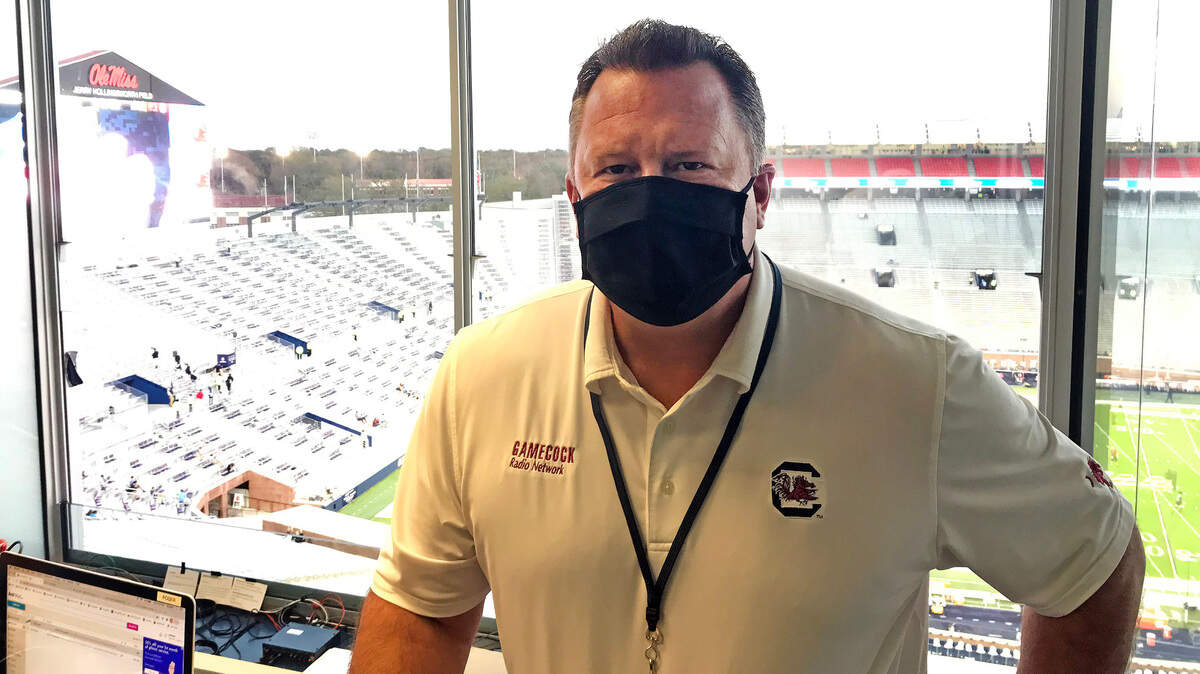
Todd Ellis and Tommy Suggs are used to pitching it back and forth.
The two were among the more memorable quarterbacks in this history of South Carolina football, and for nearly three decades they’ve shared a broadcast booth, calling Gamecock games and honing that timing that comes with long-held camaraderie.
But this year, those pitches during Gamecock road games have to be more fine than usual. Suggs must rely on Ellis’ voice as a guide. Ellis has to set up his partner’s commentary in new ways.
That’s because the two have not been together for those road games. They’re separated by hundreds of miles — and often 18 seconds between what Ellis sees in person and what Suggs can see on a video feed.
“It’s a balancing act,” Suggs said. “It’s very stressful.”
Ellis echoed that “it is incredibly different.”
The coronavirus pandemic has changed a lot of how the world works, never mind the world of sports broadcasting. In the athletic world alone, it’s pushed back seasons, moved and canceled games, and made things tricky all over.
In recent weeks, Ellis saw his streak of covering games that dated back to 1992 snapped. He was exposed to someone who tested positive for COVID-19 and had to stay home. It was strange not being at Williams-Brice Stadium, Ellis said. He’ll be back in action for Saturday’s season finale against Kentucky.
In truth, every trip away from USC’s home stadium has been a strange one.
“By the time I’ve called a play and (Suggs) might comment, he can’t look up and see it,” Ellis said. “He’s got to comment without doing that. And Tommy and (sideline reporter) Jamar (Nesbit) are both having to concentrate really hard to keep up with the broadcast, where we are, what trends are going on. It’s been more difficult on them.”
The dynamic took a bit to get used to it, for folks back at the studio in South Carolina to normalize not being able to jump in because they couldn’t see what Ellis was seeing in real-time. It helped to have him there at all, as the perspective from a TV angle is just so much narrower than being in the stadium. (Ellis was relieved when he learned a few others would join him for road games.)
Suggs will listen to the game and chart it. Ellis leads his partner into a point or an opening more than he’s had to in a normal year.
It helps to have decades together to keep things from being uncomfortable.
The seeds for that plan came together in the summer when everything was up in the air. The expectation, for the most part, was that everyone was going to call games off TV.
As games grew closer, the challenges with delays and limited angles led to a move toward a partial crew for road games.
What limited things? Space.
“Some of the radio booths are very, very small,” said Liz McMillan, the executive director of Gamecocks Sports Properties. “It’s hard to social distance for certain.”
The Gamecocks’ pre- and post-game shows had already been moved to a radio station in Rock Hill.
So the road team got cut from seven people down to four:
- Engineer Dave Stewart
- Ellis calling the plays
- Doug Adams, usually just working stats but he helps out with spotting
- McMillan on production, managing cue cards, getting the broadcast in and out of breaks and numerous other things.
That group usually includes David Spence as the spotter and the rest of the broadcast crew. The travel crew has to go to the morning COVID-19 testing with the football team and staff. Ellis admitted he misses the camaraderie on trips, dinner the night before, breakfast on game day and sharing those moments.
Nesbit lives in Charlotte, and Suggs has a home in the mountains and has had a few health issues. It made sense for them to go to Rock Hill for road-game broadcasts. Suggs said he put the choice in McMillan’s hands, and she thought it was best for him to hang back. (He says he would’ve gone if they asked him to.)
And that leaves the trio having to work in concert around the 18-second delay.
“I’ll listen to it like I’m riding down the road in a car,” Suggs said. “And I’m making notes. And when I get a chance to say something, I say it.”
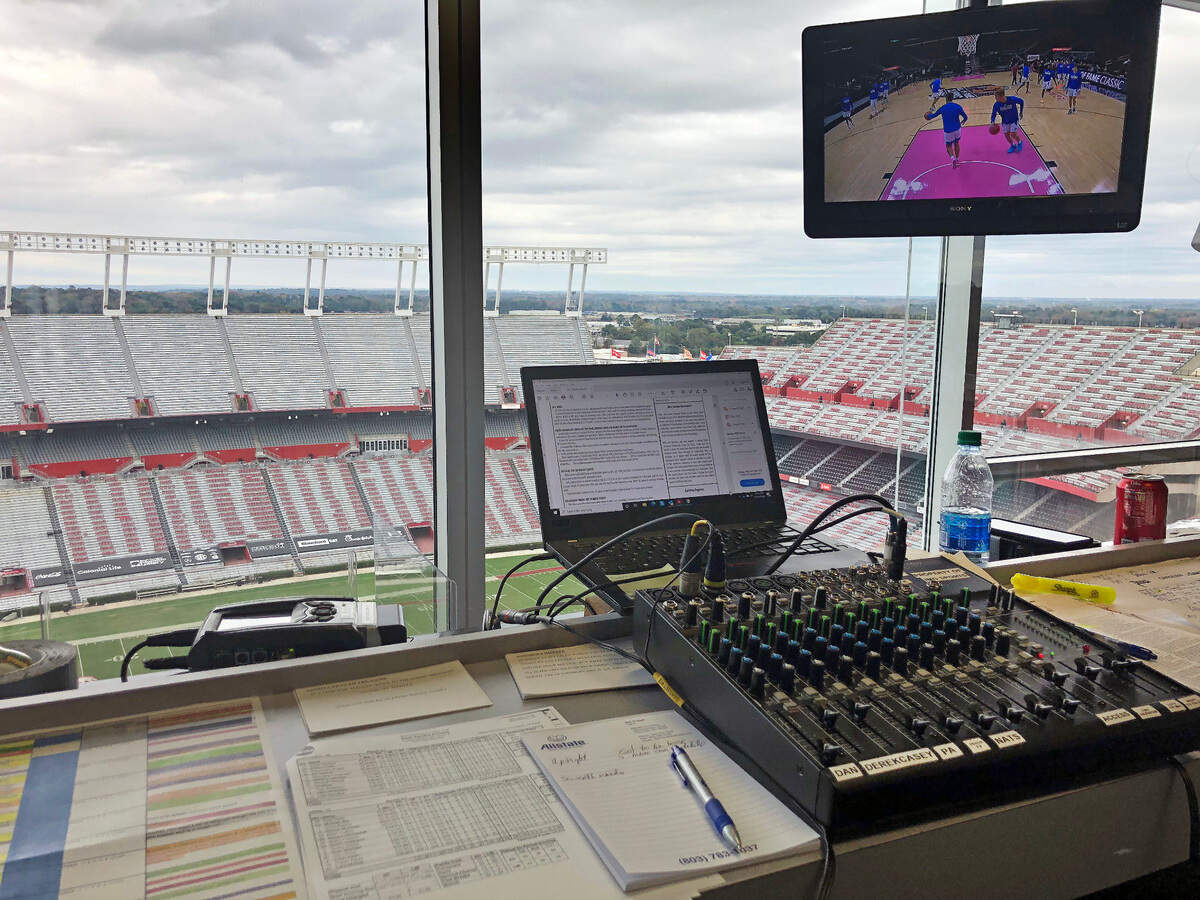
On the basketball side, there had been some hope to get Derek Scott and Casey Manning traveling with the men’s basketball team and Brad Muller with the women’s basketball team.
That was eventually nixed by the SEC.
Scott will do all the road games from a TV feed. (Muller did go on USC’s first road trip when the games weren’t televised). It’s a small thing in the grand scheme of things during the pandemic, but it changes dynamics.
“It’s more challenging to deliver a broadcast where you’re really providing insight if you’re just seeing one camera angle,” Scott said. “You can’t look away from what’s on camera to see a coach’s reaction or what’s going on at the other end of the court.
“There are still most certainly challenges in terms of how you deliver a quality portrait of what is going on.”
Basketball home games will still be done live and in person. Scott noted that when he had done SEC Network volleyball games, he was afforded access to multiple camera feeds, but there’s a different situation for radio.
McMillan said it helps to have seasoned, experienced voices in all the booths, as this year has thrown the department a lot of curve balls.
Ellis missed the final two home games because of contact tracing. He’s going to Kentucky this week, aiming to finish out the season with the crew’s unusual road configuration.
When he could go to home games, it was a little reunion of sorts. The home booth is big enough for seven, and he could see all the folks he’s spent so many years around and likely will again when things return to normal.
“I always say on the broadcast, ‘We got our full A-Team with us today’ and call out everybody’s name,” Ellis said. “Getting a feel for the game and our entire team in one place, it’s made the home games much more special.”