
75 years ago, the first Gator Bowl featured a Gamecocks team in its own unique era
“Firsts” are forever.
First date, first car, first kiss, first job — first touchdown or home run. Those are engraved in the museum of the mind forever.
In delving into the University of South Carolina football history, peel the pages off the calendar for 75 years and discover a “first”: the first band of Gamecocks to play in a bowl game.
Look a little deeper and find the team’s regular-season record: 2-3-3. A team on the wrong side of breaking even going to a bowl? There’s that, too, in Carolina lore. Another “first,” if you will.
Then was, in a way, like today in the sense the United States found itself in a search for normalcy.
December 1945: World War II is over, military service personnel have received, or soon will receive, discharges and the United States is slowly taking steps to look into the future.
In the arena of sports, baseball fans longed for the return of superstars Joe DiMaggio and Ted Williams, striving to forget a World Series that one writer called a battle between the Toothless Tigers and Clawless Cubs. Boxing aficionados thirsted to see Joe Louis in the prize ring again.
On the college football scene, cities took note of the positive economic impact of bowl games and perhaps envisioned a local version of the Rose Bowl — the game that on Jan. 1, 1946 would draw 93,000 fans to witness Alabama run roughshod over Southern Cal.
December 2020: With the coronavirus pandemic creating havoc in all walks of life, records did not matter in the bowl selections, and the 2-8 Gamecocks accepted the opportunity to compete in the Gasparilla Bowl in Tampa, Florida.
Thus, circumstances — the quest for more bowls in more communities both then and now — came together to make the Gamecocks one of the few teams, if not the only one, to head into a bowl game with a losing record on two occasions.
But virus guidelines forced USC to abandon the current Florida venture, leaving the 1945 Gamecocks the only team in the program’s history to compete into a bowl with a losing record.
Who are these guys from “back then”? How did they go bowling? Who are these 1945 Gamecocks?
On the diamond anniversary, look back 75 years and consider Carolina’s first venture into the world of bowl games.
THE SCENARIO
Indeed, the archives reveal Carolina had two bowl possibilities after the 1945 season.
Per reports in The State newspaper, high-ranking state of South Carolina officials sought to get into the bowl business and wanted to establish the Tobacco Bowl. The proposed game would be played Jan. 1, 1946 in Columbia at then-named Carolina Stadium and would pit a state team — the Gamecocks, in this case — against a worthy opponent. Perhaps state-rival Clemson for the inaugural?
The possibility of that game vanished after the Gamecocks decided to play in another fledgling event, what would become the Gator Bowl in Jacksonville, Florida. The Lions Club that originally proposed the game could not afford the $25,000 guarantee, and four Jacksonville businessmen came together to underwrite the venture.
The Gator committee quickly decided on Wake Forest and its colorful coach Clyde “Peahead” Walker for one team. According to reports in The State in December of 1945, Carolina became involved after Georgia, Tennessee, LSU and Tulsa declined overtures.
The late Don Barton, a former Columbia sports editor and an authority of USC athletic history, reported that Rex Enright, who coached the Gamecocks before and after World War II, played a significant role.
Then in the U.S. Navy stationed in Jacksonville and awaiting discharge on Dec. 31, 1945, Enright went to bowl officials to tout the Gamecocks and later, The State reported, represented USC in pre-game negotiations.
Enright’s idea: Why not a rematch between the Gamecocks and Wake Forest, teams that played to a 13-13 tie during the regular season?
Bowl officials liked the possibilities.
THE GAMECOCKS
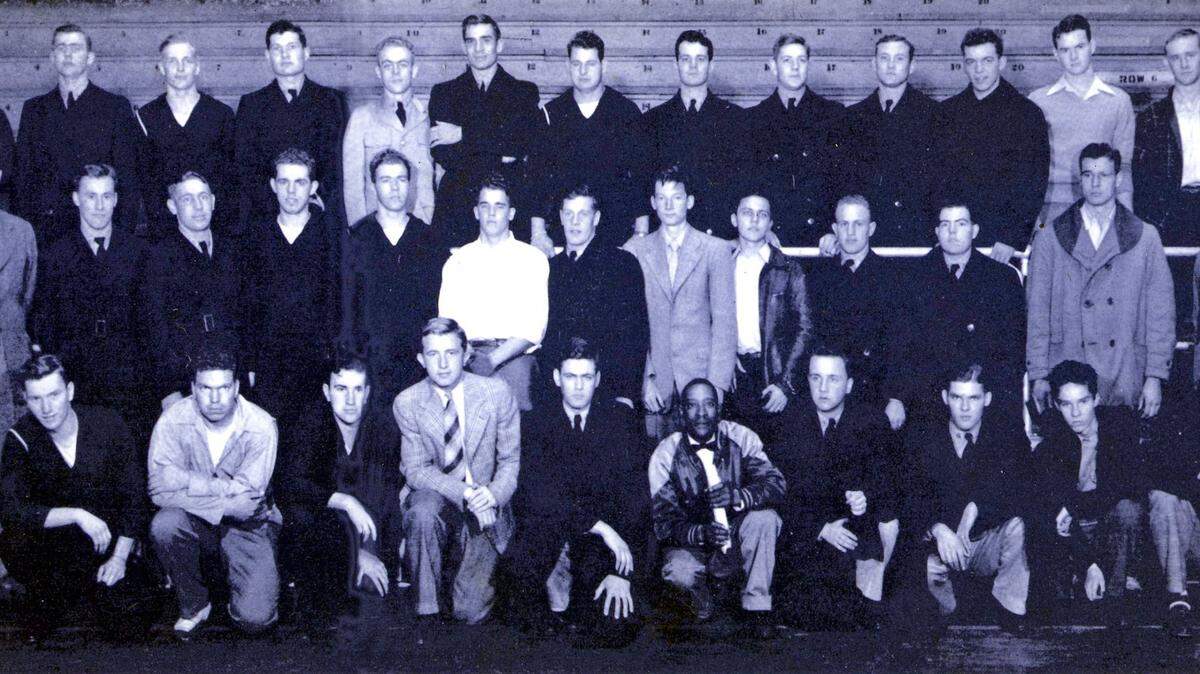
Like many college teams of the era, the 1945 USC squad was a mixture of Naval ROTC cadets and those ineligible for the draft, plus a few veterans returning from military service. The one-platoon rules meant players played both offense and defense, and Carolina’s traveling squad for the Gator Bowl consisted of 32 players.
After Enright, USC’s coach from 1938-42, entered the Navy, J.P. Moran took the helm for 1943, Doc Newton in 1944 and Johnny McMillan in 1945. Enright would return in 1946 after his discharge from the military.
McMillan had played for Enright in 1938 and had turned out successful high school teams in Sumter before becoming a USC assistant under Newton. McMillan installed Enright’s Notre Dame box offense to tackle a schedule that included heavyweights Duke and Alabama, a couple of cupcakes and an assortment of foes from the Southern Conference, then the Gamecocks’ athletic home.
“A ragamuffin team,” the Gamecocks’ best player, Bryant “Junior” Meeks, said in a profile in Don Barton’s book “They Wore Garnet and Black.”
Bryant was a typical player of the day. He had begun his college career as a freshman starter for the Georgia Bulldogs at age 17, too young for the draft. The Naval ROTC program brought him to Carolina.
Predictably, USC suffered one-side losses to Duke (55-0 in Durham) and Alabama (60-0 in Montgomery). In between, the Gamecocks whipped Presbyterian 40-0 and Camp Blanding 20-6 at home. Three straight ties — 0-0 vs. Clemson, 13-13 at Miami and 13-13 vs. Wake Forest in Charlotte — followed before the regular season ended with a 19-13 loss to Maryland at home.
Following the Maryland game on Dec. 1, players started to focus on the Christmas holiday break and on part-time jobs to earn spending money. Then along came the bowl possibilities.
Meeks, a center-linebacker who earned a second-team berth on the 1946 Associated Press’ All-American squads and later would play a couple of years with the Pittsburgh Steelers, told Barton: “Some of us were kinda shocked. I had already made plans to go home to Macon and work, because I needed the money.”
Meeks said that after the team voted to accept the Gator Bowl opportunity, the university declined to provide any spending money.
“A group of us ... went to the president of the university (Adm. Norman M. Smith) in his office,” Meeks told Barton. “... I made the mistake of calling him ‘Mister’ (instead of Admiral) and he seemed a little shocked.”
In essence, the players said they would not play unless the university replaced the money they would have earned on jobs during the holidays. The result: The players received “about $150 each,” Meeks said. “We were as happy as all get-out!”
THE GAME
Unlike the pomp that surrounds today’s bowls, Meeks recalled one dinner, a few radio interviews and some newspaper coverage prior to the game. USC’s on-field preparation included only one week of practice, which, Meeks said, led to the team not being in the best physical condition.
But McMillan sounded confident, telling The State in the pre-game report that the Jacksonville scrimmages of the past week “have been the most satisfactory of the year.”
Officials touted the game as Wake Forest’s power against Carolina’s speed, and oddsmakers made the Deacons a 13-point favorite. Wake arrived in Jacksonville with a 4-3-1 record that included close losses to Duke and Tennessee.
In The State, Meeks told reporter John Montgomery, “We came down here to rub that Wake Forest tie blot off our record.”
Noting the point spread, Montgomery reported that Wake had been favored by the same margin in the regular season and that the Gamecocks had played Clemson to draw despite being a substantial underdog.
As LSU and Ole Miss proved in 1959, Florida and Florida State illustrated in 1996, and Clemson and Notre Dame showed in the ACC championship game in 2020, close first games do not guarantee a great repeat. Think about this: How many unforgettable movies have been followed by dreadful sequel?
And so it was that the oddsmakers proved prophetic. After a Bobby Giles touchdown and Dutch Brembs’ point-after gave USC a 7-6 halftime lead, the Deacons rolled to a 26-14 triumph.
The Gamecocks intercepted 24 of opponents’ 95 passes that season, an amazing statistic even against the unsophisticated passing attacks of the day. But that strength would be useless against Wake’s ground-pounding offense.
The Gamecocks cut into the lead and covered the gambling spread on Brembs’ late-game 90-yard interception return for a touchdown and his extra point.
Statistics found online vary, but they all agree that Wake dominated. USC’s records show the Deacons with a 23-7 advantage in first downs and a 388-181 edge in offense, with 368 yards coming on the ground.
Attendance: 7.362.
Meeks’ memento? The Gamecocks won the pre-game coin toss and the Carolina captain got to keep the silver dollar.
THE EPILOGUE
And now, 75 years later, the Gamecocks observe the diamond anniversary of their first bowl game in eerily similar circumstances.
Uncertain times, then and now. A quest to return to normalcy and better days, then and now.
And like all “firsts” — first date, first car, first kiss, first job — the 1945 Gamecocks are a team to remember.