Shaving cream, semis and sweat: These USC staffers make Gamecocks’ road trips go
It’s 6:47 a.m. on a fall Thursday as carts, trunks and wheels scrape against the torn-up gray floors that open onto the loading dock on the back side of the Long Family Football Operations Center.
The 18-wheeler that will trek more than 1,000 miles from South Carolina to Texas in a few hours sits facing toward the parking lot as student equipment managers race in and out of the truck bed.
“Woahhhhh!” one garnet-and-black-clothed manager hollers as a box filled with training equipment teeters toward the six-foot drop between the ground and the top of the loading dock.
Larry Waters slips two fingers of tobacco into his left cheek as he watches the organized chaos play out in front of him. Waters is South Carolina’s director of football equipment and apparel operations. He oversees the operation with his two full-time partners, Shuler Hayes and Brandon Dubuy.
On this morning of Oct. 23, Waters, Hayes and Dubuy keep a watchful eye over the 15 student managers who work close to 40 hours per week for partial scholarships, sweaty shirts and random assignments as they load the truck for South Carolina’s trip to Texas A&M.
“Anything that doesn’t get used at practice today goes on the truck,” Waters explains.
South Carolina gave The State access to the process of packing up the program from Columbia and transporting it to College Station, Texas, for USC’s longest trip of the year aside from this Saturday’s contest at Missouri.
From prepping footballs, packing pads and perpetual banter, the 44 minutes loading the truck serves as a look behind the scenes at a department that’s often under the radar and under the gun in the grand scheme of major college football.
In 72 hours, South Carolina and Texas A&M kick off in Aggieland. There’s no time to spare.
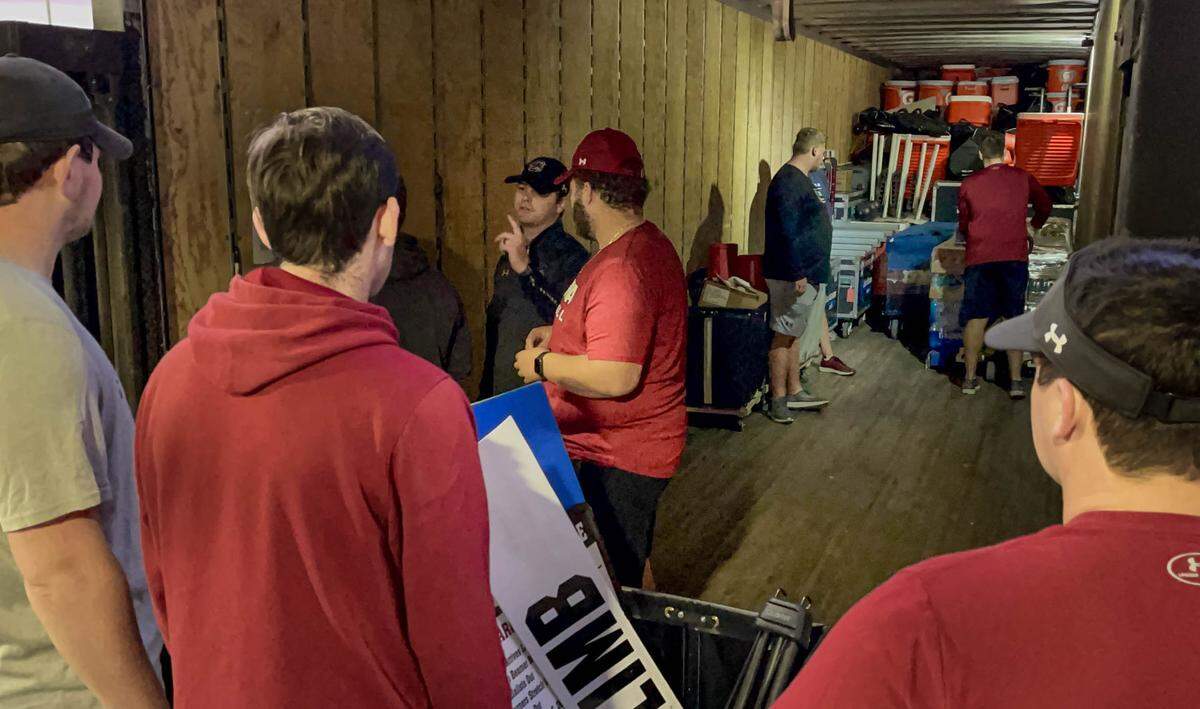
Loading South Carolina’s equipment truck
A fully-loaded 18-wheeler can legally max out at 80,000 pounds. South Carolina’s truck won’t get quite that heavy, but the boxes and bins that need transporting from USC to Texas A&M will fill the trailer just about to the brim.
Waters and his staff have the process down to a pseudoscience. Uniforms are decided early in the week. The equipment staff then begins organizing jerseys, pants, cleats and any other game-day materials needed. Coaches’ polos, sweatshirts, hats, visors, khakis, rain gear and other varying clothes are also accounted for.
Dubuy quips he’s got a running list of shoe and pant sizes stored in his mental Rolodex. You figure it out quickly, Hayes adds.
Name anyone on the coaching staff and Shuler, Hayes or Waters can more than likely list their preferred attire for a game day or practice.
Offensive coordinator Marcus Satterfield? Dubuy rattles off Satterfield’s usual getup of a long-sleeve shirt and cutoff sweatshirt for practices, but notes he ditches the cutoff for just a long-sleeve shirt and ball cap on game days.
Head coach Shane Beamer’s attire is Hayes’ responsibility. That almost always entails a polo, khakis and sneakers of some sort. More recently, a hat was added to the equation.
“He’s easy,” Hayes says through a wry smile.
With practice still to come on Thursday, the equipment staff loads everything it can for the time being. After Thursday’s session, players drop their gear into bags placed in front of their lockers that can be quickly zipped and loaded onto the truck.
Dubuy and Hayes will double back through the bags to make sure the players haven’t forgotten anything.
Then again, if they do forget, South Carolina brings along slews of backup equipment. The Gamecocks travel with extra jerseys for the two-deep. Trunks full of cleats ranging from size 9 through 18 in three different cuts are also brought along. Extra helmets, shoulder pads and leg pads are another part of the equation.
Granted, there’s the grander question hanging over the whole scene: Has anything important ever been left behind?
“Nothing major,” Hayes says through a smirk, looking toward Dubuy for backup.
“The key to that is putting the pack list on the inside of the truck and checking it off,” Dubuy adds.
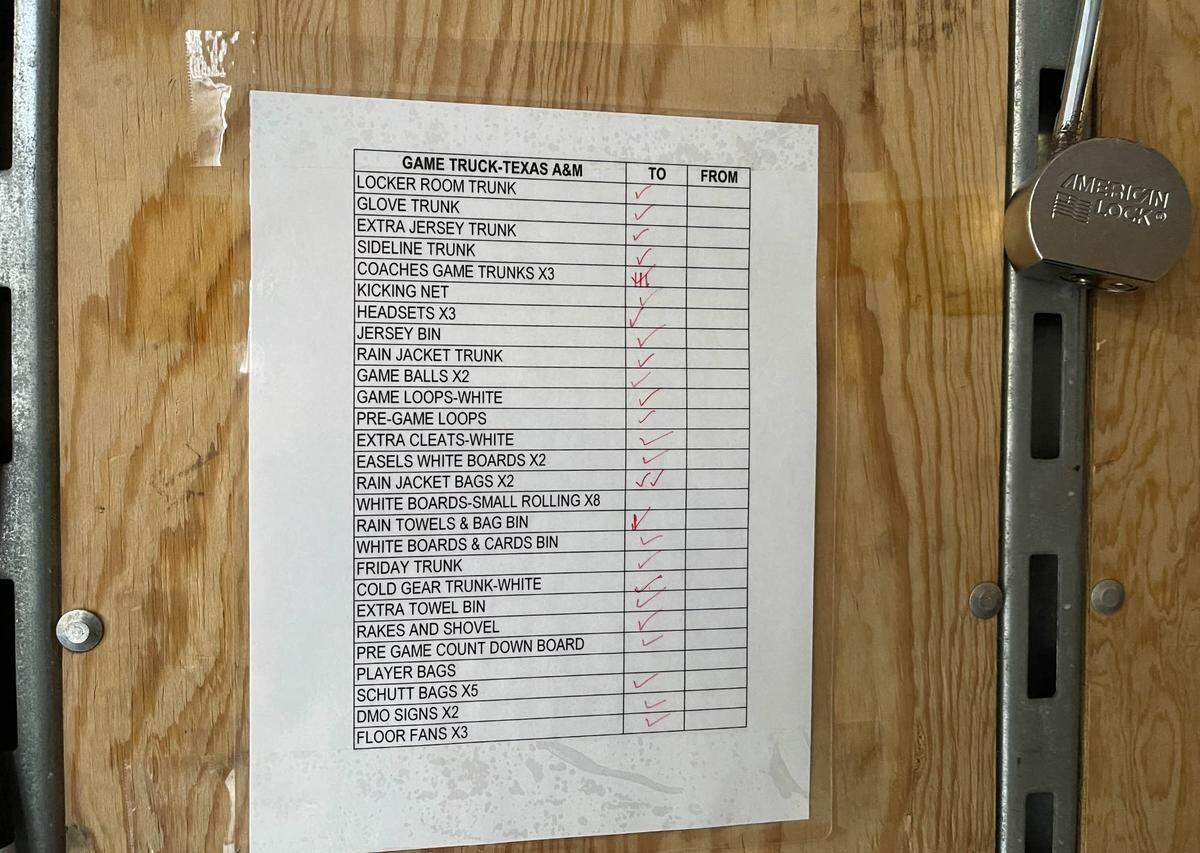
‘It’s kinda like grandma’s pasta sauce’
Connor Leoni laid on the floor of the bathroom in the Long Family Football Operations Center and stared toward the ceiling.
It was late July 2019 when Leoni took part in his first practice as a student equipment manager. The New Jersey native was a quarterback at Hillsborough High School and — like most of the student managers — wanted to keep football in his life once in college.
Leoni landed an interview with Waters during his summer orientation at South Carolina. There were the usual questions that come with being an equipment manager: Can you lift 50 pounds? Can you manage the time commitment?
Then there are the queries outside that of a normal job description: Can you handle getting chewed out from time to time?
“I guess I answered enough questions correctly to where I’m still here,” Leoni said as a smile graced his face.
Not used to the hellish midsummer Columbia heat, Leoni hadn’t hydrated properly the night before his first practice. So while his manager pals, players and coaches grabbed food after the session, there a dehydrated Leoni — better known as “Yankee” around the operations building — lay on a bathroom floor.
“First practice I was terrified, just worried about messing something up,” he conceded. “But luckily, I was able to ease in.”
Leoni works with the quarterbacks most mornings. The fit made sense given his own background under center. He manages the chains, tosses passes and catches balls during practices.
He’s also in charge of the game balls.
Prepping footballs takes a level of wizardry. The concoction Leoni uses differs from player to player, though his secret sauce tends to involve baseball mud, shaving cream and a few other, undisclosed but legal, ingredients.
Sophomore Luke Doty likes his footballs muddied and worn. So too does freshman Colten Gauthier. Graduate quarterback Zeb Noland, on the other hand, prefers his football fresh out of the box.
“It’s kind of like grandma’s pasta sauce, everybody has their way and they’re kind of reluctant to completely tell people what it is,” Leoni explains. “... Zeb’s really weird. He likes it really smooth. He likes it pumped up like a brick and the other guys are ‘normal,’ as I like to say it.”
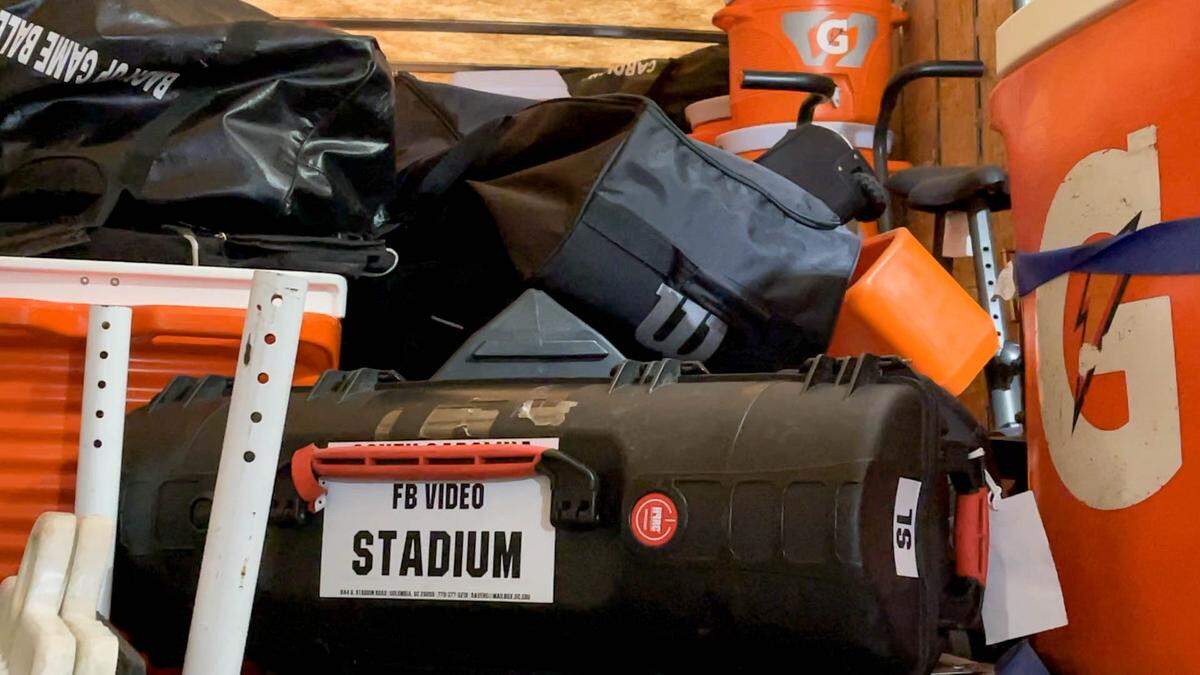
Finalizing Gamecocks’ preparations
There’s a general calmness to the scene despite the dizzying flurry of bodies whizzing by. It’s midway through the season, so those less-seasoned managers have their tasks mostly down.
Waters, Dubuy and Shuler are also there to answer any questions that need answered. After all, they’re not that far removed from their own student manager days.
Dubuy played football in high school before landing on the equipment staff as an undergrad at LSU through a roommate who worked in the football team’s video department.
Hayes’ father, Jackie, was a legendary head football coach at Dillon High School, so sticking close to the game when he was at Coastal Carolina was a natural transition.
Waters worked as a student equipment manager at Mississippi State for Sylvester Croom and where Beamer, coincidentally, was also on staff as an assistant coach. He then bounced between gigs with the New Orleans Saints and at Alabama. He’s now in his sixth season running the show at South Carolina.
“He’s been to every SEC visiting locker room,” Dubuy says of Waters. “So he knows how it works.”
The number of student assistants at USC fluctuates between roughly 12 and 20 people per season. It skews older as far as college kids go, Waters said, as most kids need a semester or two under their belts before they take on the massive time commitment.
The incentive is getting to be up close and personal with the football program daily. There’s also the added perk of a $1,000 scholarship that begins your first semester working with the team and rises in $1,000 increments each subsequent semester.
“You can have class from 8 to 10 on a Monday, and then what are you doing the rest of the day, right?” Dubuy explained as to why he got into equipment management as a student. “I mean, for me, LSU would practice in the afternoon, so I had class Monday through Friday, but it was like class from 8 to 10 (on Monday) and then Tuesday was like 11 to 1. What do you do with the rest of your day? It’s not like you’re studying all day. I just didn’t really have structure.”
Getting from Columbia to College Station
Most managers carry boxes and crates amid the swath of garnet and black that dances along the loading dock. One calls out, asking if safety R.J. Roderick’s helmet has been changed from a Riddell Speedflex to a Schutt F7. Others just stop by to shoot the breeze, even for just a moment.
“Who won that game?” Dubuy asks Waters, referencing the Appalachian State-Coastal Carolina game played the night before just up the road in Boone, North Carolina.
Waters informs him the then-No. 14 Chanticleers dropped their first game in almost three years. Hayes — a Coastal Carolina graduate — steps out of the doors to the facility and walks toward them.
“It’s ‘cause of those teal helmets,’ ” Dubuy jokes of the new lids Coastal Carolina employed that night. “... Should’ve worn the white ones.”
“I saw they were going to wear teal helmets,” Shuler, who’s admittedly superstitious, chimed in later. “And I said, ‘Game over.’ ”
Waters steps down the stairs on the right side of the loading dock and slips into a red Dodge Ram 1500 just to the side of South Carolina’s tractor-trailer.
His day is stalled for the time being as he heads for the airport for an 8:45 a.m. commercial flight to College Station.
Part of a three-person crew that will arrive at South Carolina’s team hotel ahead of time, Waters, Kim Fields — South Carolina’s assistant to the head coach and assistant director of operations — and USC director of nutrition/director of performance nutrition Kristin Coggin leave early to make preparations on the other side.
For Waters, that involves meeting the truck at the team hotel, hauling out the video equipment, white boards and other varying equipment to set up meeting rooms wherever the team stays. He’ll also get a head start on organizing the coaching staff’s rooms with whatever clothes they might need for game day.
“What’re we waiting on?” Waters asks before dipping out.
“The trainers’ stuff,” a voice from around the corner responds.
The tractor-trailer hauling South Carolina’s equipment peels out of the loading dock in Columbia around 2 p.m. It’ll take 16-plus hours for the truck that’s owned by a third party but outfitted by USC to make it to College Station.
Normally driver Terry Mayes would make the trip himself, but regulations only allow for one to drive for 11 hours within a 14-hour period that must include at least a 30-minute break.
On the shorter trips, Waters, Dubuy or Shuler will sometimes ride along in the passenger seat alongside Mayes. Each opted for the plane when it came to College Station.
“I rode with (the truck) to Tennessee,” Waters said, beginning to laugh. “But I wasn’t volunteering for that trip to A&M.”
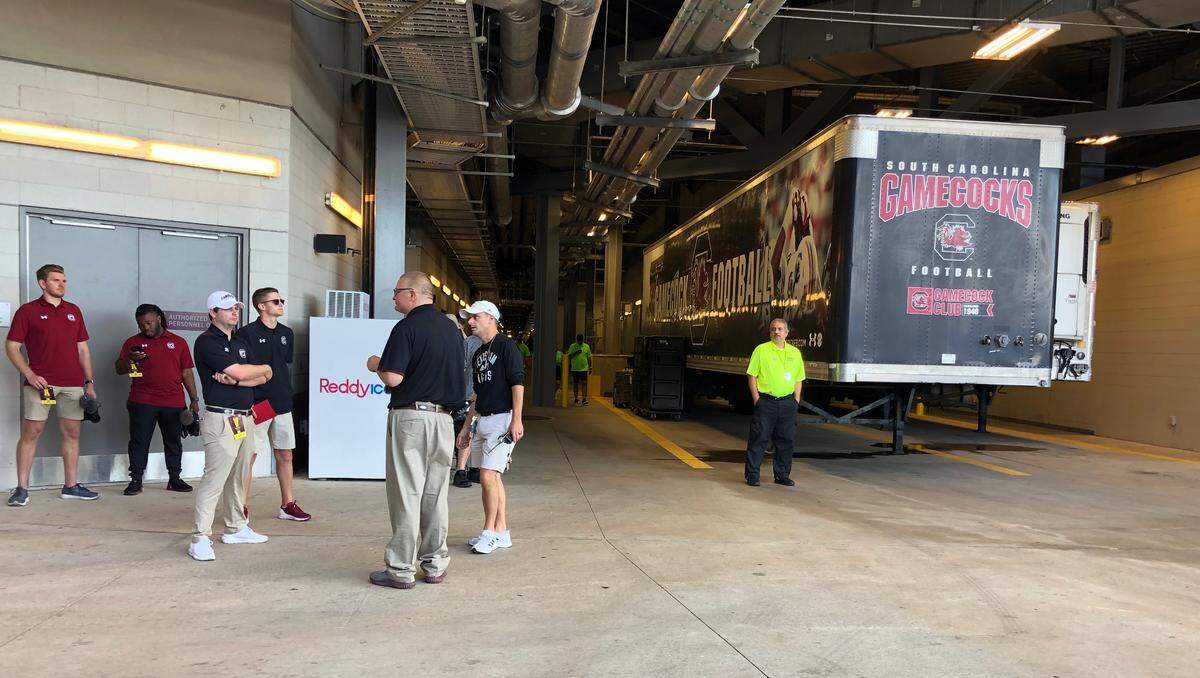
South Carolina arrives at Texas A&M
Dubuy stands in the hallway in the underbelly of Kyle Field donning a short-sleeve black South Carolina cage jacket and khaki shorts.
To his left, the tractor-trailer hauling South Carolina’s gear has been unloaded aside from a couple cases of water and Gatorade and a few scattered boxes.
The buses carrying the Gamecocks from the team hotel to the stadium pull up within seconds of the brief respite. A pair of event staffers stand by either side of the steel gates as an automatic system opens them up and the buses skirt onto the driveway built under the stadium.
A handful of garnet-and-black-clad fans cling to the black beams separating them from the team and scream at the players as they spill off their transports in waves.
“This is one of the best setups in the conference,” Dubuy said, stepping out from inside the locker room.
Kyle Field was renovated in recent years, making it one of the nicer, more updated facilities in the league.
Inside, South Carolina’s uniforms are ready to go. Cleats are set up for convenience. Helmets have decals and are painted properly. Shoulder pads are prepared as needed.
Over 1,100 miles away from the confines of Williams-Brice Stadium and the Long Family Football Operations Center, it’s just like home.
This story was originally published November 11, 2021 at 5:00 AM.