Ticket trends have South Carolina finding new ways to fill up Williams-Brice Stadium
South Carolina football coach Shane Beamer stopped a team meeting and took his Gamecocks for a walk.
Out the football operations building. Through Gamecock Park and across Bluff Road. Up the ramp and to the seats in Section 302 of the upper deck at Williams-Brice Stadium.
“That wasn’t easy to get up here, correct?” Beamer asked the players. “People pay money to come watch you guys play.”
Pointing to the field, he added, “I don’t want us to lose sight of the sacrifices that people make to come watch you guys play down there.”
Those sacrifices, the coach stressed, include fans buying tickets, making the often-long treks to their seats and then sometimes baking in the hot South Carolina sun. The motivational moment played out in a 3-minute, 10-second video posted to social media on Aug. 11.
Behind the scenes, the people and university departments charged with helping fill the Southeastern Conference’s eighth-largest football stadium have a unique perspective on Beamer’s message. Simply put, the way fans buy tickets to any sporting event is increasingly a moving target, even for a South Carolina fan base that’s regarded publicly for its passion and loyalty.
Colleges looking to fill seats in home football stadiums are no longer just competing with the allure of staying home for big-screen televisions and other comforts. The habits of ticket-buying spectators are changing — specifically, the popularity of buying season tickets has waned, and younger fans don’t always want to go to every game — and schools such as South Carolina are adjusting accordingly.
“I think that particularly with with college football, there’s been a steady decline (of season-ticket sales) for easily 15 years,” USC professor of sports and entertainment management Stephen Shapiro said. “Obviously, team to team is a little bit different and performance and other factors play a role in a case-by-case basis. But if you just look at the data, you’re gonna see a pretty steady decline over the last decade or so.”
USC season-ticket number overview
In 2005, South Carolina sold 62,618 football season tickets, according to data provided by the university. Last year, that figure reached 38,483 — a 38.5% decrease — though it did represent a bounce-back from the limited stadium capacity in 2020.
The years in between 2005 and 2021 saw a generally downward trajectory at South Carolina — in the mid- to upper-40s from 2009 to 2012; a more recent peak of 54,005 in 2014; followed by a steady decline since, with 2016 the last year above 50,000.
At least two other programs in the SEC are also seeing decreases in season-ticket sales. The State requested season-ticket data since 2010 from the 12 other public schools in the conference — Tennessee and LSU responded.
Both schools have seen ticket numbers decrease since the mid-2010s, albeit not as dramatic as South Carolina’s. Tennessee’s season-ticket sales peaked in 2016 at 73,116 and fell 28.5% to 52,236 in 2021. LSU’s sales reached 74,350 in 2014 and were down 10.3% to 66,654 last season.
For South Carolina, reaching the 62,000 mark again is an impossible mission. According to Eric Nichols, USC’s chief marketing officer, the season-ticket max is closer to 55,000 now.
That reduced ceiling for season tickets is, in part, due to Williams-Brice Stadium’s slightly smaller capacity — down from 80,250 to 77,559 after stadium renovations in 2020 — and from how visiting teams are allotted tickets.
“Our maximum that we can sell is about 55,000. So that’s the number we’ve always kept in our mind as what we’d like to get back to,” Nichols said. “We’re clearly not close to that right now.
“As we build the program back and build the fan base, it’ll become more of a target, but more of our emphasis right now is just focused on selling out in however way we get there. Combination of seasons, singles, and groups and students. We just want to sell out as many games as we can.”
Even still, season-ticket sales have only come close to 55,000 twice over the past 14 years — during the 2008 and 2014 seasons. South Carolina was coming off a 6-6 finish going into Steve Spurrier’s fourth season as coach and sold 54,347 season tickets for 2008. During Spurrier’s last full season as head coach in 2014 — coming off three consecutive 11-win years — South Carolina sold 54,005 season tickets.
Additionally, season-ticket sales haven’t hit the 50,000 mark since 2016, which was Will Muschamp’s first year as coach. Sales have declined every year since.
There is reason for optimism as the Beamer era enters Year 2. Season-ticket sales for the Gamecocks have surpassed last year and have reached 40,000, according to Lance Grantham, USC’s director of ticketing and customer relations. That total represents 9,500 to 10,000 or so individuals who each buy multiple tickets.
The 2020 limited-capacity season, where so many people couldn’t or just didn’t go to games, had a big impact on where the market is now, Grantham said.
“There were people who got out of the habit of buying tickets, got out of habit of buying season tickets for sure,” he said. “It shook up the foundation of what we had been doing for a number of years in a row. We’re looking to rebuild that.”
A new emphasis for ticket sales
One game at a time — it’s a popular refrain from coaches, and it’s fair to say that’s an emerging emphasis with how the University of South Carolina is trying to fill Williams-Brice Stadium.
USC wants to turn the increased enthusiasm that has been pumped into the fan base since Beamer’s arrival into single-game ticket sales.
“Season-ticket sales are fine, and they’ll will pass last year’s number. But it’s not on fire like I would have hoped to match that enthusiasm,” Nichols said. “It further cements our opinion or insight that that enthusiasm needs to translate into single-game sales to come to the ball games. I think they still are interested in the program; it just is not manifesting itself in the season tickets.”
Last year, there were 22,630 total single-game tickets sold during Beamer’s first season — the most since South Carolina started tracking those sales in 2009. Outside of 20,007 in single-game ticket sales in 2012, most years have been at or below 6,000 total.
Among the ways USC is pushing single-game sales:
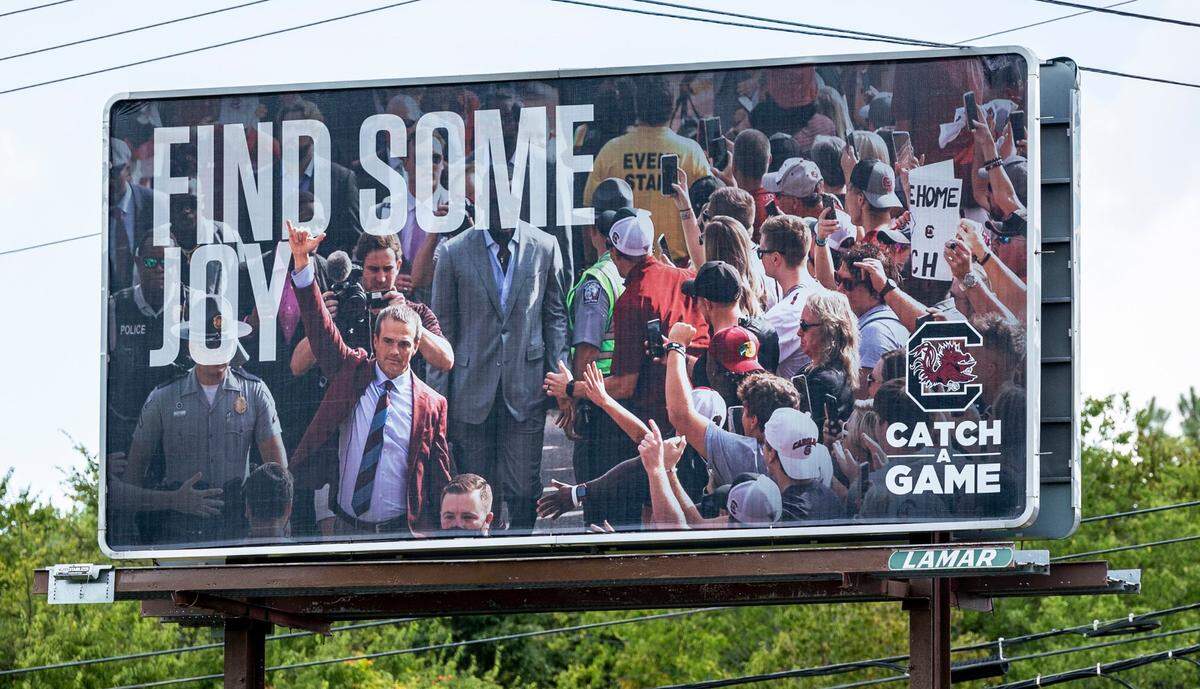
▪ South Carolina’s athletics department in March launched the “Catch A Game” marketing campaign — its purpose is pretty self-explanatory.
“Part of the strategy is to prioritize single-game ticket sales earlier in the process to promote both availability and for you to, quote unquote, ‘catch a game’ at least once a year no matter what the sport is,” Nichols said.
In the news release announcing the initiative, Nichols said, “While season tickets are still the lifeblood of our organization, not everyone has the time or resources to commit at that level.”
▪ USC in late June brought back the Gamecock Go Pass, an admission subscription option for all sports. Nichols called the Go Pass the “most economical” of the various ticket options South Carolina fans have. For $20 a month, fans can attend “all non-conference home football games and all home games for men’s and women’s basketball, baseball, softball, men’s and women’s soccer and volleyball,” according to a news release on the feature, with “the ability to secure a seat for all 2022 home conference football games starting at $15 each pending availability.”
▪ In one of the more interesting promotions, South Carolina began selling tickets through Costco stores across the state. The tickets are priced at two for $89.99, and are good for all regular-season home games excluding Georgia.
▪ More recently, USC offered a brief “flash sale” with tickets to the season opener against Georgia State discounted to $18 each, more than half off the regular price. The school also offers such promotions as Teacher Appreciation Day, where a ticket to the Oct. 22 game against Texas A&M is offered with a $40 discount.
Single-game tickets are vital in helping sell out stadiums, Grantham said, and they help recoup lost revenue from the dip in season-ticket sales.
“It’s incredibly important,” Grantham said. “If we’ve got any chance of a sellout, it’s gonna be because we have done a good job of selling single-game tickets across all methods.”
What about ticket prices?
Season tickets are back to normal prices for 2022 after being discounted in 2021 in honor of Beamer’s inaugural season. The 2021 season tickets all had a base cost of $320, the same price of tickets in 2010 when Beamer was first at South Carolina as an assistant.
This year, most season tickets range from $410 to $1,195 for seven home games, with that cost including seat donations.
Those seat fees — what a Gamecock Club member pays on top of ticket prices — were adopted by USC in 2008 as a way to boost revenue. The fees effectively doubled the price of tickets in a lot of areas of the stadium, Grantham said.
That first year, according to Grantham, the $7 million made from the seat donations helped USC borrow $250 million that would go toward construction of capital campaign endeavors over the next 10 years.
Nowadays, Shapiro said there’s a trend among fans to spend their money on premium seating for a few games, as opposed to season tickets elsewhere in the stadium.
“When you are trying to sell the one- or two-game experience, you might be able to sell a more premium experience,” Shapiro said. “So someone might not be able to afford club seats or seats that are better lower-deck seats for season tickets, but maybe they would be willing to do that for one game or two games. Maybe you can enhance the experience and therefore generate more revenue by a higher-price ticket for someone that’s not necessarily going to go to every game.”
USC is seeing variations of how folks are making a one-game commitment, Nichols said.
“A pattern that has changed is, people are still spending the same amount of money but they’re spending it on a more elaborate game, a more elaborate party,” Nichols said. “So instead of maybe buying season tickets previously in an upper-deck seat, they may use that money and apply it and go to just the Georgia game and buy tickets off the secondary market and have a big tailgate — and just make that just a bigger event for themselves..”
Renovations to Williams-Brice Stadium in 2020 opened several new premium-seating areas that are “for all intents and purposes sold out,” Nichols said.
Those options include access to climate-controlled club space, upgraded food and beverage options, and nicer bathrooms — and in some cases such things as covered seating, loge box seating or individual chair-back seats. The higher-end options include catered-food buffets, lounge areas with televisions, cellphone charging stations and free WiFi.
Single-game ticket prices for traditional seats are not as steep. The Georgia State and S.C. State games have a face value of $40 each. All of South Carolina’s home SEC games are $70 per ticket — except for the matchups with Tennessee and Georgia, which are $75 and $110, respectively.
While season-ticket sales are still the foundation for revenue generation, Shapiro said they aren’t quite the measuring stick they used to be. That’s as most season-ticket holder bases are aging, he said, with average age of those fans in their 50s or 60s.
“More recently, it’s much more difficult to get individuals to buy season tickets. ... Younger audiences aren’t as interested in going to every game,” Shapiro said. “So the thought is, can you make an experience, a one- or two-game experience, something that’s attractive to a younger audience so that you can still fill the stands without needing people to buy tickets to seven, eight games a year?”
USC football: Season ticket sales year by year
- 2005: 62,618
- 2006: 61,826
- 2007: 60,004
- 2008: 54,347
- 2009: 47,851
- 2010: 45,985
- 2011: 47,591
- 2012: 49,195
- 2013: 51,967
- 2014: 54,005
- 2015: 51,167
- 2016: 50,395
- 2017: 49,700
- 2018: 47,381
- 2019: 47,347
- 2020: 8,475 *COVID*
- 2021: 38,483
- 2022: 40,000-x
x=final number not yet determined
2021 USC home game attendance
Announced attendance, or tickets sold (with “tickets scanned,” or actual attendance, in parentheses). USC had two announced sellouts (UK and Clemson) in 2021; there were four sellouts in 2019 and two in 2018.
- Eastern Illinois: 64,868 (43,980)
- Kentucky: 77,559 (59,117)
- Troy: 60,686 (35,332)
- Vanderbilt: 64,695 (44,405)
- Florida: 70,131 (45,961)
- Auburn: 70,299 (49,241)
- Clemson: 79,897 (68,506)
This story was originally published August 25, 2022 at 9:00 AM.