
It’s Year 5 for Shane Beamer. How did previous USC coaches fare in same season?
South Carolina football coach Shane Beamer heads into the 2025 season in an unusual position for a South Carolina football coach.
He has reached his fifth season and goes into it without the pressure to do something big and without the pressure to win in order to hold onto his job. That’s not often been the case.
There are plenty of South Carolina coaches who went into Year 5 in considerably tighter spots. So what has the fifth season brought for the previous men who held the seat Beamer now occupies?
Will Muschamp, 2020
Muschamp went into his fifth year decidedly on the hot seat after a 4-8 campaign in 2019. The COVID pandemic left the team with an SEC-only schedule, and they lost a key swing game in the opener against Tennessee. The team showed some life with an upset of Auburn, but disheartening losses to LSU, Texas A&M and Ole Miss ended Muschamp’s year at 2-5. (USC went on to finish 2-8.)
Steve Spurrier, 2009
The Old Ball Coach had been solid in his first four years, but only with a few spectacular moments. His fifth team ripped out to a 6-2 start, including an upset of No. 4 Ole Miss, but struggled down much of the backstretch. The Gamecocks did top No. 15 Clemson to end the regular season, but had a poor offense (102nd in scoring) and closed with the disastrous PapaJohns.com Bowl loss to UConn. He lasted at USC through the middle of the 2015 season.
Lou Holtz, 2003
The second and third years of the Holtz era were the high points, and the fourth saw a dip below .500. The fifth season in 2003 was more of the same. A 5-3 start gave way to an 0-4 finish. The defense was not particularly strong, and an offense led by Dondrial Pinkins, Daccus Turman, Demetris Summers and Troy Williamson finished 82nd nationally in scoring. A second year with no bowl led to Holtz taking away the offensive coordinator role from his son, but he got one more season at the helm.
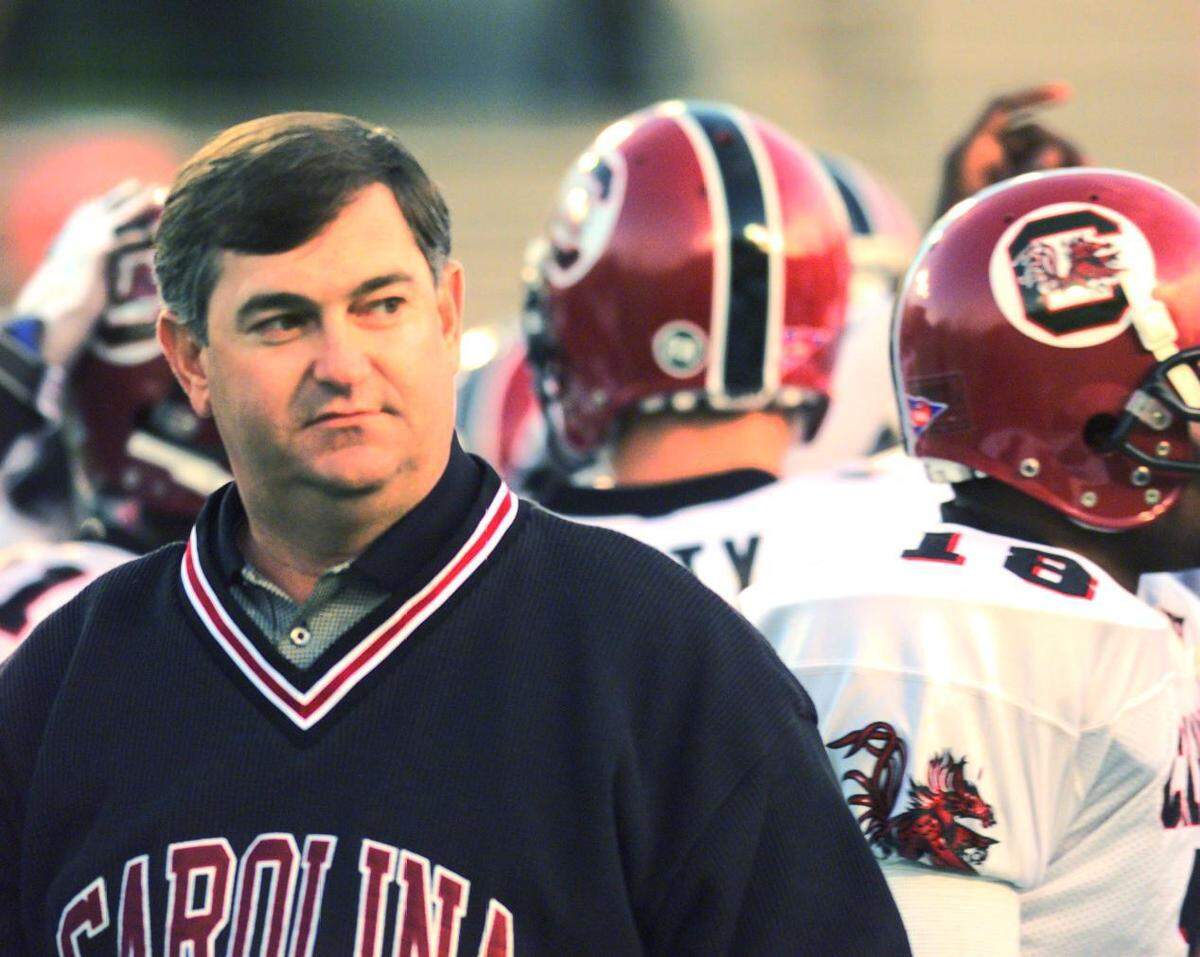
Brad Scott, 1998
Scott’s fifth year was when the wheels finally came off. He’d gone 22-22 his first four seasons with plenty of inconsistency. The year started with a 38-20 win against hapless Ball State, and the Gamecocks didn’t win again. Despite having name players like Anthony Wright, Troy Hambrick, Zola Davis and John Abraham, the Gamecocks lost by an average of 30-19 and went 1-10.
Sparky Woods, 1993
After starting his tenure with a pair of winning seasons, Woods entered Year 5 off a pair of losing campaigns. The program’s second year in the SEC started with an upset of No. 15 Georgia, but the Gamecocks only had one more conference win the rest of the way and a 16-13 loss to Clemson wrapped a 4-7 campaign, Woods’ last as USC coach.
Joe Morrison, 1987
This was the rare case of a coach being backed into a corner and delivering. After the famed 10-2 Black Magic team, Morrison delivered 5-6 and 3-6-2 campaigns in his third and fourth years. He’d just switched to a high-powered run-and-shoot offense and the defense completely locked in for 1987, allowing just 9.2 points per game. The Gamecocks went 8-4, with losses coming to the Nos. 1, 5, 6 and 13 teams in the AP poll, with three of those losses by 9 points or fewer. The 1988 season was his last as USC coach.
Jim Carlen, 1979
After starting his tenure with a pair of winning seasons, Carlen’s third and fourth years failed to reach that mark. Still, he had something he could turn to in Year 5: riding the George Rogers bus. The Big Duluth, Georgia native carried the ball 286 times for 1,548 yards, and Spencer Clark added 558 more. They didn’t throw it much, but the run game and a defense that allowed 15.1 points per game was enough to knock off Georgia 27-20, No. 17 Wake Forest 35-14 and No. 13 Clemson 13-9 on the way to an 8-4 record and trip to the Hall of Fame Classic. He led the program through the 1981 season.
Paul Dietzel, 1970
The follow-up to South Carolina’s lone conference title was not exactly a memorable one. The offense was relatively pass-heavy, relying on Tommy Suggs’ arm, but the defense slipped a good bit. The year opened with a 3-1-1 stretch and ended with a win at Clemson, but a five-game losing streak led to a 4-6-1 campaign. He coached the Gamecocks for four more seasons.
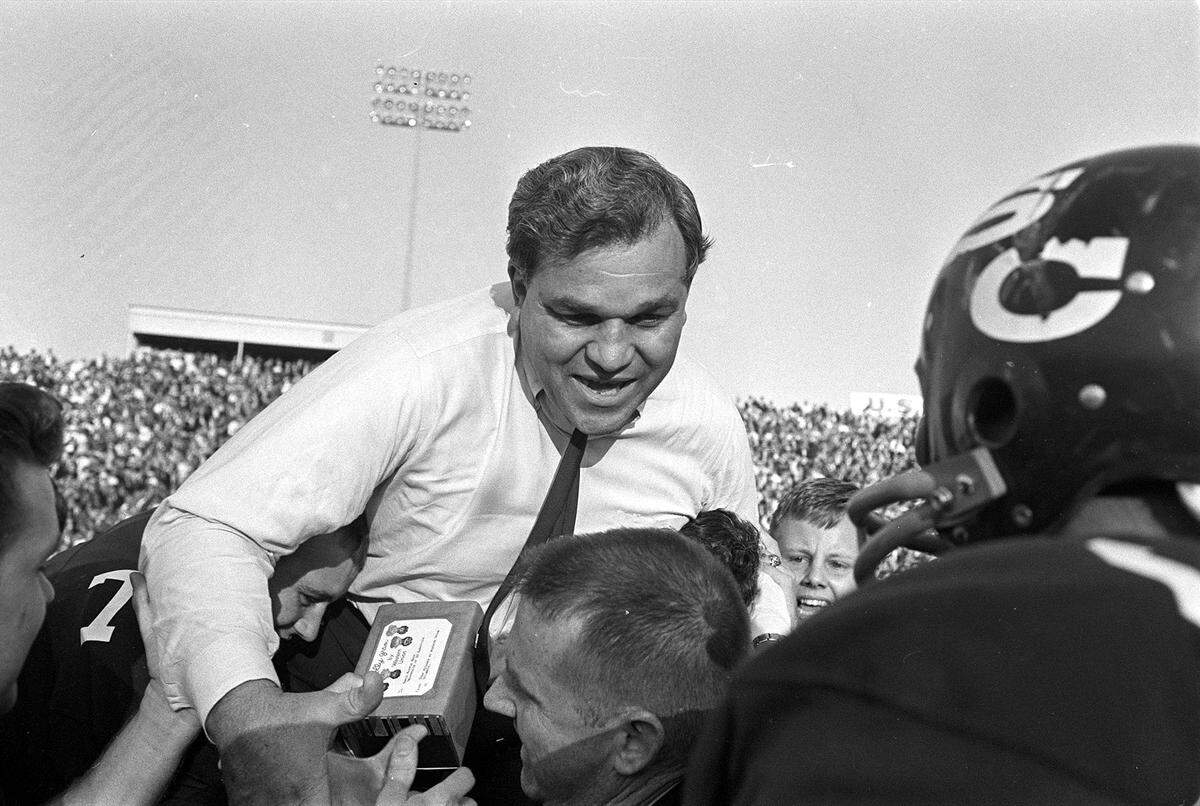
Marvin Bass, 1965
Bass delivered the best record of his tenure in his fifth year, but it ended up being his last. He’d had four losing seasons in his first four years, and made it to 5-5 in 1965. The team never managed a winning streak, but only lost in consecutive games once. The wins included N.C. State, Virginia and Clemson, and the offense was led by Mike Fair in one of the more pass-heavy attacks in the ACC. Bass then jumped to join the Montreal Beavers of the new Continental Football League. A year later, the ACC vacated South Carolina’s conference wins because of ineligible players, but the NCAA and school still count them in their records.
Warren Giese, 1960
Through his first four seasons, Giese had never led his team to a losing record and finished above .500 three times. That was not the case in Year 5. The team opened with three blowout losses in a row, and after topping UNC, it lost three more. A late push got the Gamecocks to 3-6-1, but it wasn’t enough to prevent him from being replaced and moved into a purely athletic director role.
Rex Enright, 1942 and 1950
Enright’s fifth season (1942) came the first fall after the United States had entered World War II. In those unstable times, he coached a team that went 1-7-1 against a mostly traditional schedule. Most of the rosters were likely patchwork, and the team averaged just 5.1 points per game. He coached the next year at Georgia Pre-Flight, served in the Navy for three years and then returned to USC.
His second tenure lasted 10 years. The second Year 5 for Enright (1950) saw a 3-4-2 record, including a tie that was the only blemish on Clemson’s record. The team bounced back across the next few years, with four consecutive seasons of .500 or better.
Billy Laval, 1932
Laval coached the Gamecocks to above .500 seasons his first four years in Columbia, and did the same in his fifth, going 5-4-2. Wins included the likes of Sewanee, The Citadel and Clemson. Across all 11 games, USC opponents only scored more than seven twice, but the Gamecocks only reached that mark four times.
Sol Metzger, 1924
The fifth year for Metzger was his last with the Gamecocks, but also the most successful. South Carolina went 7-3, allowing just 4.8 points per game with five shutouts. They beat Clemson 3-0 and Wake Forest 7-0, but took losses to Sewanee, Georgia and Furman.
This story was originally published May 14, 2025 at 7:00 AM.