Her dad, a USC pilot, died picking up Lou Holtz. Coach’s death stirred mixed emotions
It is rare that nostalgia surfaces out of thin air. It needs to be triggered, pulled out by some sense of another time — a scent or taste or face that unlocks thoughts of the past. Something that stirs up nostalgia most-acutely, though, is death.
To hear of someone’s passing is to formulate an obituary in your head, a rundown of every memory and moment your brain has associated with that person. It is story after story that often start with, “One time …”
When Lou Holtz died March 4 at age 89, nostalgia seemed to flood over millions, bringing to light forgotten stories about the legendary college football coach.
Shane Beamer remembered that his father, Frank, was in contention for the USC head coaching job, and then being flabbergasted to learn the Gamecocks hired Holtz. What came to the mind of former South Carolina QB Erik Kimrey was 19 Holtz-isms that he’s never forgotten — quips like, “Hey son, you are so slow if you got in a race with a pregnant lady…. You would come in third.”
But when Amy Martin heard that Holtz had died, her mind immediately drifted back to the wee hours of Dec. 20, 1999, when the voice on the other end of the phone said so succinctly, “It’s Sonny. His plane crashed. He’s gone.”
“I mean,” Martin told The State, “it’s words you’ll never forget.”
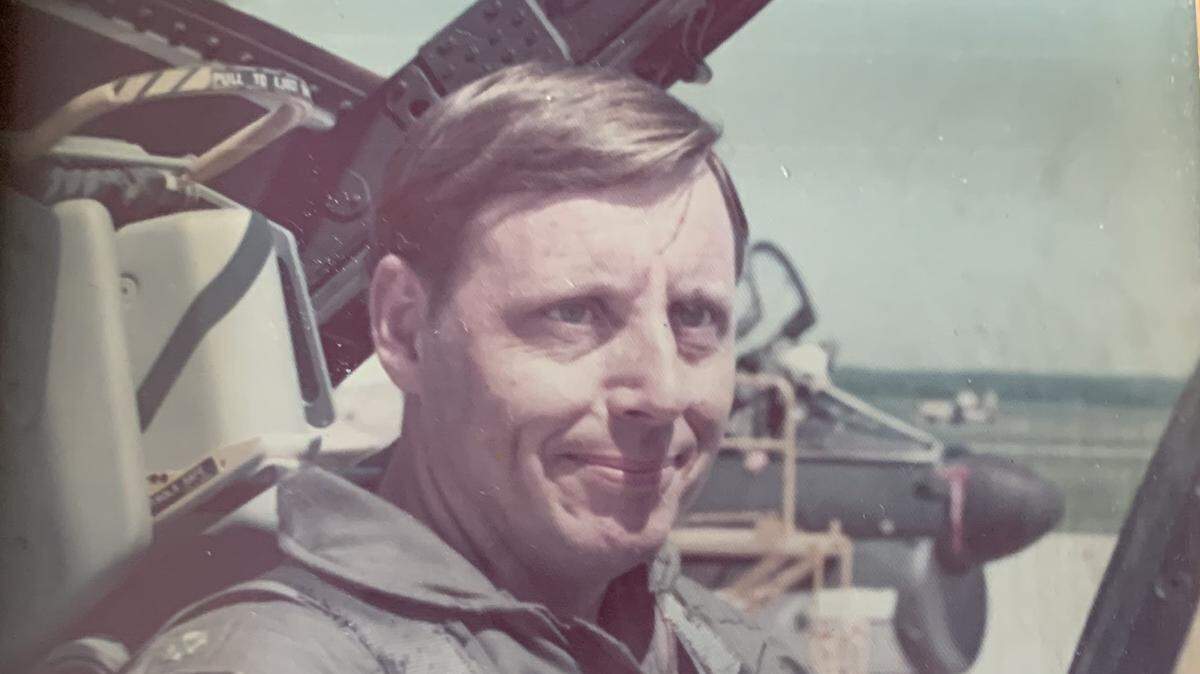
Hours earlier on that day in 1999, her father — pilot Dewey “Sonny” Foster — died in a plane crash near Beaufort while his co-pilot, 77-year-old Joe Baier, escaped without major injuries. It’s been over 26 years since that fateful night, and the ensuing week after, when it seemed like the entire world was less concerned about the man who died but, rather, Holtz, the man he was on his way to pick up.
Turning around a season, starting a new job
Holtz arrived at the Beaufort County Airport at 9:35 p.m. on Dec. 19, 1999, unaware that his aircraft was two-and-a-quarter miles away, lying upside down in a tidal basin.
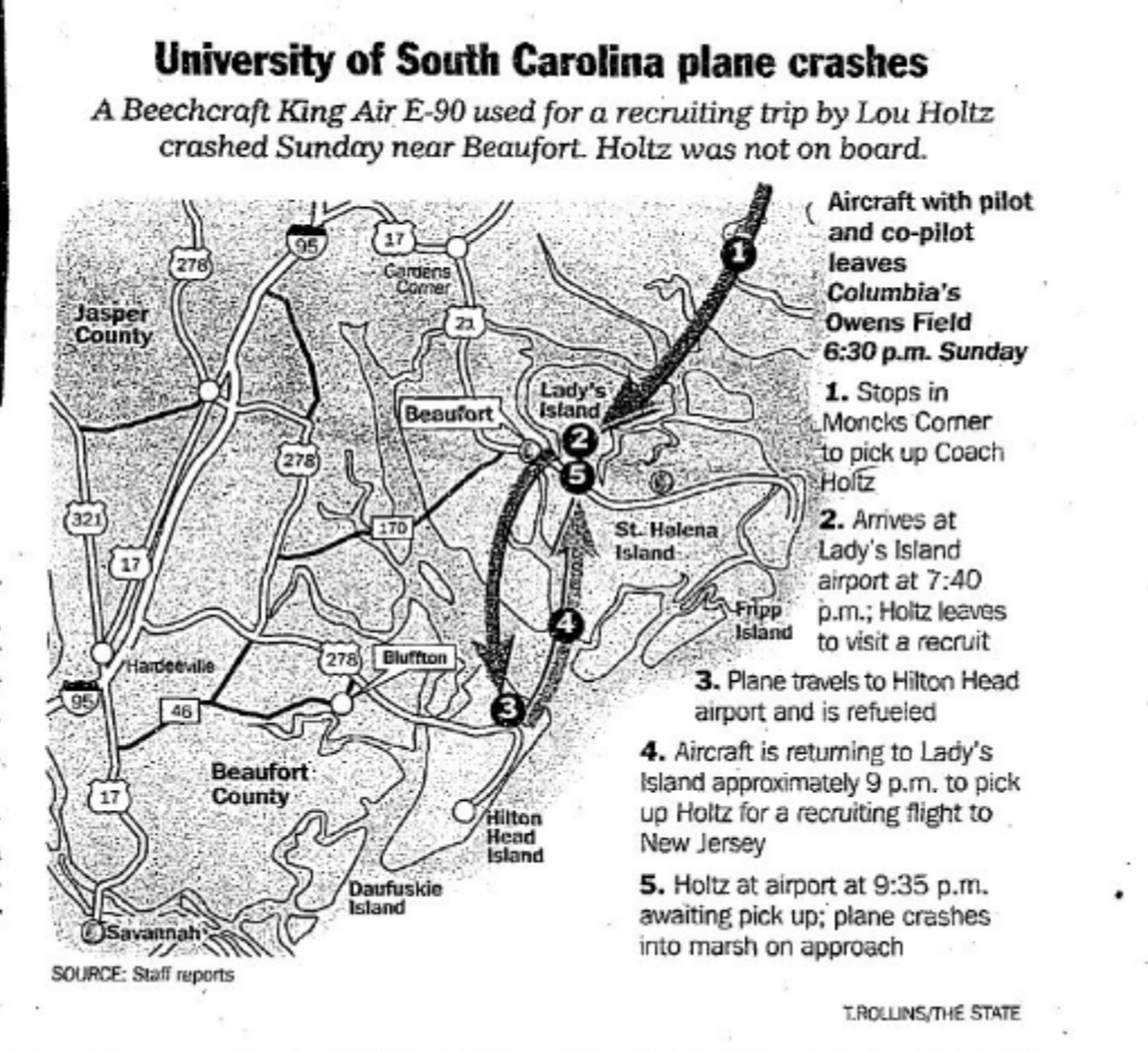
Earlier that day, Holtz was visiting a recruit in Moncks Corner before Foster and Baier picked him up in the athletic department’s 1976 Beechcraft King Air E-90 and flew him to the Beaufort County Airport.
The plane landed at 7:40 p.m., and Holtz met up with defensive coordinator Charlie Strong for an in-home visit with Battery Creek senior Donnell Washington, a 6-foot-5, 275-pound defensive lineman who signed with Clemson two months later.
The night was just getting started. Holtz was scheduled to fly directly from Beaufort to Morristown, New Jersey later that night and meet with a recruit the next morning.
Coming off an 0-11 season in his first year leading the Gamecocks, these nights were set up to feel like the most-tangible signs of hope for Holtz — or, at least, proof the then-62-year-old was doing all he could to turn USC football around.
For Foster, this was all part of a new gig. A former Eastern Airlines pilot who also spent time in the Air National Guard, retiring as a brigadier general in 1984, Foster continued flying privately in the 1990s, scratching his itch to be in the air while giving him enough free time to play tennis three to four times a week in the “Geezers” group at Forest Lake Country Club.
He flew for retired NASCAR driver Cale Yarborough for years before getting the USC gig — which wasn’t exactly a bucket-list job. Though he graduated from Carolina in 1955, he didn’t care much about Gamecock football.
“He just wanted to stay in an airplane,” Martin, who’s won five state titles coaching A.C. Flora’s tennis teams, said about her father.
The night the plane crashed
That night, after dropping Holtz off in Beaufort, Foster and Baier jetted over to Hilton Head for fuel up (the fueling service had already closed in Beaufort) ahead of their three-hour flight to New Jersey. At 8:23 p.m., 13 minutes before the crash, the seven-seat turboprop lifted off for the Beaufort County Airport to pick up Holtz.
Six minutes into the flight, according to the National Transportation Safety Board’s investigation, Baier checked in with the Beaufort Marine Corps Air Station, asking for a weather update.
“Yeah. We’re showing, uh, trace layer 500 feet,” the controller responded. “Overcast at 1200. Visibility, five miles with mist. … About the same you had, uh, for the last approach.”
The plane was cleared for landing while it was six miles out. Soon after, they broke out of the clouds at 900 feet, descending to the minimum descent altitude of 580 feet. The sky over the Lowcountry was overcast. It was 55 degrees outside and there was a light drizzle, depending on where you were. Airplanes have four miles of visibility, but it’s hard to see four feet in pitch-black darkness.
Foster, the pilot, was “on the instruments,” aviation code for flying the plane by relying on the gauges (altimeter, airspeed, etc.), common practice for flights at night or in bad weather. Baier, the 77-year-old Air Force veteran of World War II and Vietnam who had been flying Gamecock coaches dating back to Jim Carlen, was looking outside the aircraft, scanning for any signs of the horizon. The co-pilot saw some lights in the distance, but certainly not a 3,400-foot runway.
At this point, it is believed Baier tried to activate the runway lighting. Though the NTSB investigation did not mention the pilot-activated lighting, former NTSB Chairman Robert Sumwalt, a Columbia native who graduated from USC in 1979 and knew both Foster and Baier, reviewed the report, concluding its “pretty obvious” that played a part in the crash.
“It’s an easy error to make,” Sumwalt told The State. “You’re going into a black-hole airport over a swamp and it’s dark.”
No control tower, no automatic landing strip lights
The Beaufort County Airport — like many small strips with no control tower — does not have automatic lights. It’s on the pilots to activate the runway lights by tuning to the airport's frequency and hitting the button on their push-to-talk microphone in quick succession. Seven clicks for intense lights. Five for medium intensity. Three for low. Once activated, the lights remain on for 15 minutes.
According to NTSB transcripts, the common traffic advisory frequency (CTAF)— which pilots tuned to in order to speak with the air-traffic controller — picked up seven evenly-spaced clicks with no modulation. Twenty-one seconds later, the controller informed Foster and Baier they were two miles away from the runway, slightly left of course.
Then there were four more clicks. Evenly spaced. No modulation. There was no fifth click. It’s likely that as Baier was about to hit the button — either one or three more times — before realizing the transmitter was still on the CTAF (123.0), instead of the Beaufort County Airport’s approach-control frequency (132.85). He looked back inside the cockpit to check the radios, perhaps to tune into the airport’s frequency, when he said heard a thump.
In the complete darkness, and amid his Baier’s struggle with his transmitter and radio frequency, Foster and Baier didn’t realize the aircraft had dropped below the minimum descent altitude.
“What I suspect happened is,” said Sumwalt, “Joe’s clicking the radio and then Sonny probably said, ‘Hey Joe, what are you doing? You’re on the wrong frequency. You need to be on this frequency.’ And that’s when it diverted Sonny’s attention away from the flight instruments.”
The landing gear collided into a salt marsh, separating on impact. As the plane hit the ground, the NTSB investigation found, it slid 128 feet, colliding with a berm that sent it airborne. The plane spun, cartwheeling until it became inverted, eventually settling 987 feet from initial impact.
Foster died from a broken neck, an autopsy would later show. His last words were, “Get me out of here.”
Baier, meanwhile, was able to unbuckle his seatbelt and escape the plane through the main cabin door. He saw folks walking toward the crash site with flashlights, and trudged through the water and mud of the marsh. When he reached them, he said the pilot was still in the wreckage. Then he looked back, only to see his plane on fire.
Holtz arrived at the airport an hour later, asking a security guard if he’d seen a tan King Air. Three days later, Holtz resumed recruiting in a new plane being flown by someone else.
The overshadowing of a death
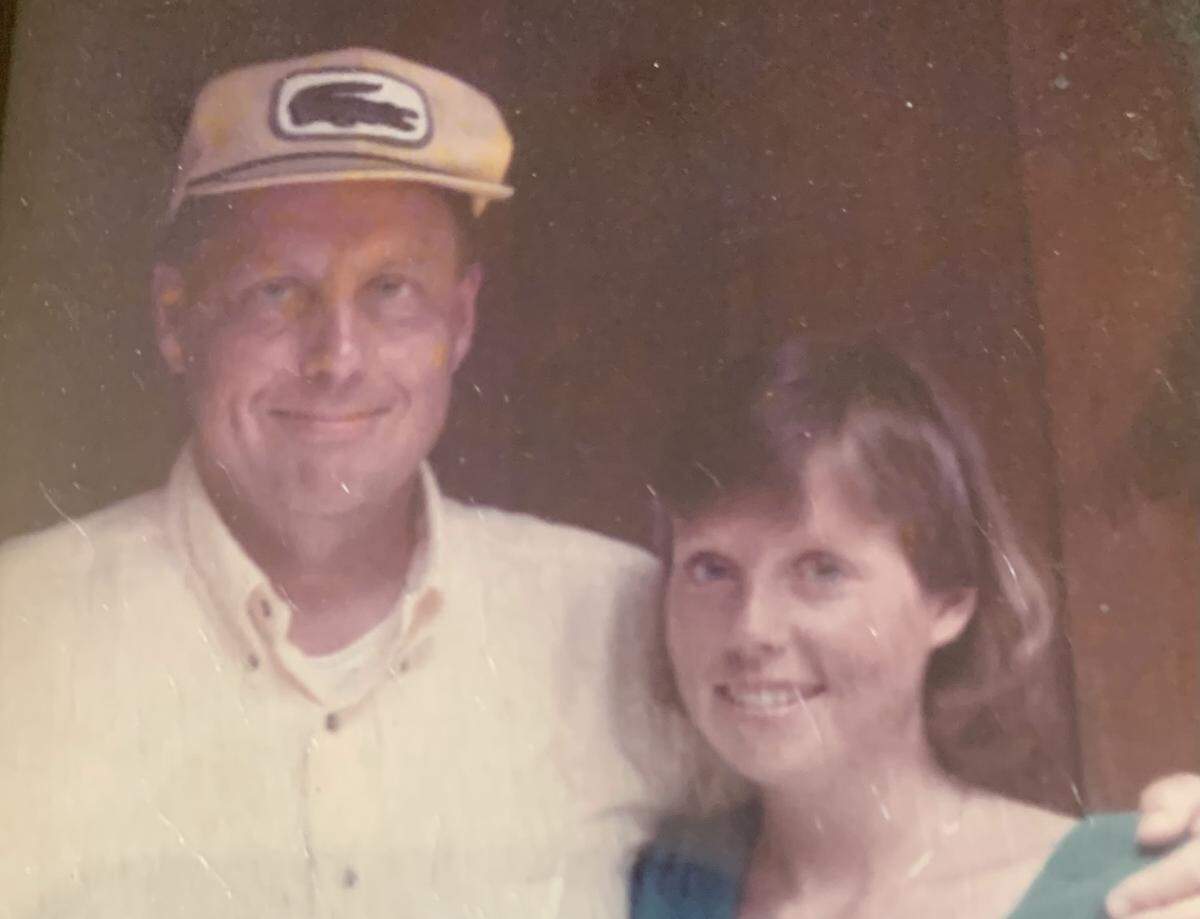
When Holtz’s died earlier this month, Martin heard his name, which meant the neurons in her brain got to firing, conjuring up memories of her father. Some were positive. For as tragic as the end was, she’ll always think about how much joy flying brought him.
Before those thoughts came, she thought about the plane crash that took her father’s life. Nostalgia’s sting.
“You know, Lou lived a long, healthy (life). He was a great coach, leader and got 89 great years,” Martin said. “It was just interesting that ... I’m trying to find the right words here. It’s just, you know, the last time you had any association with somebody, and then that’s when your mind goes straight back to that.”
Martin never harbored any ill will toward Holtz, but one might understand if there was resentment in the fact that her father’s death became a tale within Holtz’s life.
The State’s Page 1 newspaper story on the plane crash began: “A pilot on his way to pick up USC football coach Lou Holtz died Sunday night…”
That same day, The Associated Press wrote about Holtz’s grief-filled year, which included the death of his mother, his wife receiving surgery to remove what was thought to be cancerous glands, and his son, Skip, becoming seriously ill with a hard-to-diagnose virus.
And, well, now he was almost on a plane that crashed.
“Evidently, from what I understand, that was all over the nation,” Martin said. “That Lou dodged a bullet. Well, not really. Lou wasn’t anywhere near (the crash). He was on the passenger list to be picked up, but he wasn’t on the plane.”
.jpg "usc09 lou holtz ec8(2).jpg")
A day after the crash, Holtz gave an interview saying that he flew with Foster about 30 times and grew close, which Martin finds hard to believe. She estimates her father piloted Holtz “a couple times, at best.”
“This is not about me,” Holtz said a day after the crash. “It’s about losing a friend, but at the same time I feel very blessed. I feel very lucky. At Christmas, I have a lot to be thankful for. Right now, my heart goes out to Mrs. Foster and the family.”
That Christmas was a blur for Martin. Little memories pop up. Seeing her father’s Wilson tennis bag sitting next to the door, packed up for his Tuesday match with the “Geezers.” Watching the family dog, Perry, eyeing the door, waiting for Foster to come through. There were the eight HoneyBaked Hams that kind folks brought over, six of which they donated to the Oliver Gospel Mission. There was a fruitcake Foster had ordered for himself — it arrived the day of his funeral.
Martin’s daughters were 5 and 6 at the time, that age where the days leading up to Christmas are filled with this magical anticipation. Martin struggled to think much about presents or Santa. She was too busy calling funeral homes and waking up two mornings in a row wondering why a TV station was camped outside her house.
“I was just trying to make sure my mom was putting one foot in front of the other,” Martin said.
Sonny Foster’s crash leads to NTSB changes
A graveside service was held on the afternoon of Dec. 22 — just over 66 hours after the crash — at Greenlawn Memorial Park in Columbia.
South Carolina Athletic Director Mike McGee, who had, just days before, knocked on Jerry Foster’s door just past midnight and broke the news that her husband was gone, was in attendance. As were Yarborough and Holtz, whose presence deepened the sense that Foster’s death had been overshadowed by the men he flew.
“The notoriety of those two,” Martin said, “kind of gave him the second chair at his own funeral.”
Yarborough offered his condolences to the family that afternoon. Holtz didn’t speak with them that day, but later sent cards letting the family know they were in his thoughts. Little by little, the healing process began.
Early relief came when Foster’s autopsy showed he died of a broken neck, giving them consolation knowing he died before flames engulfed the plane. The grieving process continued that summer, when Martin met with Baier over lunch, talking with the last person to see her father alive.
“He had huge survivor’s guilt,” Martin said. “I don’t know if he took that to his grave. But I tried to tell him, ‘It was a horrific accident. It is what it is.’”
Baier died in 2003 at the age of 80. He’s buried in the same cemetery as Foster.
She talked with Sumwalt, the former NTSB chairman who told her Foster’s fatal crash sparked him to improve how airlines trained their pilots on working together to monitor aircraft systems (like altitude). The FAA amended its advisories. And during his 15-year career at the NTSB, he regulated airlines to train their pilots on what is now called “pilot monitoring.”
“All of that was sparked by that accident,” Sumwalt said.
About a decade after the crash, Martin was driving home from a tennis tournament in Hilton Head when she diverted. She got out, walked around the marsh her father’s plane hit, putting together the picture of what happened that night.
Then in 2022, journalist Connor Tapp published a story detailing the crash while explaining in plain language how the pilot-activated-lighting frequency error partly resulted in the crash.
“That article gave me a huge sense of peace,” Martin said. “That answered a lot of questions for me.”
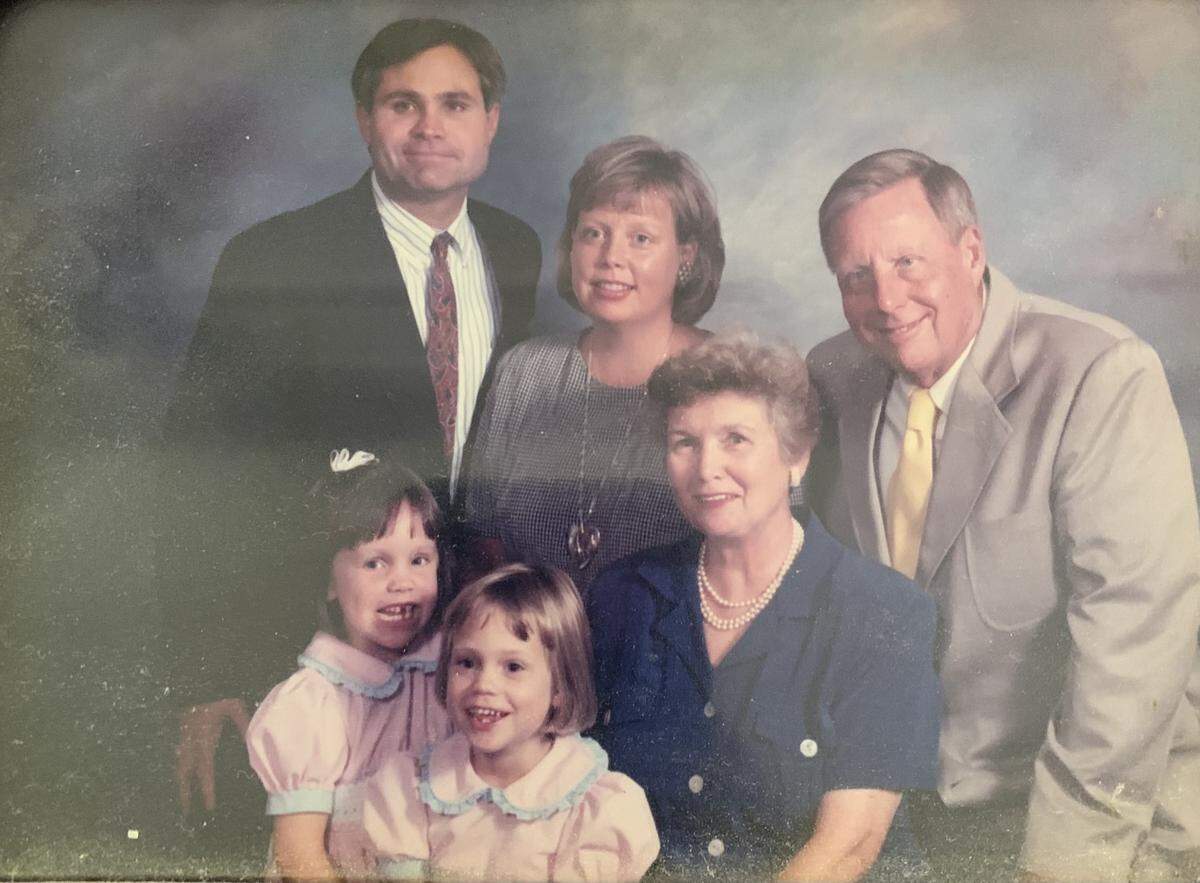
But the deeper questions were answered just over nine months after the crash. Martin and her husband, Edwin, welcomed their first boy into the world, Edwin Martin III. As one life ended, another began.
“(He) looks like my dad. Acts like my dad,” Martin said. “There is life after death.”
This story was originally published March 13, 2026 at 7:00 AM.