Why those who know Lamont Paris best say he was ‘destined’ to be a head coach
There are 4.3 seconds left in overtime when Chattanooga guard David Jean-Baptiste receives the inbounds pass. With no wasted steps, Jean-Baptiste darts past the red-and-blue Southern Conference logo at the center of the court, zigs toward his left, and with two Furman defenders draping him, he unleashes a Hail Mary 3-pointer.
The shot could be the final heave of the graduate student’s college career. Instead, it’s the shot that gives No. 1 seed Chattanooga the SoCon title game win over No. 2 Furman — the shot that sends the Mocs to the NCAA tournament. Pandemonium ensues. TV cameras pan to stunned faces in the Asheville, North Carolina, crowd, hands clasped over mouths.
Across the Atlantic Ocean — in Spain — Nigel Hayes watches the scene unfold on his TV screen. The FC Barcelona basketball player can’t help but chuckle. He isn’t watching the Mocs as much as he’s watching their head coach on the sideline, Lamont Paris, the man South Carolina would hire as its 33rd head coach two weeks later.
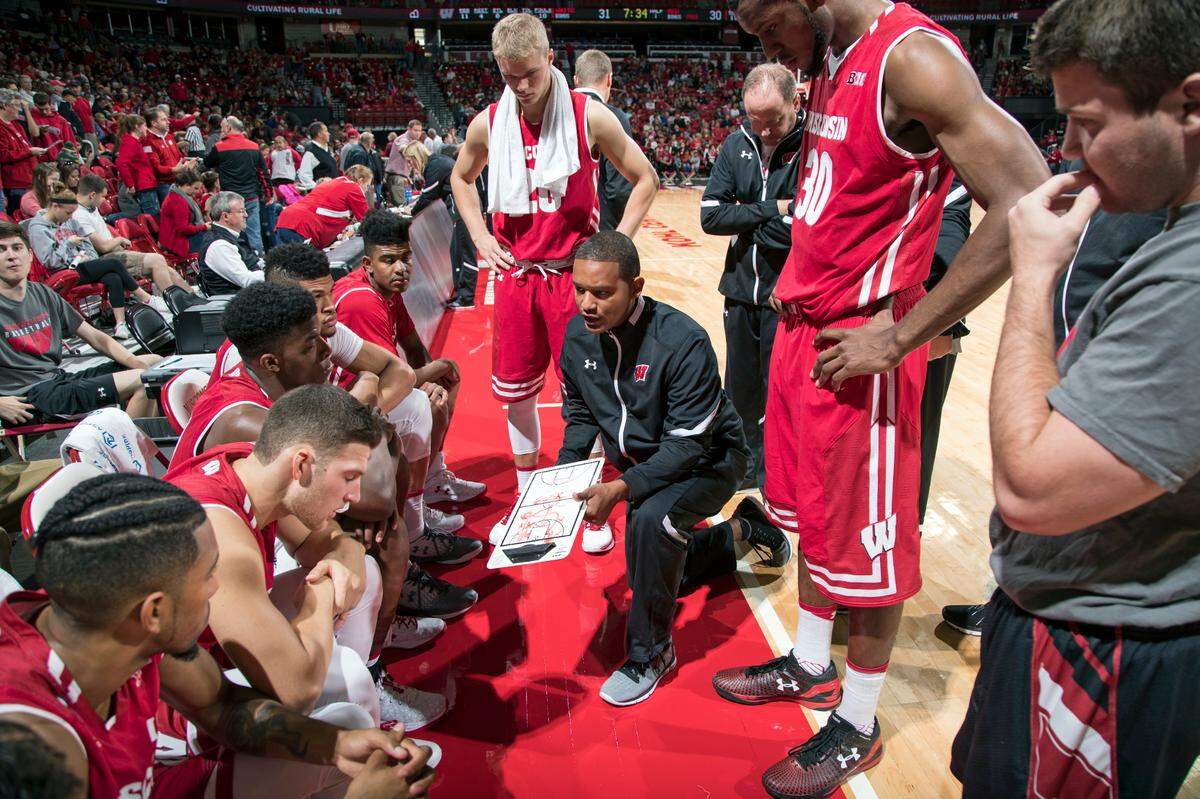
Paris was an assistant coach at Wisconsin when Hayes starred for the Badgers from 2013-17. He still remembers Paris calling him after he accepted the head coaching job at Chattanooga in 2017 and telling him, “Nigel, once I get some things in motion, I get my recruits, I can establish my culture, I think we could really do some things here.”
Five years later, Hayes is watching Paris’ team seal a bid for the NCAA tournament. Amid all the court-storming chaos, he sees that Paris is cool and collected. His players are dog-piling at one end of the court, ripping their jerseys off — Paris is lightly jogging behind them, taking in the moment. Hayes would make fun of Paris for it afterward.
“He had a nice little cool jog trot,” Hayes told The State, laughing. “He didn’t want to seem too excited about it. And I was like, ‘Aw man, look at L.P. being all calm and stuff!’ ”
Of course, that’s just who L.P. is. Quietly confident. Smooth and charismatic, with a touch of endearing Midwestern dorkiness. Those who knew him best at Wisconsin weren’t surprised to see him turn Chattanooga into a winner, and they won’t be surprised if he does the same in Columbia. He’s the kind of coach players love to play for, whose mentors have long viewed as a star in waiting.
The USC administration clearly sees those same traits in him. The hiring of Paris marks a conscious shift in direction and style from 10-year coach Frank Martin, whom USC fired after the 2021-22 season. Martin rubbed some portions of the fan base the wrong way with his old-school, tough-love approach that sometimes included yelling and cursing at players during games. Paris is the opposite. He’s new school. A player’s coach. He saves his yelling for practice.
A self-described lover of life and a jokester, the 47-year-old Findlay, Ohio, native is known to get his players laughing — or rolling their eyes — at his impressions of Charles Barkley, Avery Johnson and Morgan Freeman. In moments of stress, Paris likes to cut the tension by yelling, “Just plaaaaaaaaay!” During practice, he’s never been afraid to get on the court and body up players five or six inches taller than him. Paris has a comforting aura, a way of putting players and people at ease.
“There’s not a room he hasn’t walked into where, when he left, people said, ‘He brought air in here,’ ” retired Wisconsin head coach Bo Ryan told The State. “He makes people feel better when you’re around him.”
When the Hall of Fame Badgers coach hired Paris as an assistant in 2010, he saw many of the same qualities in Paris that he once saw in assistants Tony Bennett and Greg Gard. Bennett has since gone on to build a powerhouse and win a national title as the head coach at Virginia, and Gard took the reins from Ryan at Wisconsin when he retired in 2015.
In hiring Paris on March 21 — two weeks after Jean-Baptiste’s overtime stunner — South Carolina staked its claim to the next branch of Ryan’s illustrious coaching tree.
At least, that’s the hope.
Athletics director Ray Tanner and the USC athletics department took a calculated gamble when they replaced Martin with Paris. Though Martin had fallen out of favor with the fan base in recent years due to a lack of NCAA tournament appearances, he still left the program as its third-winningest coach and took USC to new heights with a Final Four run in 2017.
During USC’s coaching search, Ryan called Tanner and vouched for his former assistant, telling Tanner that Paris was on a path to stardom, that he’s ready to take the next step at an SEC school after building Chattanooga into an NCAA tournament team in five years. Ryan, 74, told The State that he had similar conversations with other schools and that if South Carolina hadn’t hired Paris, another program “would’ve scooped him up.”
“He was just destined,” Ryan said of Paris. “I could see it from Day One.”
Early days at Wisconsin
Greg Gard first met Paris on the recruiting trail.
At the time, Paris was an assistant at Akron, where he coached from 2005-10. He and Gard kept bumping into each other on the high school circuit, and they started sitting together and exchanging stories, striking up a friendship in the process. Gard could see himself in Paris and could relate to the blue-collar path Paris was taking through the coaching world. He could see the hunger Paris had, how relentless he was in recruiting.
The assistant coaches would commiserate about their time grinding through the Division III ranks. Paris got his coaching start at his alma mater, the D-III College of Wooster in Ohio, in 1997 before moving on to D-III school DePauw and D-II school IUP. Gard started coaching under Ryan at D-III school Wisconsin-Platteville in 1993 before following Ryan to Milwaukee, then to the Badgers.
Gard still remembers the day Ryan walked into his office at Wisconsin in 2010 and told him they needed to hire a new assistant.
“He goes, ‘What are we gonna do?’ ” Gard told The State. “And I just said, ‘I got our guy.’ And I Googled Akron’s staff and pulled him up and said, ‘Here, Lamont’s the guy.’ ”
Four prospective assistants interviewed for the position, and Paris blew them all away. Ryan saw the same traits in Paris that Gard saw: a grinder, a teacher, a stickler for details, someone who worked his way up the ranks.
“He played at a Division III school, and that’s where we pay our own way, where we do it for the love of the game,” Ryan said. “I knew his affection for the game of basketball, which had nothing to do with dollars or cents. It was for the love of the game.
“I know that term is used a lot, but with Lamont, I could see it in his eyes and the way he expressed himself. And I’ve never looked back after hiring him.”
Wisconsin’s coach from 2001-15, Ryan built a program founded on discipline and fundamentals. Under Ryan, the Badgers played a slower-paced brand of basketball with an emphasis on moving the ball, limiting turnovers and stifling teams defensively.
Paris was both a philosophical and cultural fit. Though the program was structured on routine, Ryan allowed his assistants the latitude to work with every position group and to put their own stamp on practices.
.jpg "Gard_Paris_Sweet16_Practice_160324 (2).jpg")
Forward Keaton Nankivil was a senior on the first Wisconsin team Paris coached, and he remembers how quickly Paris won over the senior class, how he stepped into practice, walked onto the court and started posting up the team’s big men without any kind of padding or protection.
“It was the first coaching shift to any of our staff that we experienced in our four years, and he just jumped right in and made it his own,” Nankivil told The State. “It was the enthusiasm and just the willingness to put his spin on something that had been so traditional, and we were like, ‘Oh, here’s a different energy. That’s nice. That’s fun.’ ”
Paris made such an impression on Nankivil that he’s continued to follow the coach from afar long after his playing career ended. He watched Chattanooga’s NCAA tournament game against Illinois this March, when the No. 13 seed Mocs led the No. 4 seed Illini for almost the entirety of the contest before falling by one point in the game’s final seconds.
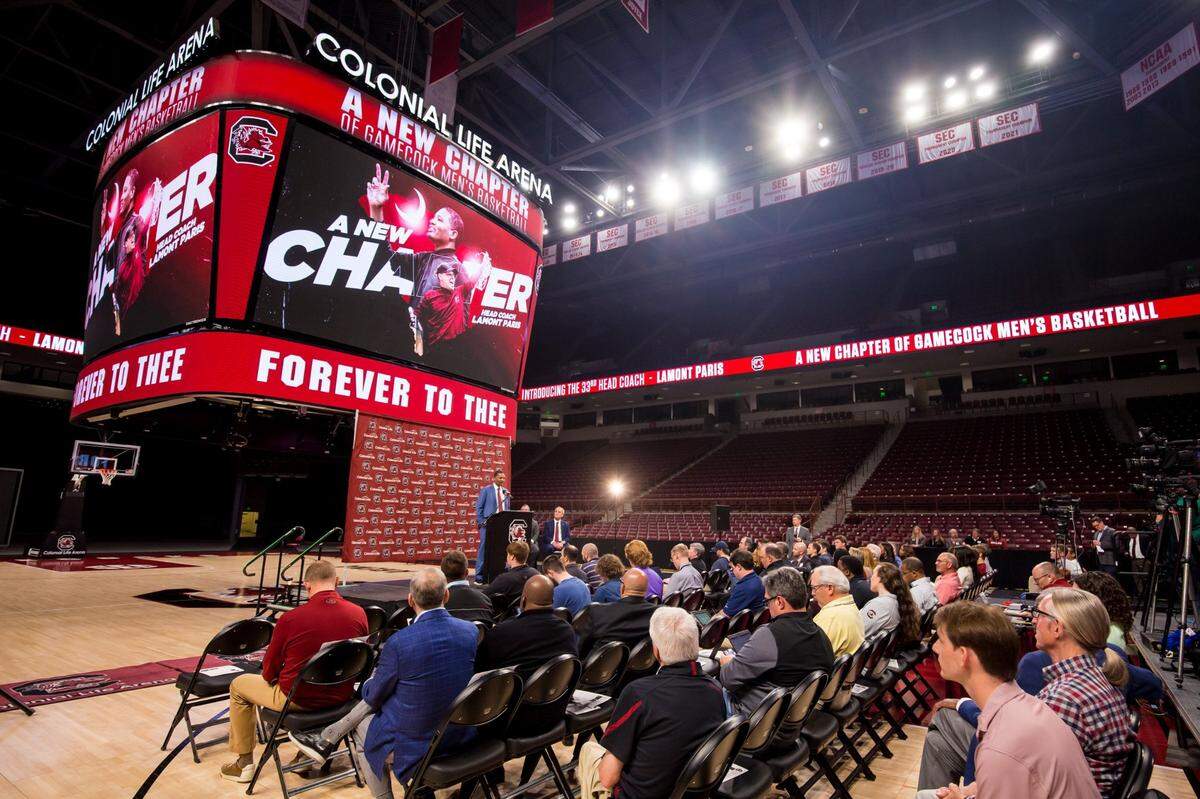
Nankivil texted Paris after that loss to tell him how proud he was to have played for him and to be part of his journey. Days later, Paris referenced that exact text message in his introductory press conference at South Carolina, saying how much it meant to him.
“Coach P is one of the most high-character people that I came across in my career,” Nankivil said. “I think that alone — him making that effort in a press conference — is really illustrative of the bigger picture.
“I saw in that press conference, he’s just a human being, there’s no pretense about him at all. He relates to young people. He also relates to middle-aged people. He relates to everybody because he’s just a good human being through and through.”
Gard came to know just how good of a human being Paris is during their time together as assistants. He remembers how Paris was there for him in October 2015 after Gard’s father, Glen Gard, died from brain cancer. Gard recalls the emotional conversations they had, the support he shared. Paris lost his father, a former Marine, earlier in life. He could relate to the grief Gard felt.
After Ryan retired and Gard took the helm, he named Paris his top assistant.
“And then, ironically, in between my first and second years as head coach, his mom passed away,” Gard said. “And we went down to Findlay, Ohio, and went to the services and everything, and it just went way beyond basketball in terms of our relationship. I have three kids. When he was here, they were younger, and they kind of always looked up to him like an uncle. He was hanging around the house.
“He’s just a really great personality, can talk to anybody, can relate to anybody, a really good teacher of the game. I think that comes from the people he’s been around and how he’s grown through the profession, so I’m really, really happy for him.”
What’s next for USC
For a large swath of millennials, the Call of Duty video game “Zombies” mode is iconic. It’s the game kids would play for hours after school, teaming up with friends to try to survive against wave after wave of increasingly powerful creatures.
Nigel Hayes and his sister were playing the game in their Ohio home when Bo Ryan and Lamont Paris walked through their door for a recruiting visit. It was in that moment that Paris showed Ryan just how adept a recruiter he is.
The plan was to divide and conquer. Ryan stepped out on the porch with Hayes’ mother and talked to her about what Wisconsin had to offer, and Paris stepped into Hayes’ bedroom, picked up a controller and started fighting zombies alongside him.
A commitment from Hayes — one of the best players on Ryan’s winningest Wisconsin team — would soon follow. The Hayes family was enamored with Paris, later hosting him for a stomach-stuffing home-cooked meal and playing him in a game of dominoes at a subsequent visit at Ryan’s house.
Most importantly, Nigel and Paris clicked. In Paris, Hayes saw someone he could relate to, someone who came from a similar background as an Ohio native and as a Black man. At South Carolina, Paris will be the first Black head coach the men’s basketball program has ever had, something he talked about with pride during his introduction.
“It was always good and comforting to see a Black face and talk to someone,” Hayes said of Paris. “I don’t know how much you know about Wisconsin, or if you’ve ever been there, but there’s a lot of white people there at the University of Wisconsin.
“From a player’s perspective, when you’re away from home, it’s just — there’s no good or bad to it — people like to be around people that look like them, have the same cultural upbringing. And what it was for us was to be able to be around an older Black man but still young enough to understand the things we grew up on, the music that we listen to, the jokes that we get, the comedians we watch, the food we eat, the way we talk.”
Regardless of race, Paris has always had a knack for connecting with younger people. Hayes and Nankivil both described Paris as a bridge between the players and the rest of the coaching staff during his time at Wisconsin, someone who could soften the blow after a rough practice or could serve as a sounding board for players to vent to. Whether he cracked a joke or impersonated a celebrity or simply said, “Just plaaaaaaay,” Paris found ways to loosen players up.
That ability will be as important as ever for Paris as he works to build his first team with the Gamecocks. The new coach will have an uphill climb. Since his hiring, six players have entered the transfer portal and veteran Keyshawn Bryant declared for the NBA draft. USC has already lost last season’s entire starting five — and then some.
Time will tell if Paris and his recently completed staff will be able to field a competitive roster and whether Paris’ recruiting chops will translate to the SEC. But Paris has at least made a positive impression on the team’s two signees, Zachary Davis and Daniel Hankins-Sanford, who originally signed with Martin’s regime but reaffirmed their commitments with Paris.
“The vibe that I picked up from him when we first shook hands, it was just like, ‘OK, I’m cool,’ ” Davis told The State. “I’m comfortable with him. And we just started talking. He made jokes. He made me laugh. If you can make me laugh, then you’re good.”
Jokes are great. But can Paris win at South Carolina?
That’s the risk USC took when it hired a coach with five years of head coaching experience and a career 87-72 (.542) record. After two consecutive losing seasons to begin his Chattanooga tenure, Paris’ teams steadily improved in each of the last three years before this year’s team (27-8, 14-4 SoCon) earned a bid to the Big Dance. That kind of progression is what Tanner and the USC administration are hoping to see in Columbia, and for his part, Paris hasn’t shied away from the expectation of reaching NCAA tournaments.
“The barriers that stand between winning — there aren’t a ton here,” Paris said. “I know we’ve been in nine NCAA tournaments in school history. I’d like to add to that. That’s my objective. I’d like to add at a fast rate. I don’t think it’s a six-year project.
“Playing in the NCAA tournament, it’s why I do this. It’s why guys come to practice. It’s why they wake up early. It’s why they run hills. It’s why they lift weights. It’s why they do community service. It’s why they go to classes. It’s why they make sacrifices, why they don’t have the social life that someone else does. It’s why they do all the things they do.”
In many ways, Paris’ journey to Columbia mirrors football coach Shane Beamer’s. Both arrived at USC as young, seemingly ascending coaches who’d drawn praise for the way they recruit, treat players and build team culture. While Beamer learned under winning head coaches like Steve Spurrier, Kirby Smart and Lincoln Riley, Paris spent his formative coaching years absorbing wisdom from Ryan and Gard during multiple Sweet 16 and Final Four runs.
Beamer made similar promises as Paris — and faced similar questions about his experience — when he was hired as head football coach in December 2020. Beamer said on the day he was introduced that he thought USC had everything it needed to create a winning program, and he went on to exceed expectations in Year 1 with a 7-6 season and a Duke’s Mayo Bowl victory.
With Paris, the Gamecocks aim to replicate that formula, to identify a winning head coach early in his career. The people who know Paris best believe USC found the right man.
“He’s just one of those special guys that don’t come along every day,” Ryan told The State. “And Frank Martin’s a good friend of mine. He’s a good man, a good coach, but I understand the coaching profession. When things happen, you try to make the best of what’s next.”
And for South Carolina men’s basketball, Lamont Paris is what’s next.
This story was originally published April 22, 2022 at 5:00 AM.