Aliyah Boston worked hard to transform her body. The journey is worth celebrating
Aliyah Boston gazed into a mirror on the Carolina Coliseum weight room’s wall.
The then-freshman didn’t like what she saw. That wasn’t the body of a professional basketball player looking back at her. She worried in particular about the lack of definition in her arms.
Boston had been working with South Carolina performance coach Molly Binetti, but impatience was winning the day.
“Molly, I don’t see my arms changing,” a frustrated Boston said. “I don’t see this happening.”
“We’re only three or four months in,” Binetti told her. “I don’t know how you’re gonna see it all happen at once.”
Binetti’s vision, and Boston’s performance, flourished. The 6-foot-5 star’s evolution to national Player of the Year contender has only been told in bits and pieces, including a very public, and uneasy, moment when her weight loss was discussed in a TV interview.
The fuller story is both a shining example of the growing investment in women’s sports strength and conditioning programs — and a reminder that the emotional strain caused by lingering societal perception about how women’s bodies should look can run deep, even for the fittest and most successful.
“It doesn’t even matter how much you weigh,” Boston told The State. “People could be like, ‘Oh, she’s too light. She needs to put weight on.’ There’s never a perfect number. But I think it also shows the fact (that) I was able to drop 23 pounds, and now you can see it. You can see the change.”
Evolving perceptions around women’s strength training
Suzanne Woolston Bossert’s memories around offseason conditioning with the Gamecocks women’s basketball team from 1978-80 center around the Weems Baskin Track, running sprints and recording times under head coach Pam Parsons.
During Woolston Bossert’s two seasons at South Carolina, the women’s basketball team worked out in and around the Blatt Physical Education Center. The men’s team spent its time at the Rex Enright Athletic Center — commonly referred to as the Roundhouse, which was demolished in 2013.
Woolston Bossert remembered the thrill of women having full scholarships and flying to games, the result of the passage of Title IX in 1972. This June marks the 50th anniversary of Title IX. For athletes, the legislation meant equitable opportunities for men and women with participation, scholarships and such things as equipment, game scheduling, facilities and travel.
“We were absolutely not treated the same as the men’s basketball players at the time,” she said. “But we were beginning to be taken seriously, and those early first steps were important.”
In the weight room, there was a primary focus on Nautilus machines, a resistance cable machine developed in the 1970s.
Getting athletes off such machines was an essential piece in developing women’s strength and conditioning programs, veteran strength coach and researcher Meg Stone said.
A lack of education kept women from being encouraged to lift free weights. Women were discouraged from various exercises, Stone said, because of the fear some movements could hinder their ability to later give birth. Another myth was that pole vaulting could hurt women’s hips.
Stone, an Olympic discus thrower from Scotland, said she saw stigmas start to dissipate after Title IX’s passage and that women were frequently working with free weights by the time she began her career as a strength coach at the University of Arizona in 1984.
“All those myths have been debunked, thank goodness,” she said.
Strength training evolution at USC
When Malissa Martin was hired as the head trainer for all South Carolina women’s varsity sports in 1983, strength training was still geared primarily to men’s sports. Women in sports agree that football played a large role in spearheading strength and conditioning programs in all of college athletics.
Much of the emphasis on strength training for USC women’s basketball started throughout Nancy Wilson’s tenure from 1984-97, Martin recalled.
“If your bread and butter is being rewarded by winning games, and you realize you’re not as strong as the person coming to visit your school to play, you’ve got to do something,” Martin said. “I think it was the coaches’ movement saying, ‘Hey, we need this.’ ”
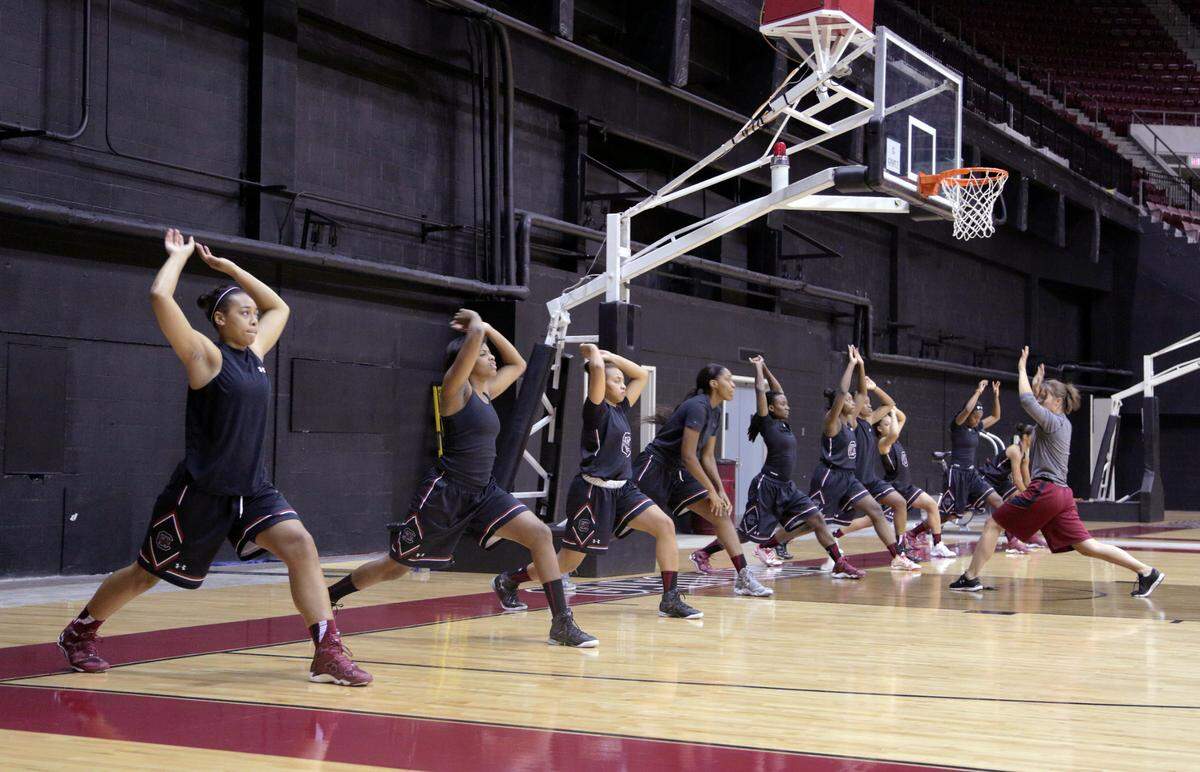
The women’s basketball team started working out in the weight room at Williams-Brice Stadium during the 1980s — the program’s first move away from the Blatt P.E. Center.
Strength training became more of a science for women’s sports from the 1980s through the 2000s, according to Martin.
“We had to be careful on squatting, we had to be careful in powerlifting,” Martin said. “We learned a lot. … Could we require certain things with women, the same things we did with men? Now we can. We might have to change the body a little bit in the stance or in the way we have the machine, but we can do the same things.”
Before the 2015-16 season, South Carolina women’s basketball shared a strength and conditioning coach with other women’s programs, including volleyball and tennis. The school hired performance coach Katie Fowler solely for women’s basketball in July 2015 — just a few months after head coach Dawn Staley’s first Final Four run with the Gamecocks.
Binetti, who was hired by USC in 2018, described a more holistic view of development for women in sports today.
“There are obviously more resources poured into it on the basketball level as opposed to some of the smaller sports,” Binetti said. “But as a whole, on the women’s side, there’s been a lot of evolution in the perception of it in college sports. It’s not just college sports, but I think young women all the way from middle school, high school (and) through the pros.”
Today, South Carolina lists a dedicated strength and conditioning coach for four of its 11 women’s varsity sports — Binetti for women’s basketball, Katelyn Woolfolk for both women’s volleyball and softball, and USC director of sports performance Billy Anderson for women’s golf.
Anderson, who oversees the performance staffs for all Gamecocks sports except football, also works with baseball and men’s golf.
Four of the eight men’s varsity sports list a dedicated strength and conditioning coach. South Carolina men’s basketball employs strength and conditioning coach Scott Greenawalt.
The Gamecocks’ football program has the largest strength and conditioning staff for a single sport, listing head strength and conditioning coach Luke Day and four assistants for a roster that exceeds 100 student-athletes.
Because strength training originated predominantly in men’s sports, strength was seen as “this really masculine thing,” Binetti said. Some women feared becoming “bulky.” It’s something she has to address with young women coming into her program.
For Binetti, meeting each athlete where she is in her own strength journey is key to her work as a performance coach. Placing emphasis on the value of strength and conditioning has helped in her work to change attitudes toward what a woman’s body can accomplish athletically.
“I think the earlier they’re exposed to really solid training, coaches that provide a safe space for them to explore their bodies, training and what that means for them, the healthier that perception becomes,” she said.
Aliyah Boston’s transformation
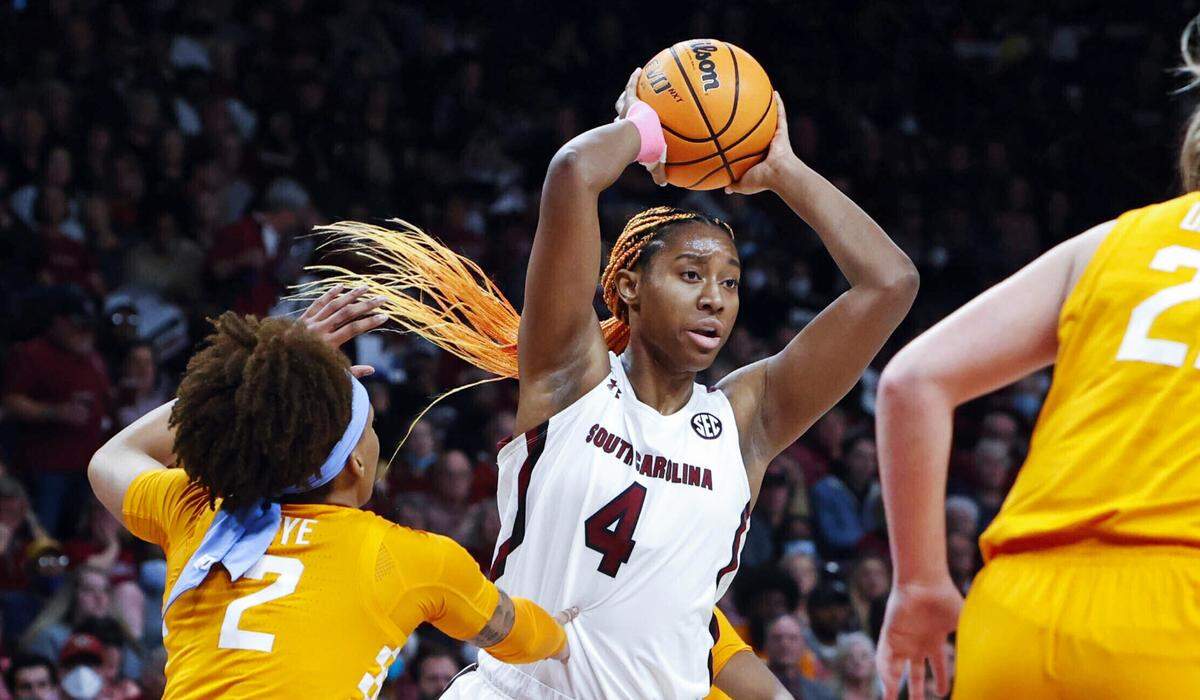
Aliyah Boston lifted weights before she came to South Carolina, but the consistency within the Gamecocks’ strength and conditioning program was new to her.
By her sophomore year of college, Boston started to hone in on losing weight, though it wasn’t an easy adjustment. Before she adapted to what she and Binetti call “pro habits,” Boston was in the mindset that she wouldn’t need to watch what she ate because she worked out.
Prioritizing nutrition over indulgence paid dividends.
“I’ve learned I am not everybody else,” Boston said. “I cannot just eat everything. There are some people that could really just go to Chick-fil-A every day, have no issues and still come down the court and be successful. You know what? I’m happy for those people. But me, I’m not one of those.”
Staley knows Boston has a sweet tooth, but she has watched her star player practice moderation.
Staley remembers handing Boston a container of cookies on a plane trip, watching as she took a couple and shared the rest with her teammates. After team meals, Boston doesn’t take extra food back home, eating a “normal-sized plate,” Staley said.
“She’s on a routine,” Staley told The State. “I know she’s thinking about, ‘What else can I give up and add to what I’m already doing? Because this is the type of success that I’ve wanted.’ ”
Boston’s routine extends past team meals and gamedays. When she goes with friends to Chick-fil-A, she often leaves her wallet at home.
“If you don’t have any money, (you) can’t buy anything,” Boston said. “Stores will not sell.”
Nutrition is often the toughest challenge with college athletes, Binetti said. Boston’s change in eating habits was important.
“Not just the transformation or body — obviously, I love that, and it’s something I nerd out on — but ultimately (it) comes down to she’s playing the best basketball of her career,” Binetti said. “I was there as a guide, but I think the most impressive part is her ability to have the discipline to stay with the process and really see that pay off.”
This offseason, Boston bettered her ¾-court sprint from 3.44 to 3.03 seconds and improved her vertical jump by 4 inches.
Staley remembers the Gamecocks’ 2011-12 NCAA tournament run as a lesson learned about the importance of conditioning. She says she vividly remembers feeling tired by mid-March. “If we’re tired, our players are tired..”
That season spearheaded the dedication to strength and conditioning within her program.
“That’s the edge we’ve tried to create in nutrition, performance, strength and conditioning,” Staley said. “It’s a big thing.”
Body image and public opinion
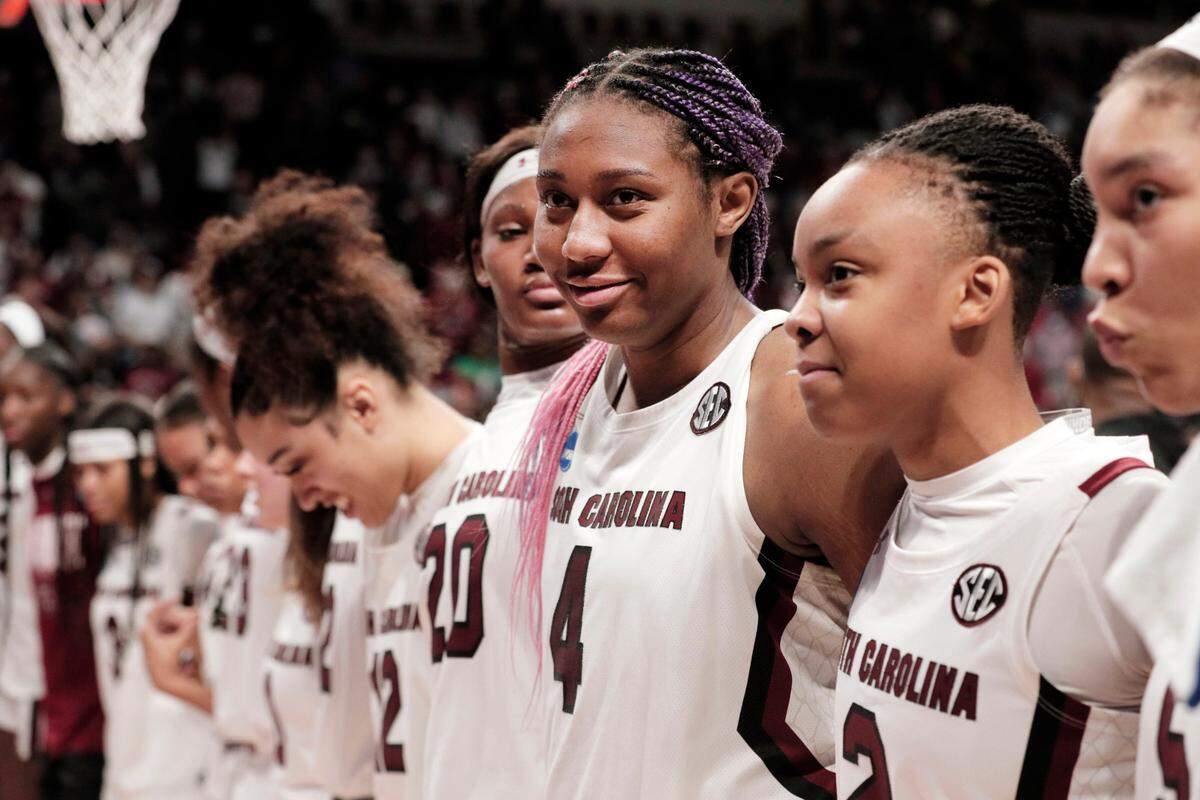
Boston was taken aback at first when Staley announced her star’s 23-pound weight loss on the SEC Network in October. She took comfort in the fact her actual weight wasn’t broadcast.
“It wasn’t about like, the number’s crazy — just 23 pounds — but I feel like girls are looked at a certain way,” Boston said. “Like for guys, when you think of their weight, you look up a guys’ roster for any team and they have 6-10, 250 pounds. It’s like, ‘Hey, that’s normal. That’s what we look at.’ ”
“But if you post a girl and her weight, some people would be like, ‘Oh, she needs to lose weight. This is not OK. How is she gonna make it down the court?’ I feel like it’s looked at completely different.”
USC doesn’t list weights on the rosters for any women’s sports, even though the WNBA and USA Basketball do.
The Gamecocks women’s basketball program last listed player weights in the 1978-79 media guide — 43 seasons ago. But the change flew under the radar, as Woolston Bossert said she had no memory of a discussion around weights on the roster.
Listing weights on college rosters isn’t a good idea, according to Caroline Silby, a sports psychologist specializing in the development of young female athletes.
Silby cited research identifying 40 physical and psychological factors impacting sport performance. Though weight is one factor, it can be emphasized too much, she said.
“Hopefully, (not listing weights is) pushing back on the notion that there is an ideal body type for sport success and that this ideal can be defined by height and weight of an athlete,” Silby said in an email.
Boston didn’t come to South Carolina thinking about her weight as much as finding the right body composition for her frame and becoming a better player.
She worked for two years before the most obvious change occurred ahead of the 2021-22 season. Just before her junior year, Boston met with Binetti. They looked at her progress pictures, side-by-side evidence of undeniable change. Thinner face. Flatter stomach. And the newly defined arms? Check that box, too.
Boston was proud. And excited.
Binetti wanted to share the pictures to social media, but decided against it, instead saying on Twitter: “Wish it was socially acceptable to show progress pics for female athletes without it being sexualized or receiving inappropriate comments…because her progress is truly remarkable. Proud of you AB … version 3.0 is a force to be reckoned with.”
Boston said she’s hopeful there will be a point where more women feel comfortable posting such progress pictures.
“A lot of it has to do with not looking for societal confirmations about yourself,” Boston said. “It’s easy for me to say we need to stop judging people, but I feel like there’s a part of each of us inside that looks for that confirmation.”
Boston’s secret? Finding the affirmation within herself.
When she started to lose weight, Boston made a deal with her mother, Cleone: If she reached a point of contentment in her weight loss journey, she would get her bellybutton pierced.
In August, Boston got the piercing. Her mom isn’t a fan of it, Boston says, but the symbolism stands. She’s happy with her body.

This story was originally published March 19, 2022 at 12:11 PM.