How projected NCAA 1-seeds stack up with South Carolina as tournament time nears
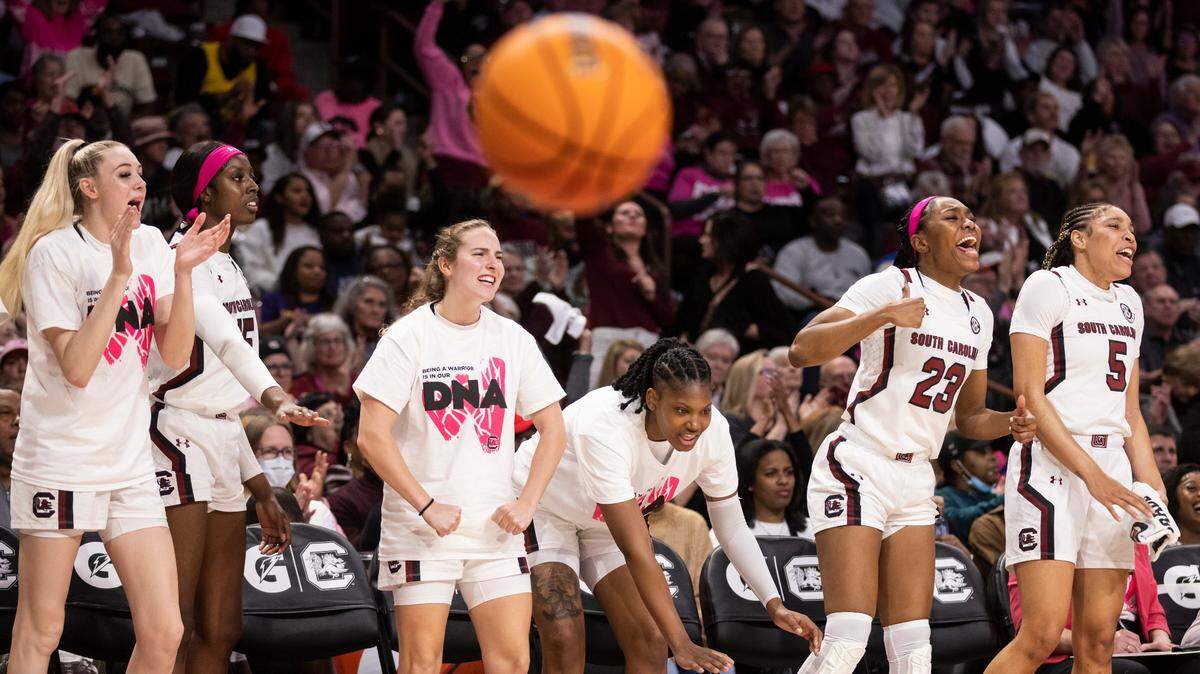
No. 1 South Carolina looks virtually unbeatable in the midst of a 31-game winning streak.
The Gamecocks’ punctuating win against then-No. 3 LSU made USC the last remaining undefeated women’s basketball team in the country.
South Carolina (25-0, 12-0 SEC) sits at No. 1 in the NET rankings and is 5-0 against ranked opponents. Two of those wins came against teams that are also projected as 1-seeds in the 2023 NCAA tournament. Those projections were announced Thursday, with the Gamecocks coming in as the No. 1 overall seed for March Madness.
USC has trailed by double-digits in two of its games this season, rallying to secure victories in both.
South Carolina’s separated itself from the rest of the field and has seen some of the best teams the country has to offer, but other squads have put together strong resumes and are projected as 1-seeds alongside the Gamecocks.
The tournament’s Sweet Sixteen and Elite Eight rounds will be played in two locations this season — Greenville and Seattle — and the Final Four is in Dallas. South Carolina is one of the two No. 1 seeds currently slotted for the Greenville region, with Indiana being the other.
Selection Sunday is on March 12 at 8 p.m on ESPN. The first and second rounds are March 17-20.
Here’s a look at the other three projected No. 1 seeds for the NCAA women’s college basketball tournament:
Indiana
SEED SUMMARY: No. 2 overall, Greenville region (23-1, 13-1 Big Ten)
Indiana is the only 1-seed the Gamecocks have yet to face. It lost to UConn in the Sweet Sixteen last season, but has taken a step forward this year under head coach Teri Moren.
Moren is in her ninth season with the team and has gotten IU to the NCAA tournament four times. The furthest they’ve gone under Moren is the Elite Eight.
The Hoosiers hold a 23-1 record on the season. Its lone loss came in conference play, when it dropped a game against Michigan State.
Indiana’s beaten seven ranked opponents this season, four of which were in the top 10 at the time of those games.
Mackenzie Holmes is having a strong season for the Hoosiers with a 22.1-point per game average. That mark makes her the sixth-leading scorer in the country. She also leads the team in rebounds and blocks.
Outside shooting is a factor in IU’s success. Freshman guard Yarden Garzon has the nation’s third-highest 3-point percentage, shooting long balls at a 49.1% clip. Junior guard Sydney Parrish — the team’s second-leading scorer — shoots 38.1% from 3-point range.
Indiana doesn’t have the size on its front line that the Gamecocks have, and it plays a different style of basketball. Nonetheless, with its offensive weapons and the best scoring defense in the Big Ten, the Hoosiers have proven to be a Final Four contender this season.
Stanford
SEED SUMMARY: No. 3 overall, Seattle region (24-3, 12-2 Pac-12)
Stanford briefly went on a slide but still has one of the most talented rosters in the nation.
The Cardinal competes in the loaded Pac-12 conference, which features five teams in the Top 25. Stanford is tied with Utah for first place with a 12-2 conference record.
Haley Jones and Cameron Brink make up the one-two punch that drives the team. Both players are on the 20-person list of late-season Wooden Award finalists.
Jones is still one of the country’s best guards, and she’s averaging career highs in points, rebounds and assists. Brink is one of the best shot blockers in the country, ranking second in college basketball with 3.4 blocks per game.
Stanford is one of the few teams that can match South Carolina’s size on the interior. Nine of its 14 players are 6-foot or taller, one fewer than the Gamecocks. The Cardinal was the last team to defeat USC in an NCAA tournament game, winning in the 2021 Final Four before capturing the national championship that year.
The Gamecocks won a overtime thriller over Stanford in November in a sold-out Maples Pavilion. USC trailed by 10 heading into the fourth quarter before clutch shooting got it back into the game.
Given the talent that both teams hold, a second matchup for March Madness is possible and could easily result in another tight finish.
UConn
SEED SUMMARY: No. 4 overall, Seattle region (22-4, 14-1 Big East)
The Huskies have overcome the injury hurdle all season and are projected as a 1-seed and the No. 4 overall team in the NCAA tournament field.
Perimeter scoring is UConn’s strong suit offensively, and it has relied greatly on Aaliyah Edwards for production. She’s averaging 16.6 points per game, excelling from inside the arc.
Nika Mühl runs the point guard spot and is tied for first in assists across Division I basketball. The team has scored 75 or more points in 16 of its 25 games.
UConn is second in the NET rankings, with wins against five ranked teams.
The Huskies don’t resort to their bench often with their depth being compromised this year. They lost star guard Paige Bueckers and freshman forward Ice Brady before the season began. Azzi Fudd, UConn’s leading scorer by average, has played nine games, and Carolina Ducharme, one of the Huskies’ best shooters, has played 12.
Still, UConn’s gotten the most out of its available players and, with time, could get Fudd and Ducharme back for the tournament.
South Carolina beat UConn last week and in last year’s national championship game.
Like Stanford, if UConn were to face South Carolina again, it’d have the advantage of familiarity that comes with a rematch. The Huskies also have a chance to improve its health by that point.
This story was originally published February 13, 2023 at 2:43 PM.