‘I believe in Dawn Staley’: Inside Susan Walvius’ decision to return to USC WBB
The Virginia Tech women’s basketball team played its last game of the 1985-86 season in a now-familiar spot to Susan Walvius: the Carolina Coliseum.
South Carolina beat Virginia Tech 67-54, ending Walvius’ All-American playing career in an arena with which she’d later get much more familiar. Walvius started her coaching career soon afterward as an assistant coach with the Hokies and worked her way up to being a head coach.
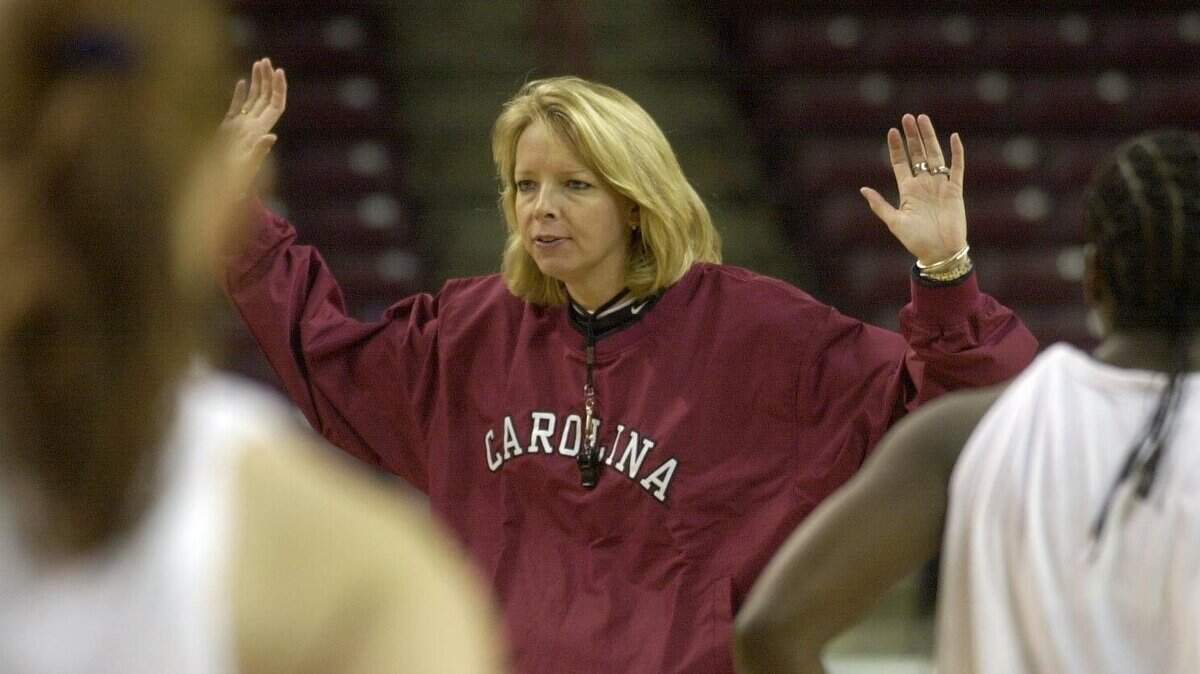
Just over a decade later, in 1997, Walvius was hired by South Carolina and began a new chapter in her coaching career in the same spot her playing career ended.
Walvius compiled a 165-160 record during 11 years as head coach of the Gamecocks. She took South Carolina to two NCAA Tournaments, including a run to the Elite Eight in 2002 (a program best at the time). After the 2007-08 season, Walvius stepped down and left college basketball altogether. Soon thereafter, she moved into the business world and co-founded SHEEX, a performance bedding and sleepwear company.
Fast-forward to just before the 2025-26 season. South Carolina head women’s basketball coach Dawn Staley (who replaced Walvius in 2008) decided she needed extra hands to help with name, image and likeness. She called on Walvius, who has now occupied an office in the South Carolina WBB section of the Carolina Volleyball Center since November.
It’s near the same location as the office she held 18 years ago.
“It’s a full-circle moment,” Walvius told The State this month. “… I’m super excited. I’m glad to be here, glad to be back a part of something that I spent 10 years of my life doing.”
Being back in Columbia and how she got the job
Senior Director of External Affairs for South Carolina women’s basketball isn’t exactly a job you see floating around on LinkedIn or some other job board. So how exactly did Walvius end up with the gig?
Walvius admitted she didn’t know Staley very well, but had a common thread with South Carolina’s longtime associate head coach Lisa Boyer, who was an assistant coach during Walvius’ final year as a player at Virginia Tech.
“We had the position and we just wanted somebody that could come in here and have a business background, a basketball background,” Staley told The State. “One day I was with Coach Boyer. Coach Boyer was like, ‘What do you think about Susan?’ I was like, ‘Yeah, that might be a great marriage, so to speak.’
Walvius’ business background speaks for itself. As co-founder and co-CEO of SHEEX, she wore many hats, including working in operations, marketing and growth, and is credited with helping build SHEEX into an “eight-figure revenue” company during her time away from the court.
After a few discussions about the position on the phone, Walvius flew to Columbia to meet Staley and her staff. Those trips sold Walvius on Staley and the gig.
“When somebody takes your place at a university and you watch them talking about all the changes and all those kinds of things, that’s hard,” Walvius said. “But I spent that time with her and fell in love. I understand why people love her. I understand the culture that she’s created. I really admire what she’s built.”
Walvius, who had been living in Minnesota, has slowly been transitioning back to living in Columbia since she started. Though it’s been nearly 20 years since she worked for USC, there are still a few familiar faces she sees in the program — including Director of Player Development Freddy Ready — and in the Columbia community.
“I feel like I’ve been gone forever in some ways, and in some ways it feels like it was just yesterday,” Walvius said. “… I’ve been surprised by this, many places that I go in the community, the grocery store, Chick-fil-A, people walk up [and say], ‘Coach Walvius, so glad you’re back!’ That’s been welcoming.
Her role at South Carolina
Although Walvius is listed as South Carolina women’s basketball’s Senior Director of External Affairs on USC’s website, her contract — which has a base salary of $200,000 — has her title as NIL Operations Coordinator.
Her position is still fairly new and Walvius said she expects her job to evolve. But at the surface level, Walvius is charged with advancing Staley’s program “any way I can.”
“Honestly, my focus right now is bringing the alumni back into the fold — that’s important — community outreach, identifying the right NIL opportunities for players — I think that’s critical — people who are interested in donating to women’s basketball are important to me…that’s where things are,” Walvius said. “Mentorship is important. Financial literacy is important to me. … I think there are things that I can do in my role with the community relationships that I have, that I can help the players.”
It’s been long assumed (and reported, for that matter) that Staley handles most of the NIL logistics with her program. Examples are Staley helping her players sign with agents or signing South Carolina up to play in the Players Era Championship — a mid-season event that promises $1 million in NIL opportunity — through 2027
The first reaction to Walvius’ hiring is that she might absorb or take some of those responsibilities away from Staley. In reality, Walvius is here to help add to Staley’s efforts, not take them off her hands.
“It’s all hands on deck,” Staley told The State. “I have to continue to do what I do. I think there are some things I’m missing that Susan’s filling in that gap of me not being in some places, and me not being able to get to the people that she’s getting to. She’s done a great job. She brings people in practice, which is to practice, that hopefully she can continue to bridge those relationships and let people know how very important it is for us to continue doing what we’re doing with the type of talent and great individual, and great human beings that we have on our team.”
Walvius’ role is essentially to bring in as much money as she can so Staley and her team can consistently compete for national titles. She won’t play a role in how the money is distributed among the roster, but she will play one in getting the money to the roster. The former is “completely up to (Staley) and her staff.”
Back in October at SEC basketball media days, Staley told The State she felt her program was competing with the best programs in the nation when it came to the amount of rev-share money USC has allotted to women’s basketball, but it isn’t enough by itself. Thus, the need for NIL dollars to supplement the rev-share money.
After three months on the job, Walvius emphasized that was “100%” a true statement. Walvius’ job is to use her business experience to build new relationships in the community to find new streams of NIL money.
“This is to make sure that any gap that could be there in a rev share, that I’m identifying that and giving them every opportunity to recruit the best possible players that they can recruit within the NCAA parameters,” Walvius said.
The biggest challenge to South Carolina women’s basketball space has a bit to do with how big the school is, Walvius said. USC was ranked in the middle of the SEC in enrollment in 2025.
“I think other schools find this, we are not the largest school in the SEC and there are challenges there,” Walvius said. “And that’s kind of where I need the community’s help. … We are up against some heavy hitters, of large schools with big donors. You look at Mark Cuban as an example of Indiana football. We’re up against some of that, and I want to do everything that I can to help Dawn have the best opportunity to be successful.”
Thoughts on the state of college athletics
The landscape of college athletics has changed dramatically since Walvius left her post as head coach of the Gamecocks. Long gone are the days when players were getting just per diem meal money, which in some instances was sent straight home to families, Walvius said.
South Carolina women’s basketball has changed with the general landscape. The Gamecocks have won 500-plus games in the last 18 years, are nine-time SEC Tournament champions and have won three national titles. The office Walvius occupied as head coach is the program’s trophy room now.
Walvius had stayed out of sports entirely since she left to run SHEEX. So why come back now?
“Because I care about the program, because I believe in Dawn Staley, because I love this community and I want to do everything I can,” Walvius said. “I also understand some of the challenges that Dawn is going to face against some of these major SEC programs in this element with these rule changes that are out there. I believe I have the relationships in the community to help.”
Moving forward, Walvius said her plan is to “stay fluid” with how she approaches the job. It’s something she said is important with the landscape of college sports in flux. As for the future of collegiate athletics, Walvius expects there will eventually be some sort of regulation.
“I like that the kids can make money, but I do think there will be some regulation,” Walvius said. “Because I don’t know that it’s sustainable the way it is today.”
This story was originally published March 2, 2026 at 7:01 AM.