Colonial Life Arena’s timekeeper for nearly 50 years keeps watch on a Gamecock dynasty
There’s a lot of moving parts that go into a South Carolina basketball game at Colonial Life Arena.
There are the stars of the show, the players and the coaches, who put in hours of practice and training. There are the fans who come from all over just to cheer for their team. There are the behind-the-scenes workers who are preparing the arena and handing out rally towels. The list goes on and on.
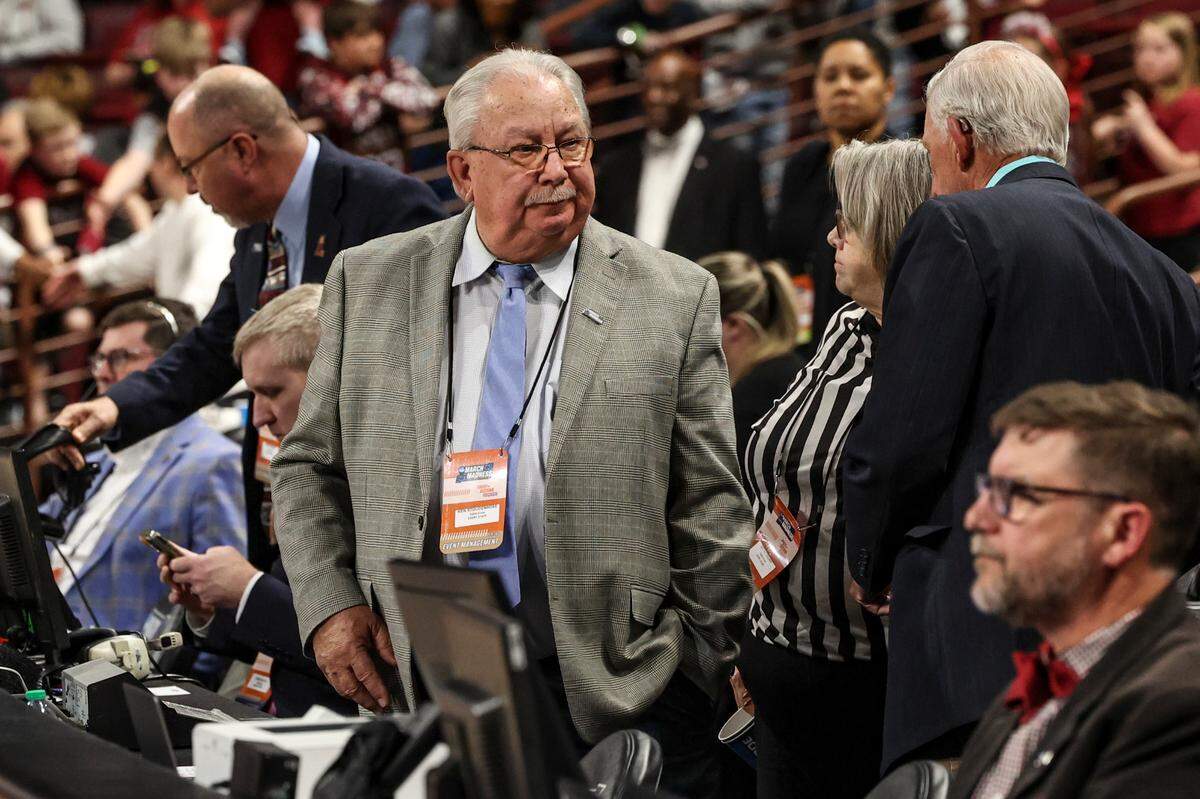
One group you’re unlikely to think about are the people who sit at a table at the center of the court between the two team benches. That’s where 75-year-old Ken Stoudenmire has been for decades, tracking time.
Stoudenmire has run the game clock for South Carolina men’s and women’s basketball games for almost 50 years. He works with the referees to stop and start the clock and sits alongside the shot clock operator, the scorekeeper and the scoreboard operator at the scorer’s table.
The average fan wouldn’t interact with him during a game. He’s focused, determined to do his job well and doesn’t want to make any mistakes. But have one conversation with Stoudenmire, and you’ll find that he’s been there for many significant moments in the programs’ history and never gets tired of showing up for Gamecock basketball.
“It’s about live entertainment,” Stoudenmire said. “I think once it gets in your blood, it’s there.”
Carolina Coliseum to Colonial Life Arena
Before Colonial Life Arena was built in 2002, Stoudenmire worked at the Carolina Coliseum, where South Carolina men’s and women’s basketball used to play.
He got his start in operations with the coliseum in 1972 after graduating from Brevard College. Hailing from Sumter, Stoudenmire said he decided to move to Columbia after seeing the area grow.
But it wasn’t until later in the ‘70s that he would develop his passion for working the game clock. At one of the games, the person operating the scoreboard had a medical issue and had to leave. Stoudenmire decided to fill in, and “the rest is history,” he said.
Stoudenmire said there are two essential aspects to operating the game clock: knowledge of the game and full concentration on the task.
“You can’t get distracted and carry on conversations with the fans,” Stoudenmire said. “I’ve been doing it so long that I can actually sometimes enjoy the game.”
Stoudenmire left his role in operations at the Carolina Coliseum in 1985. He got married, had children and traveled for work. When Colonial Life Arena was being built, he was looking to take a new job and was hired as director of operations for the arena. He stayed in that role from when the arena opened in November 2002 until 2016, when he retired.
But one thing has remained consistent for Stoudenmire: He still works the game clock. Different technological advancements have helped basketball referees stop and start the clock more efficiently, but they’re not always 100% accurate, he said.
“That’s why you still have someone, myself, that starts and stops the clock, and again, it’s all about you just got to pay attention,” Stoudenmire said.
‘Nothing like you’ve ever seen’
When Stoudenmire saw Colonial Life Arena open, there was a lot of excitement, he said. The new building had “all the bells and whistles” and was an attractive place for major performing acts.
Bruce Springsteen was the first musical artist to play at Colonial Life Arena. After that, Stoudenmire said he worked on major concerts at the arena, such as Prince and Paul McCartney, even getting his picture taken with the latter.
Stoudenmire has gotten to watch iconic performers come through Columbia, but he’s gotten a closer look at the stars it has grown most famous for housing: the South Carolina women’s basketball team.
The first public event held at the arena was a women’s basketball game against Clemson. More than 17,000 people attended. But the games that followed didn’t see the same attendance, to the point where “you could hear a pin drop,” Stoudemire said.
That is, until current head women’s basketball coach Dawn Staley entered the scene, he said. Watching from the sideline all through her ongoing 17-season run, he’s witnessed the program as it’s gone on to win three national titles and nine SEC Tournament championships.
“She has really grown the game of women’s college basketball,” Stoudenmire said. “Now you go to a South Carolina women’s game, you know, you’re gonna have 10,000 to 15,000 people there, if not more.”
This season, the Gamecocks led the nation in women’s college basketball attendance for a 10th-straight year, averaging 17,000 fans per game and selling more than 13,000 season tickets.
The atmosphere at a South Carolina women’s basketball game is “nothing like you’ve ever seen,” Stoudenmire said. The fans will sometimes get so loud that he can’t hear the game clock’s horn.
It “makes your hair stand up,” he said.
Stoudenmire has always loved college sports, especially women’s basketball. He enjoys watching them play with passion, he said.
While he doesn’t interact with players before and after the game, he keeps in touch with former players who have come through both the men’s and women’s program, as well as coaches and other people who have worked at the arena.
“[Former head men’s basketball coach Frank Martin] and I were buddies,” Stoudenmire said. “We played golf together. When I retired, he took me and my wife on the trip to Saint Thomas with the basketball team as a retirement gift to me, which was special.”
Future plans
Stoudenmire knows he won’t be able to keep working the game clock forever. At some point he’s going to have to give it up, he said. But until then, he keeps going.
Stoudenmire and the other members of the scorers table often feel like they are part of the officials team. It’s important for all of them to remain concentrated on their task so that the crew doesn’t make errors, he said. If there is an error, the officials then have to stop the game and take the time to correct it before resuming play.
“They don’t like doing that,” Stoudenmire said. “They like a crew that’s going to be on their toes and do their job and just move the game along as smooth as it can move along.”
Stoudenmire said he believes he has another year or two of being able to operate the game clock. He knows that when he starts making mistakes, it will be time to take a step back.
“I’m going to have my season tickets, and I’m still going to come to the game and watch the games,” Stoudenmire said of what he plans to do when he’s no longer behind the scorers table. “I’m going to do that long as I can walk.”

This story was originally published March 26, 2025 at 5:00 AM.