
Masters of disaster: How Jean van de Velde, Dustin Johnson have persevered
Dustin Johnson was 14 years old in 1999, a young up-and-coming golfer with dreams of playing professionally. Naturally, he was watching the final round of The Open Championship (aka British Open) on TV from his Irmo home. He and others saw that Sunday turn from a coronation into perhaps the worst final-hole collapse in the history of golf’s majors.
Feel free to insert your own ironic comment here.
“I vaguely remember watching” that day in 1999, but “not the details,” said Johnson, 33.
He might be the only person in golf who can say that.
Most who were watching that day can recite chapter and verse of the shocking conclusion, when a largely unknown French player, instead of having his name etched on the Claret Jug, carved out a spot in the game’s lore — and not in a good way.
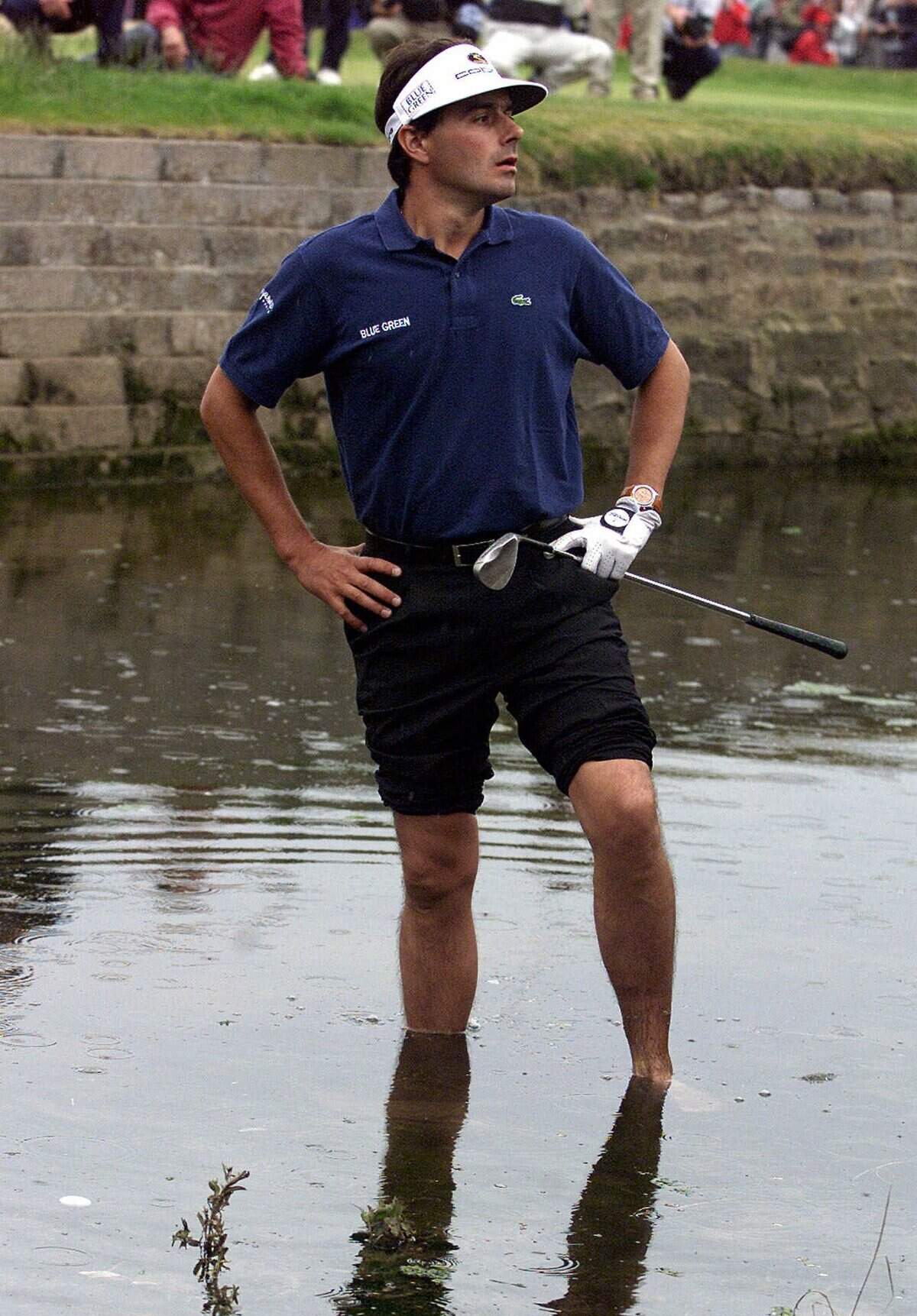
Leading by three shots as he stood over his second shot on the 18th hole at Scotland’s brutal Carnoustie Golf Club (“Car-nasty” to the locals), Jean van de Velde, then 33, proceeded to mix questionable strategy and horrendous luck into a sequence that was painful to watch. That included the unforgettable moment when he waded into a tidal creek (a “burn” in Scotland), pants legs rolled up, in a vain attempt to hit his fourth shot out of the water.
Ultimately, the stunned van de Velde signed for a triple-bogey seven, dropping him into a four-hole playoff ultimately won by Scotland’s Paul Lawrie. Anyone who has ever played golf watched that day with a mixture of horror and empathy.
Johnson? “I don’t remember how I reacted to it,” he said.
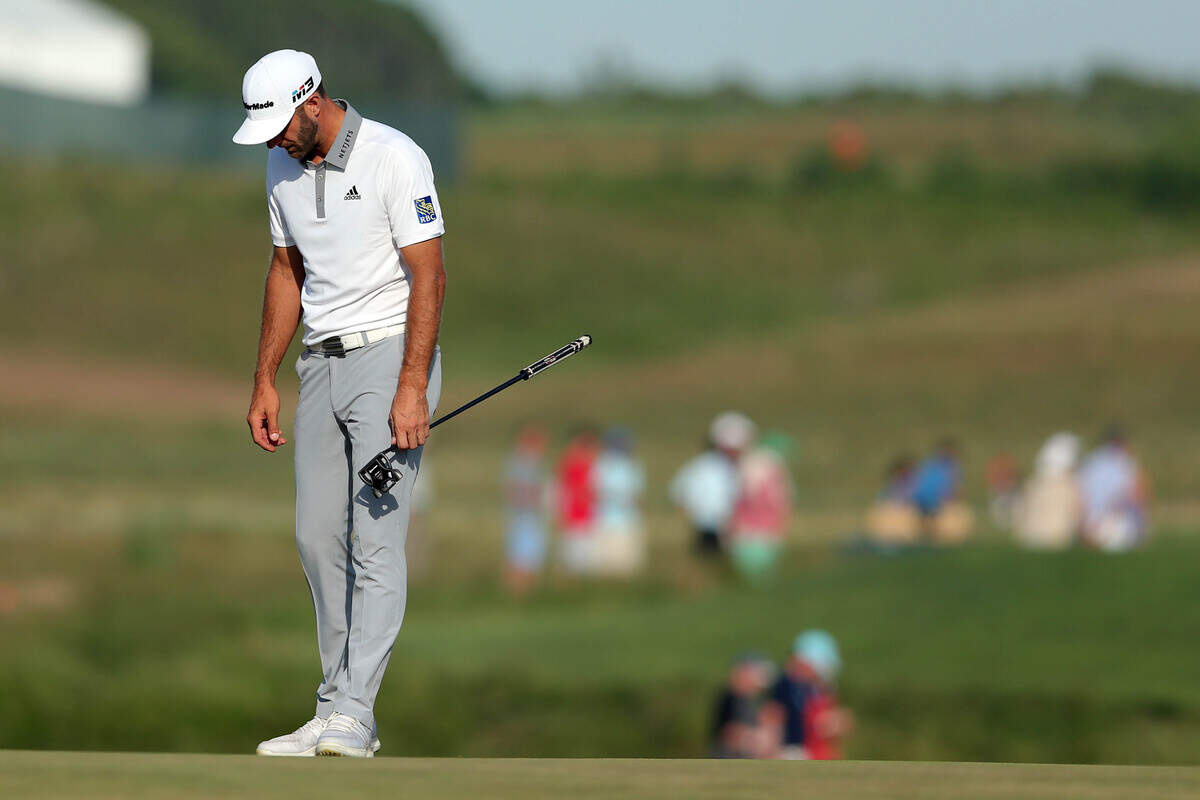
Not surprising. The world’s No. 1 player’s otherwise stellar career has been marked by both a string of blown opportunities in golf’s major championships — most recently at last month’s U.S. Open at Shinnecock Hills when, leading after two rounds, he shot 77-70 to finish third by two shots — and, at least outwardly, by his ability to shrug off such disappointments.
There was a final-round 83 that cost him the 2010 U.S. Open; his self-inflicted penalty on the final hole that kept him out of a playoff in that year’s PGA Championship; an out-of-bounds shot at the 14th hole at Royal St. George that cost him a chance in the 2011 Open Championship (he finished second).
In 2015 at St. Andrews, Johnson — shades of last month — comfortably led The Open through 36 holes before slumping to a tie for 49th. Most wrenching of all for its sudden-shock ending was that year’s U.S. Open at Chambers Bay, where his final-hole three-putt — one putt would’ve won, two would’ve forced a playoff — handed the title to a shocked Jordan Spieth.
Johnson’s redemptive victory in the 2016 U.S. Open got the “best player never to win a major” monkey off his back. But this most recent result ... well, maybe it let the monkey out of its cage again? Afterward, Johnson reportedly departed Shinnecock Hills at a gallop, declining to talk to reporters.
So, you may ask, why bring up all of this now?
Because this month (July 19-22), The Open Championship will return to Carnouste, 19 years after the van de Velde collapse. The now-52-year-old Frenchman will be there working as an analyst for French television.
And Johnson will be there, of course. As will the notoriously rabid British press, no doubt lying in wait.
“I’ve had my own situations I’ve gone through (in majors),” Johnson said prior to this year’s U.S. Open, “but the last one I had a chance to win (in 2016), I won. So I’ve got good vibes going forward.”
We’ll see how that works out. Van de Velde, though, would tell Johnson to continue not beating himself up over his majors track record. As 1999’s “tragic figure” now suggests, sometimes disaster has a rainbow at the end.
Remembering that day in 1999
Van de Velde’s accented but fluent English came over the phone from his home in Mont-de-Marsan, France. He was remembering his most recent visit to Carnoustie as an entrant in the 2016 Senior British Open, only his second competitive tournament following injuries and illness in 2010-11 and a five-year stint (2012-16) running the French Open.
“That was a fun experience,” he said. “I hadn’t played for, basically, six full years.” At Carnoustie, he “played poorly,” opening with an 83. “The second round was much better, but I was basically done after that.”
He says there were no 1999 flashbacks then; after all, he’d played Carnoustie in three Dunhill Cups before moving on to his French Open position. “There are other holes that I’ve tripled along the way,” he said, and chuckled. “Luckily for me, I survived the trauma.”
It’s easier to laugh nearly two decades removed from 1999, yes? In fact, van de Velde said, it took him “72 hours” to rebound from that day. “Going back home, and two days at home; after that, plenty of time to have the adrenaline come out of my veins, time to think about what happened, time to calmly reflect on what happened.”
So .... what did he conclude? Did a young player choke on the pressure of perhaps claiming golf’s oldest major championship? Nothing of the sort, he said.
That fateful Sunday, he arrived at the 18th tee brimming with confidence; indeed, he’d felt that way the entire round, he said. “I felt very comfortable on the golf course. It was the first time I was in such a position in such a big tournament — but there’s always a first time, even for the greatest players in the world.”
On the 18th tee, he noted that the wind, at his back there all week, was now in his face. The hole “went from a 2-iron (and) wedge to a driver (and) 4-iron,” he said. “I knew it was going to be tough, but I knew as well it was going to take quite a bit for the other players to catch me.”
Still, this was van de Velde’s first time in such a spotlight, so there were doubters. TV analyst Mike Tirico, among others that day, questioned why the player would hit driver on the narrow finishing hole, when a series of 5-iron shots easily could’ve reached the green in three shots, setting up a possible par, or bogey or double at worst.
“As soon as (van de Velde) holed out on 17, the late, great Bob Rosburg said, ‘Curtis (Strange), there’s no way this guy is going to take drive here, right?” Tirico said in a recent interview. “And that was the first seed of the calamity being planted for me.”
For van de Velde, doubt would only come later. “There was no hesitation ... I thought driver was the club,” he said. “I don’t know why it wouldn’t be. If I wasn’t making anything silly, (the finish) wasn’t going to be that dramatic. Others have asked if I was worried, but I was positive.”
“Then,” Watson continued, “he got a rotten break, and things transpired from there.”
Arriving at his ball, van de Velde briefly pondered what Tirico, Strange and others were now suggesting: hit his second shot sideways back to the 18th fairway. But the player rejected that notion.
“The angle coming back to the left was quite poor, the fairway was diagonal,” he said. Van de Velde also worried about a shot flying too far left and out of bounds. By comparison, going straight at the green with a 2-iron made the most sense to him. “My thought was, get over (the burn), and from there you’ll find a way to make the five or six” he needed to win.
His 2-iron shot flared slightly right, heading for the grandstand behind the green. No problem, he thought; he’d get a free drop from the bleachers and be pitching a short shot into the green. Then: Watson’s rotten break.
“How in the world did I hit a piece of metal holding the (bleacher’s) railing?” van de Velde asked, yet again. The ball caromed off the railing, back toward the burn, hitting the stone wall bordering it before landing in deep, gnarly rough. Now he was in trouble.
“Some people say it was destiny,” van de Velde said, a shrug audible in his voice. “Sometimes you just go (in) the wrong place at the wrong time. No matter what you do, that’s just the way it is.”
From there, it all went to hell.
His fat third shot into the water, the rolled-up pants legs, the eventual penalty drop, his fifth shot into a bunker. Amazingly after all that, he blasted out and sank his 8-foot putt to at least get into the playoff. But his moment was gone.
Asked if he had it all to do over, which shot would he want to try, van de Velde doesn’t hesitate. “Oh, the third one, obviously,” he said. “I would hit it sideways and wherever it finished, even in the rough, I’m sure I would’ve had a better lie and better angle to getting on and making (a) six.”
A 19-year-old sigh: “It’s not a big problem,” he said.
Just part of the journey
Call it what you will: resignation to his fate, a desire to move on with his career, a resilience that, some would say, also has been a saving grace for Dustin Johnson when majors blew up. Of Carnoustie in 1999, van de Velde is adamant: “I do not regret anything.
“We play golf to get into position to win coming down the stretch in major championships. Now, do I regret not having my name on the (Claret Jug)? Of course, but do I regret what I went through, what it brought to me and the way it made me after that? No, no, no ... not at all.”
Van de Velde tells how later in 1999, he was invited to an outing for local schoolchildren at his home course in Mont-de-Marsan. Previous years, attendance numbered less than 20, but the day he showed up, so did 120 kids. “They all wanted to play golf because of what happened to me,” he said. “If you can inspire kids to follow behind you, then that’s what the sport is about.”
Van de Velde later won another European Tour event despite injuries, and finished in the top 30 in four other majors. Among his post-golf achievements: helping France win hosting rights for this fall’s Ryder Cup, near Paris. He says golf in France is on the rise; witness Victor Dubuisson, who has two European Tour victories, two top-10 finishes in majors, played on the winning European Ryder Cup team in 2014 ... and who was 9 years old in 1999.
“I’ve had a phenomenal life,” van de Velde said. “The world is my playground, I’ve met incredible people, played in everything and everywhere other people would dream of. I’ve played every major, played in the (1999) Ryder Cup. I’ve been fortunate.
“So, no; this is just one part of my journey. The Open Championship does not define who I am; it just made me who I am.”
Case in point: How many people remember Lawrie won the 1999 Open, versus how many remember van de Velde’s final hole?
Though he’s never met Dustin Johnson, van de Velde is an admirer. It would not surprise him to see the tall, athletic player holding the Claret Jug come Sunday. “I think he really has the full package going (to Carnoustie),” he said.
“He’s young, extremely talented, and there’s no reason — if he’s putting together all the elements — he wouldn’t be in contention on Sunday. He’s won the U.S. Open, so he knows what it takes to get to the finish line.”
Has van de Velde considered seeking out Johnson, sharing their singular histories? Not really.
“He’s come back and won one (in 2016),” he said. “From what I’ve heard, he’s digested those losses and been able to move on with his career” — the way the man with history’s worst collapse has moved on with his life.
Van de Velde paused before adding, “Maybe he can appreciate that not winning those previous chances helped him win the one he did.”
That seemed to be the case in 2016. Going forward? As van de Velde learned post-1999, who knows what lies ahead?
The Open TV schedule for 2018
Round 1 : Thursday, July 19
Golf Channel: 1:30 a.m. to 4 p.m.
Round 2: Friday, July 20
Golf Channel: 1:30 a.m. to 4 p.m.
Round 3: Saturday, July 21
Golf Channel: 4:30-7 a.m.
NBC: 7 a.m. to 2:30 p.m.
Final Round: Sunday, July 22
Golf Channel: 4:30-7 a.m.
NBC: 7 a.m. to 2 p.m.
This story was originally published July 14, 2018 at 5:29 PM.