
Pete Dye has lasting impact on SC golf courses and designers who followed
The conversation centered on Pete Dye, and who better to talk about the famed golf course architect, who died in January, than Bobby Weed?
That’s Bobby Weed, Irmo High Class of 1973 who dipped his toe into golf course design at the old Weed Hill Driving Range and fell hopelessly in love with the profession under the influence of Dye — the architect that players loved to hate.
“My confidant, my mentor and my best friend,” Weed said the other night in addressing the South Carolina Golf Course Rating Panel’s spring meeting that honored Dye.
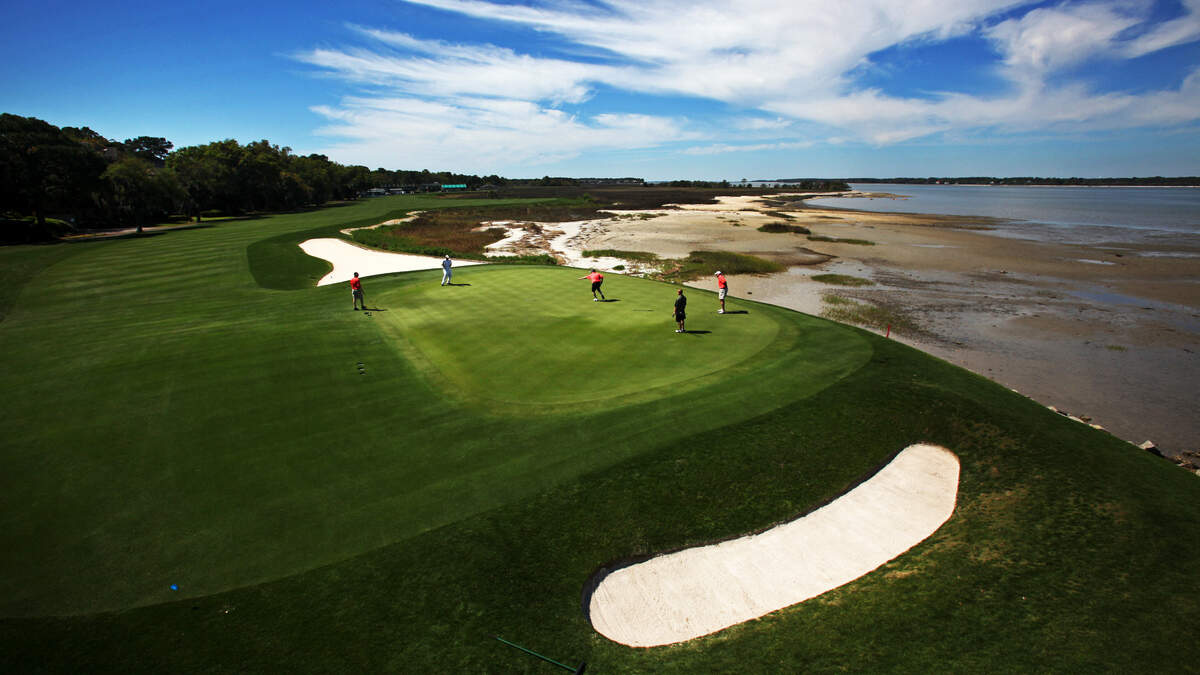
Dye’s influence on golf in South Carolina is profound. Three of his Palmetto State courses — the Ocean Course on Kiawah Island and both Harbour Town Golf Links and Long Cove Club on Hilton Head Island — take a place on any list of great courses.
“He did ‘quirky’ better than anyone,” Weed said. “With Pete, design was all about angles. He made the golfer think. He made the golfer uncomfortable. He would say, ‘Life’s not fair; why should golf be?’”
Weed, whose family sold the property to Michael Mungo for the old Coldstream course, talked his dad into giving him some land across Lake Murray Boulevard from the club and carved Weed Hill Driving Range out of the bean field. The property, now being developed, has a distinguished alumni list that includes Dustin Johnson, Wesley Bryan and Lauren Stephenson.
After attending Presbyterian College and a turf school in Florida, Weed met Dye at Amelia Island and learned from a master during his apprenticeship. He became Dye’s project manager for Long Cove in 1981.
“I think of Pete’s design this way,” Weed said. “He did art work on the ground. His courses were works of art. What people don’t understand is what a strong work ethic he had.”
Perhaps Dye’s biggest challenge came in the construction of the Ocean Course. He got a call in 1988 “to build a course for a major event in 1991,” Weed said.
Not only did he face a severe deadline to prepare for the 1991 Ryder Cup, he and his crew had to overcome the devastation that Hurricane Hugo left in its wake in the fall of 1989.
“Kiawah was a big, ol’ sand pile, and Pete took full advantage,” Weed said.
That came a generation after Dye changed the face of golf course architecture. The Fraser family called on Jack Nicklaus to build Harbour Town, and Nicklaus, familiar with Dye’s work at The Golf Club in Ohio, summoned Dye.
“Jack was a player in his prime and didn’t know design at the time,” Weed said. “Jack said to bring Pete on and we’ll do it together. But there’s no question that Pete was the architect and Jack was the consultant.”
Dye built the Harbour Town course in 1969 that was the total opposite of the designs of the day. He constructed small greens, employed multiple tees, used various grasses to create contrasts and, borrowing from ideas gleaned on a trip to the United Kingdom, made extensive use of railroad ties. There were the angles of course, and pot bunkers, too.
“He ushered so many new things into golf course design,” Weed said. “(The pros) had never seen anything like Harbour Town, but Arnold Palmer won that first Heritage and provided instant credibility.”
Playing a Dye course assures that the par-3 holes will be a test. The 17th at TPC at Sawgrass resulted from a suggestion by wife Alice, and the 17th at the Ocean Course gives pause to the finest players. The four par-3s at Harbour Town rank among the finest set anywhere.
“He liked to say that he couldn’t know from where a player would be hitting into the green on a par-4 or a par-5, but he had ‘control’ with the par-3 tees,” Weed recalled.
Dye’s architect “tree” includes Weed, Tom Doak, Bill Coore and many others. “He believed in passing knowledge down to the next generation, and he did that,” Weed said.
Armed with a “degree” from the Dye School of Architecture, Weed became construction superintendent for TPC projects and moved on to become chief designer for the PGA Tour before forming his own company with headquarters in Ponte Vedra Beach, Florida.
At 64, he remains busy with multiple projects, including following his firm’s restoration of Long Cove by conducting planning and advisory services at the club.
His approach: imaginative, holistic, visionary and passionate.
The philosophy comes compliments of Pete Dye.