
Kiawah’s Ocean Course, 30 years later, still providing moments to remember
Think about the baseball scout who first spotted Mickey Mantle in a sandlot game, the basketball coach who saw a skinny 10-year-old named Pete Maravich in a dank, dusty gym or the football recruiter who came across Barry Sanders in a Y-league.
They knew. They knew: He can’t miss.
And so it was — and is — with the Ocean Course.
Those of us who watched this tract of property by the Atlantic Ocean evolve from swamp into a golfing treasure just knew.
Could 30 years have passed since a candidate for the United States Ryder Cup team arrived at the end of a two-lane road on a South Carolina island seemingly in the middle of nowhere and, as legend says, asked: Where is the golf course?
Perhaps the story is apocryphal, but in the beginning the question did not seem far-fetched.
Rushed to completion in order to provide the stage for the 1991 Ryder Cup, the Ocean Course illustrated both then and now the genius of architect Pete Dye.
Three times in those 30 years has the golf world come to the Ocean Course for competition at the highest level, and three times has the Ocean Course delivered to and beyond expectations.
Each is different, yet special in its own way.
The first came in the aforementioned Ryder Cup, and the competition those three September days in 1991 sizzled. Definitions of heartbreak and triumph would be scattered over a golf course.
That Ryder Cup featured some of golf’s grandest names and the 17th hole became golf’s answered to the rack, the torture device of choice in medieval times. Although Mark Calcavecchia became the symbol of futility on the 17th, the hole really played no favorites. Almost every player visited the green-guarding pond at least once.
The United States eked out a 14.5 to 13.5 victory, but golf in general and the Ocean Course in particular won, too. For a punctuation mark, the Concorde that flew into Charleston to ferry the European team home soared over the course and delivered a Sunday sonic boom, the perfect salute.
The Ryder Cup format is match-play. Emotions can — and did — run high. During that particular competition, civility and sportsmanship seemed like no more than words in the dictionary.
But better theater is hard to imagine.
Each time the golf world returns to the Ocean Course awakens the echoes of those September days 30 years ago, but the more recent high-profile visits — the PGA Championship in 2012 and again this year — are stroke-play and decorum is the order of the day.
The scene may be more orderly — no cries of “USA! USA!” or sing-song chants of “Olé, olé, olé, olé” that characterized the Ryder Cup — but the course remains a brute. The wind always blows, but the directions vary, creating migraines for players.
Even though the layout remains virtually the same, changes in grasses and maturation through the years make differences. Not easier, understand; just a bit different.
The 2012 PGA remains indelible for two reasons: Rory McIlroy’s excellence and the course access debacle.
Rory left the field playing for second place and the golf world prepared to crown “the next Tiger Woods.” But the world has come to understand that Jack Nicklaus and Tiger Woods stand alone atop golf’s pyramid.
Meanwhile, getting to and from the golf course proved more challenging than making birdie on No. 17, and the system crashed completely after a Saturday afternoon rainstorm.
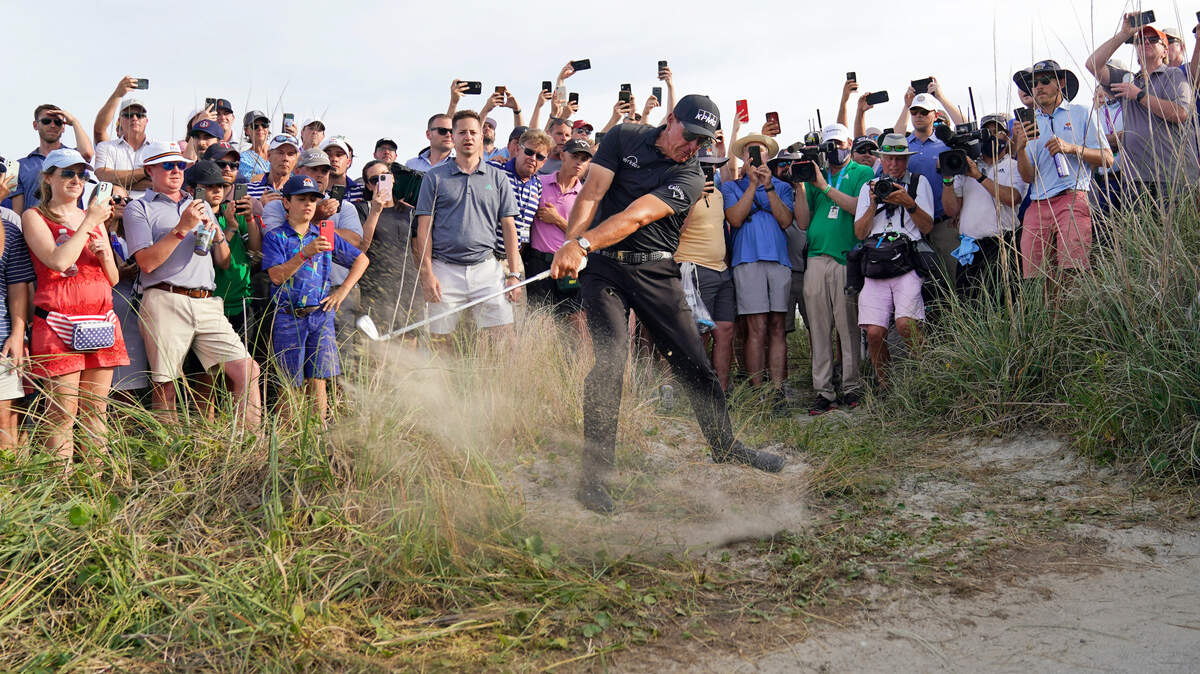
The world’s best golfers completed another test Sunday at the Ocean Course, and the contrast of those two PGAs, one in August and this one in May, illustrate the majesty of the Ocean Course.
A bomber, McIlroy, dominated in 2012, yet a look at the top 10 that year reveals players of contrasting styles. Ian Poulter, Carl Pettersson, David Lynn and Steve Stricker illustrated that this is an equal opportunity course.
Fast forward nine years to PGA Sunday in 2021; diversity might be the watchword for the crowded leaderboard.
There’s the old man, Phil Mickelson. There’s Mr. Major Brooks Keopka, bum knees and all. There’s Louis Oosthuizen, with an enviable record in golf’s biggest events, and... there’re players few would expect to have late tee times on a major championship Sunday. With the course set up for scoring, more drama awaited.
Access remains a challenge; that same two-lane road is the only way in. The COVID pandemic reduced the number of spectators and solved the problem of access this year, but the future ... well, who knows?
But what we do know is, the golf world will be back. Possibly in 2028, more likely in 2030.
The scene is too beautiful, the course too challenging and the siren’s song too tempting to stay away for too long.
2021 PGA leaders
Top scores as of 5 p.m. Sunday, through 9 holes
Phil Mickelson —7
Brooks Koepka —5
Louis Oosthuizen —5
Kevin Streelman — 3
Future PGA Championship sites
2022: Southern Hills Country Club, Tulsa, Oklahoma
2023: Oak Hills Country Club, Pittsford, New York
2024: Valhalla Golf Club, Louisville, Kentucky
2025: Quail Hollow Club, Charlotte, North Carolina
2026: Aronimink Golf Club, Newton Square, Pennsylvania
2027: PGA Frisco, Frisco, Texas
2028: The Olympic Club, San Francisco, California
2029: Baltusrol Golf Club, Springfield, New Jersey
2030: To Be Determined
2031: Congressional Country Club, Bethesda, Maryland
2032: To Be Determined
2033: To Be Determined
2034: PGA Frisco, Frisco, Texas
Future U.S. Open sites
2021: Torrey Pines Golf Course, San Diego, Calfornia
2022: The Country Club, Brookline, Massachusetts
2023: Los Angeles Country Club, Los Angeles
2024: Pinehurst Resort & Country Club No. 2, Pinehurst, North Carolina
2025: Oakmont Country Club, Oakmont, Pennsylvania
2026: Shinnecock Hills Golf Club, Southhampton, New York
2027: Pebble Beach Golf Links, Pebble Beach, California
2028: To Be Determined
2029: Pinehurst Country Club No. 2, Pinehurst, North Carolina
2030: To Be Determined
This story was originally published May 23, 2021 at 2:32 PM.