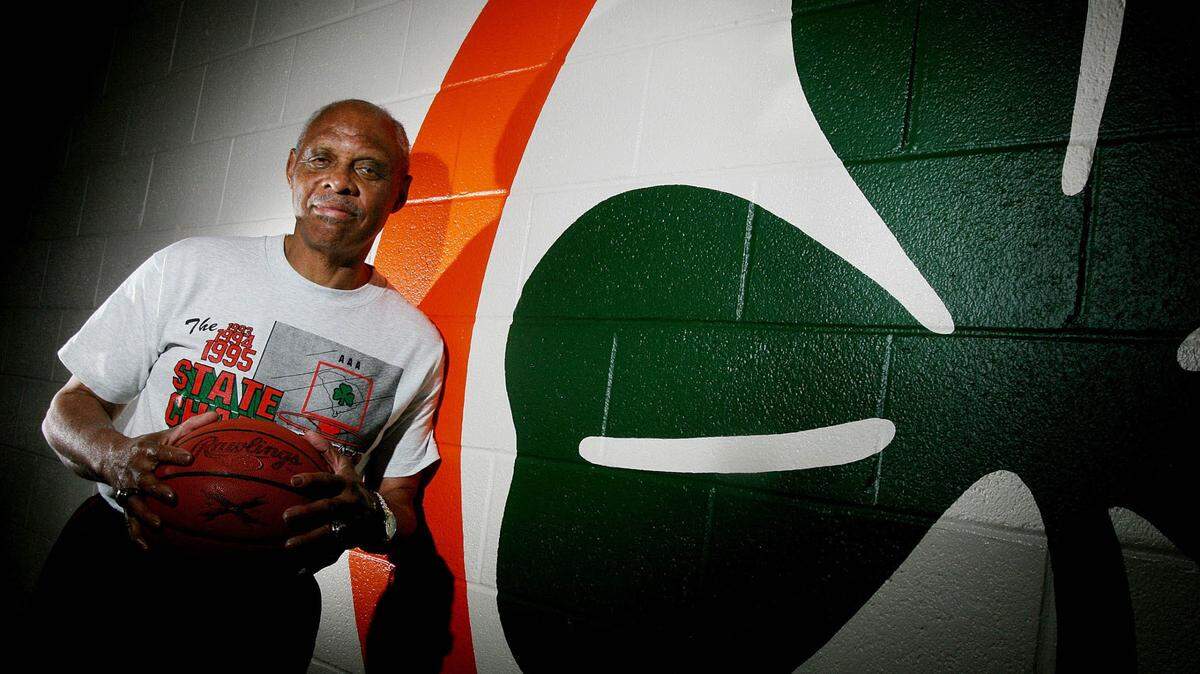
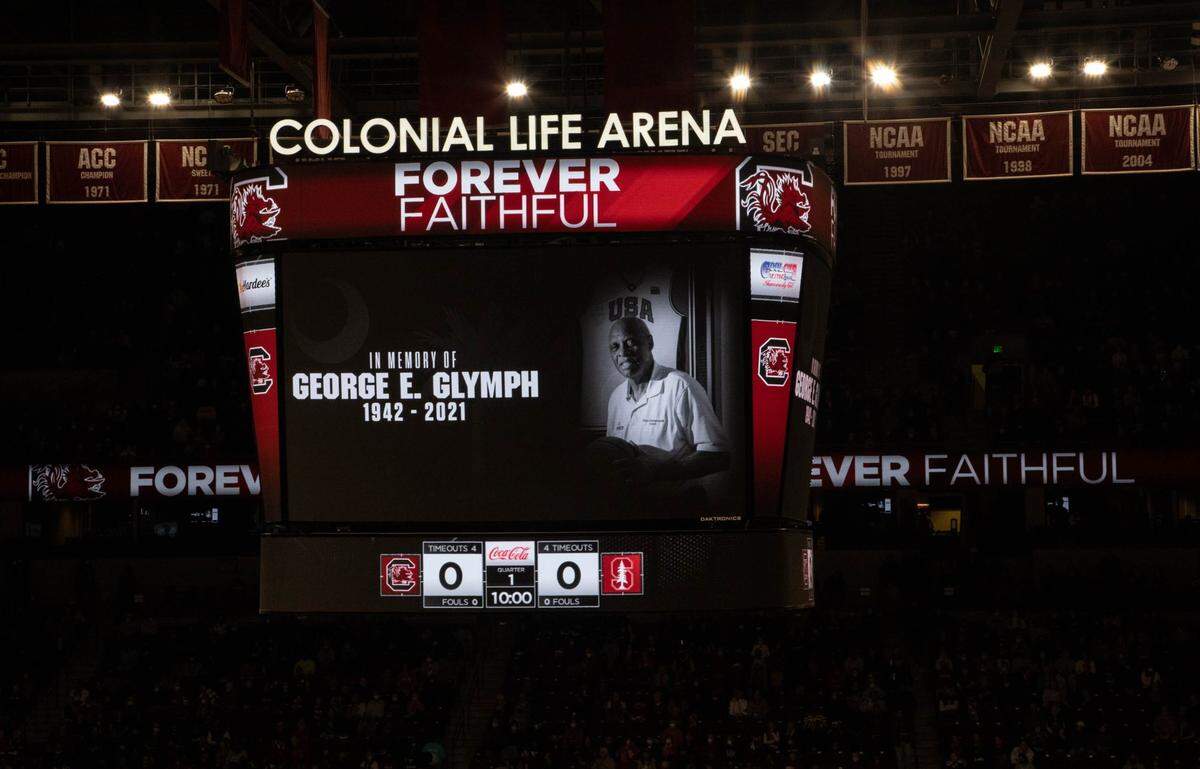
More than a basketball coach, the late George Glymph was a father figure to many
Just before Jermaine O’Neal started his freshman year at Eau Claire High in 1992, he got his ears pierced.
A mistake, he’d soon realize.
Back then, O’Neal carried himself with a rebellious sort of swagger. He was angry. A troublemaker. He grew up without knowing his father, and his feelings of unworthiness and abandonment led to constant trips to the principal’s office. Before the NBA Draft and the all-star seasons and the fame, O’Neal was a Columbia kid without direction.
That is — until he met George Glymph. That man changed O’Neal’s life in profound ways, just like he transformed the lives of countless others.
O’Neal will never forget the first day he walked into the legendary Eau Claire basketball coach’s office. By that point, Glymph and the Shamrocks had established themselves as high school basketball powers in the Southeast. In a time before social media and the internet, basketball people all over the country knew the name George Glymph. Even people who had never set foot in South Carolina.
“Hey son, take those earrings out,” Glymph told O’Neal when he stepped in his office in 1992. Those were the first words Glymph ever said to him.
“And pull those pants up — if you want to be a part of this program.”
In those days, O’Neal didn’t respond well to authority. But he listened to Glymph. There was something about the way Glympth carried himself, an air of wisdom, an undeniable sense of leadership. O’Neal couldn’t say no to him. He took his brand new earrings out, pulled up his pants and sat in the chair in front of Glymph’s desk.
“Now,” the coach continued, “what is it that you want to do in life?”
O’Neal pondered that question for a minute. He had no grand vision for his future. Before that day, he had barely even played basketball. All he knew was that he was tall and athletic — and that Glymph was a winner. Like many of his inner-city peers, O’Neal thought he was destined to end up on the streets. Or in jail. Or worse.
“I just want to take care of my mom and brother,” O’Neal responded, finally.
Seemingly satisfied with that answer, Glymph reached down behind his desk, scooped up an orange basketball and placed it in O’Neal’s hands.
“Well son,” Glymph said, “here you go.”
Four years later, at age 17, O’Neal was selected in the first round of the 1996 NBA Draft and played 18 seasons in the league. He was one of hundreds — if not thousands — of young men to benefit from Glymph’s tutelage.
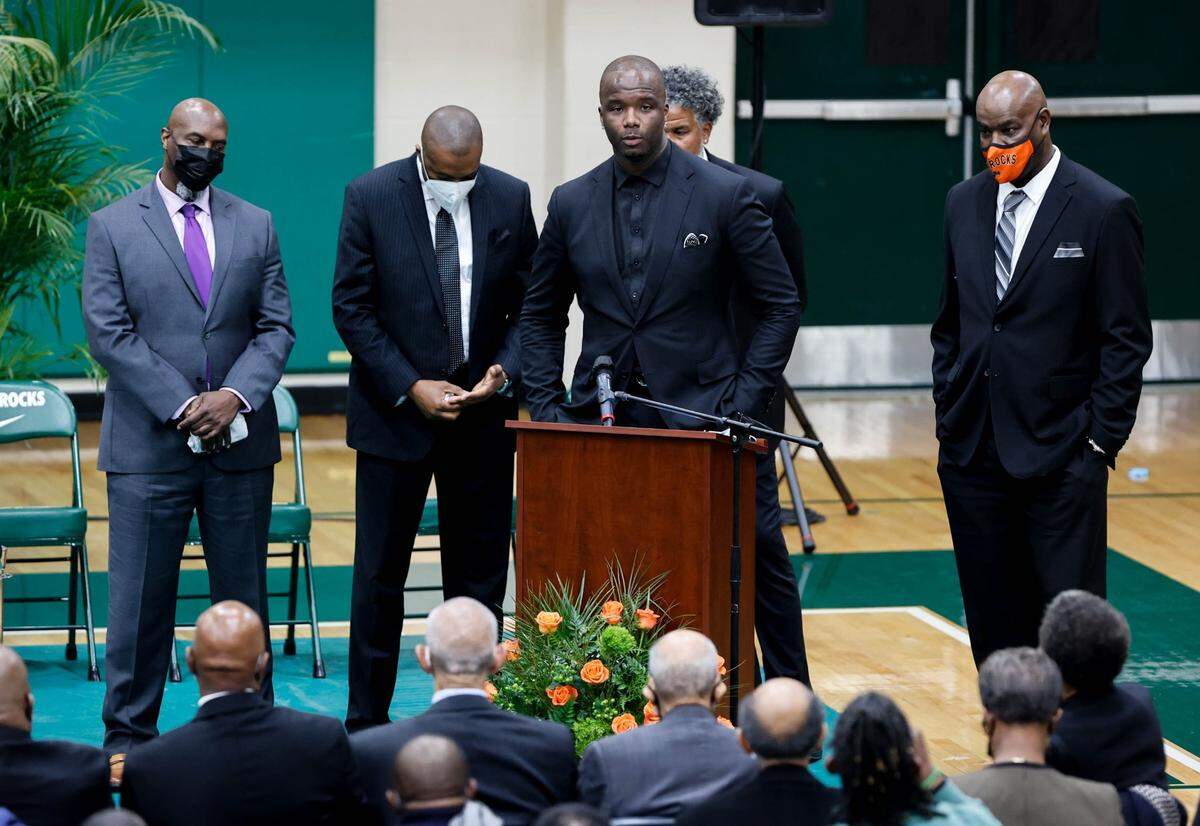
When Glymph died on Dec. 15, a week shy of his 79th birthday, heartbreak spanned every inch of the basketball world, from the NBA, to the college ranks, to the high school level and beyond. The city of Columbia mourned the loss of a community pillar. From his home in Dallas, O’Neal couldn’t shake the deluge of tears and memories that flashed in front of his eyes.
O’Neal called Glymph’s wife of 58 years, Betty Glymph, and thanked her for all of the time she sacrificed with her husband while he was educating and shaping thousands of young men like him. He called Glymph’s son, Michael Glymph, and traded story after story about the glory days.
Most of all, he thought about his first day in Coach’s office, Glymph handing a young teenage boy a basketball and telling him it had the power to change his whole world. That moment was significant for O’Neal — and not just because it marked the start of a long basketball career. It was one of the first times in O’Neal’s young life he felt like someone believed in him. He felt, for the first time, like he had a father. Glymph tried to create that feeling for every young boy he coached.
“That’s what made Coach’s relationship with me so impactful,” O’Neal told The State. “Because the very thing that I’ve yearned for my entire life — really even to this very day — Coach has given it to me.
“I began to understand how to look another person in his eye. I began to understand how to communicate and take my time and make sure I’m understood when I speak. I understood what my transition would be for a 17-year-old drafted out of high school. He stood with me. Through all of my tough times, my tough transitions, he’s always been there, and for that I’ll always love Coach.”
More than a basketball coach
Pride, poise and dedication.
Those three words hold deep meaning for anyone who ever played for Glymph. Those words formed the backbone of his program and life philosophy. They set the standard for anyone who even dreamed of playing basketball at Eau Claire.
“We had ‘pride, poise and dedication,’ on our shirts — and you could only earn those shirts,” former Eau Claire player James “Pooh” Abrams told The State. “If he saw someone that didn’t earn that shirt, he would go find a shirt for them and make them take it off.”
In many ways, those three words embodied Glymph’s essence as a person.
Born Dec. 22 1942, Glymph spent the bulk of his life in Columbia, graduating from Booker T. Washington High, then Benedict College before embarking on a 32-year coaching and teaching career. Between 1974 and 1996, Glymph led the Shamrocks to five state titles, one state runner-up and 471 wins. His name is honored in nearly every athletics hall of fame that exists in the state.
But no title, milestone or statistic can quantify the impact Glymph made on his community. He was as proud a math teacher as he was a coach, named teacher of the year twice. An Ordained Elder at Northminster Presbyterian Church, Glymph sang in the choir for five decades and had an appreciation for culture and the arts.
Make no mistake, winning basketball games was important to him. He won more games than most. But the game was never more important than the people he coached. Glymph viewed every player on his roster as a boy he was keeping out of trouble. That’s why he’d roster more players than he needed to. Between varsity, junior varsity and all his various teams, Glymph would often have up to 50 kids in his gym at a time, practicing basketball fundamentals until 7 or 8 p.m., instead of spending that time on the street.
“If they weren’t a better kid when they left me than when I got them, then I failed them,” Glymph said in 2016. “We wanted to make the Eau Claire area proud. When I got there, Eau Claire was crime-infested.
“To be an Eau Claire Shamrock, you had to be special. You couldn’t get in any problems, and you had to do your lessons. You had to be a good role model and good citizen. We changed the culture with basketball.”
Glymph didn’t just give away roster spots. Everything was earned. In the first week of school in August, in the sweltering Columbia sun, Glymph used to make all prospective basketball tryouts run from Eau Claire to Columbia International University (formerly Columbia Bible College) and back — a distance of about three miles each way.
“I said, ‘Coach, why would you give us that route so early in the year?’” Abrams recalled, laughing. “And he said, ‘I wanted to get rid of the riffraff.’”
Every single student who played basketball for Glymph at Eau Claire participated in fall and spring sports. It was mandatory. Most ran cross country in the fall and did track in the spring. Some played football and baseball. For Glymph, that requirement was a way to keep tabs on his players and hold them accountable. He knew where they were supposed to be and when they were supposed to be there, and he’d make sure they’d show up.
At the end of every week, he’d collect grade sheets from his players and scour over them, making sure no one was slipping in the classroom. On the weekends, he’d drive by all the nearby parks and basketball courts just so his players knew he was keeping an eye on them. Sometimes, on his own dime, he’d take a group of boys to Lizard’s Thicket and treat them to lunch. Glymph told his players they could call him at any time for any reason — and that they could call him collect. Most of them took him up on it.
“In the 80’s in the community that we come from on this side of town, it was a drug epidemic,” Abrams said. “It was an easy way to sell drugs, and a lot of people went left. And he kept us off the streets and just kept us occupied year-round.
“There was a negative stigma about our community, and what we were prideful about was Eau Claire basketball, and that overshadowed the negative stigma that was laid on us.”
Abrams played for Glymph from 1990-92, before going off to play at East Tennessee State. He would later return to Columbia to start mentoring kids and coaching basketball, spreading the lessons of discipline he learned from Glymph.
Whether they played basketball beyond high school or not, many of Glymph’s former players have gone on to become coaches, mentors and community leaders themselves. O’Neal works with a group of about 2,000 kids in Dallas, trying to inspire them in the way he was inspired as a young boy. The Glymph coaching tree is forever expanding.
“He’s one of those once-in-a-lifetime coaches that affected a lot of people more than just basketball,” former Gamecock and NBA great Alex English told The State.
“He didn’t care if you were Jermaine O’Neal or Lou Costello, he was gonna treat you the same way. He was gonna make you work as hard. He didn’t care about status. You were gonna do it his way or the highway.”
‘He put Columbia on the map’
Former Lower Richland coach Jim Childers remembers the feeling of pure shock he had in 1988 when he looked up from the sidelines at Carolina Coliseum and saw 12,000 people in the stands — all to watch a high school basketball game against Glymph’s Shamrocks.
The arena was so full, fans sat down in the aisles and stairways. Hundreds of them were turned away at the door.
That was the spectacle of high school basketball in Columbia in the 1980s, a spectacle that coaches like Glymph and Childers helped create. At the time, Columbia was a hotbed for basketball talent, with players like O’Neal, Stanley Roberts, Xavier McDaniel and Tyrone Corbin drawing national attention.
No rivalry was fiercer than Eau Claire vs. Lower Richland. Glymph won five state titles; Childers won three. The Shamrocks produced stars like O’Neal; Lower Richland had Roberts and Jo Jo English. Every game carried the weight and intensity of a playoff matchup — which is what prompted the idea to play in Carolina Coliseum. Those two teams sold out the arena multiple times.
“Oh, we wanted to beat each other bad, I’m telling you,” Childers told The State, laughing. “They were kind of like the city boys. We were the country. ... But I think George was kind of like the measuring stick. If you could beat a George Glymph team, you were doing pretty good.”
Glymph’s Shamrocks played with the same kind of discipline he demanded off the court. They were connected and fundamentally sound, especially on the defensive end. Eau Claire was known for a highly aggressive full-court press style, a style so aggressive that other teams would prepare for it by practicing against six defensive players instead of five. Glymph used to joke with Childers that his players would press his team the moment they stepped off the bus.
A younger coach at the time, Childers said Glymph was nothing but welcoming and encouraging to him as he broke into the local basketball community. Along with other coaching greats in the area like A.C. Flora’s Carl Williams and Keenan’s Ben Trapp, Glymph and Childers formed a coaching fraternity of sorts.
They used to gather at Lizard’s Thicket on Saturdays to discuss the games from the night before and talk about ways to build up the basketball scene in Columbia. Over the summers, they’d coach each other’s star players in the AAU circuit, knowing full well it could come back to bite them during the winter season. Without question, Glymph was the ringleader, the one who vaulted Columbia basketball into the national consciousness.
In 1986, Glymph’s Shamrocks became the first South Carolina team to win the prestigious Beach Ball Classic. That same year, with a coaching staff that included Childers, Glymph led his 17-and-under AAU team to national title runner-up. In 1987, Glymph’s team made it to the national title game again, and won.
“Basketball wise, he put Columbia on the map,” Alex English said. “He loved to be able to do stuff like that, to be able to go out and show people the kind of talent that we had coming out of here.”
Glymph built such clout in the basketball world that at one point, in 1988, he was able to convince Michael Jordan to come down to Columbia for a slam-dunk contest against Jo Jo English.
Basketball players, coaches and executives revered Glymph for his no-nonsense style and holistic approach. Alex English never played for Glymph, but he trusted the coach to lead his Alex English Basketball Skills Camp for more than a decade, a camp that taught kids reading and math skills along with basketball fundamentals.
In 1997, the Portland Trail Blazers hired Glymph as one of the NBA’s first directors of player development, letting him work directly with O’Neal. Glymph would later follow O’Neal to the Indiana Pacers in 2000, where then-coach Isiah Thomas was so impressed with Glymph’s approach, he employed him in that same role for the next seven years, bringing Glymph with him to the New York Knicks in 2004.
“He was there helping players get through mental blocks, which is one of the most important, if not the most important, transitions in the pro game,” O’Neal said. “Coach was there in full construction mode, right there with myself and others. And I was so proud of him because he literally deserved that.
“He deserved every bit of it.”
A lifelong mentor
Just before his senior year at Eau Claire, O’Neal stepped into Coach Glymph’s office for another meeting. This time, he brought his mother with him.
O’Neal wasn’t happy. He had developed into the best player on a perennial title contender, yet the brighter his star grew, the stricter Glymph became. O’Neal didn’t understand why his coach was still so hard on him, so demanding, why Glymph squeezed tighter and tighter with his discipline.
When O’Neal stepped into Glymph’s office that day, the thought of leaving Eau Claire was at the forefront of his mind.
“Coach, I just can’t do it,” he told him. “You’re always on me.”
Glymph, of course, already had an answer queued up. He always knew exactly what to say. He was a razor-sharp orator, a master motivator, constantly conjuring up little phrases, acronyms and images to get his points across.
“Jermaine,” Glymph said, “I would never ask you to go fly a plane.”
What? O’Neal didn’t know how to respond to that.
“That’s because I know you’re not capable of flying a plane,” Glymph continued. “Everything I ask you to do, I know you’re capable of doing. I’m going to hold you accountable to everything that you’re capable of doing. If you don’t want to do the things that you say you want to do, then we can make different plans. But I’m gonna hold you accountable.”
Those words resonated. In that moment, O’Neal understood where Glymph’s heart was, why he was pushing him so hard. Glymph saw the best in the young men he coached. He saw who they could be, and his life’s mission was to help them reach that potential, to help them tap into something greater within themselves. Greatness didn’t mean wins and titles. Greatness meant consistency of action and effort. It meant carrying oneself with pride, poise and dedication.
More than a basketball coach, Glymph was a lifelong mentor and father figure to innumerable young men who passed through his program. His relationships with his players didn’t end when they left Eau Claire. He rode through life with them from the passenger’s seat.
During O’Neal’s rookie season with the Portland Trail Blazers, he’d call Glymph almost every day. Only 18 years old and living away from home for the first time, O’Neal struggled to cope with the pressures of the NBA and the strangeness of his new environment. It brought him comfort to hear Glymph’s voice on the phone, reminding him, “Hey, Jermaine, it’s just the process, right? It’s no different than what you went through your freshman year and your sophomore year.”
Their father-son dynamic only blossomed as O’Neal grew older and became a husband and father himself. Though they’d butt heads at times, their love for each other was unconditional, just as it was for any person who was fortunate enough to have George Glymph in their corner.
In recent years, O’Neal almost felt like a student teaching the teacher, supplying Glymph with an occasional dose of his own wisdom. With his mobility limited by hip and knee replacements, Glymph would sometimes call up O’Neal and joke about growing old, saying, “Hey man, my body isn’t working in the way it used to work.”
“Coach,” O’Neal would reply. “That’s just part of the process.”
This story was originally published January 5, 2022 at 5:00 AM.