
Why these Carolina Panthers remind Al Wallace of the franchise’s early 2000s era
The Carolina Panthers might just be brewing something special in 2026 and beyond.
But could it be early-2000s special?
That was one of the many questions posed to Al Wallace — a former defensive lineman and a key part of the Panthers team that earned the franchise’s first appearance in a Super Bowl — in the latest podcast episode of Processing Blue, hosted by Alex Zietlow and Scott Fowler.
Wallace offered a ton of praise of the direction of the team, and also drew some connections between the Panthers of today and the Panthers of 2002-06, which encompassed his four years in Carolina.
“The one ingredient that we had that no one in the NFL accounted for in 2003: We didn’t know we weren’t supposed to beat everybody,” Wallace said. “We didn’t know we weren’t supposed to be the Cardiac Cats. And watch John Kasay kick the ball through the uprights. So when you play with the, maybe ignorance, if I can use that word, you just do your job. You trust the coaches. And what I saw from this 2025 iteration of the Panthers was a team that finally started to trust what Dave Canales and Dan Morgan were planning.”
Wallace went on to explain how the end of the 2002 season “propelled us to an incredible offseason where we learned how to love each other,” and how the team trusted each other as well as head coach John Fox — and the tough brand of football he insisted on playing. Then came the additions of a few players that made the offense more dynamic, including running back Stephen Davis.
“So I think you’re right,” Wallace said of the early 2000s era of Panthers football to what the present day of the franchise could be. “Very similar. They’re one or two pieces away. Now, I don’t know if those pieces are Jaelan Phillips, bringing in some offensive linemen to solidify the depth at that position. But it could be in the draft. It could be another young piece.
“But the confidence of Bryce Young, I think the experience of Dave Canales, and then that team coming together — the love, the bond, the belief in one another — it was very reminiscent of those teams I played in from 2002-03.”
You can check out the entire 20-minute interview in the episode of Processing Blue, found on YouTube, Spotify, Apple Music or wherever else you get your podcasts. Fowler and Zietlow also offer their own perspectives ahead of this year’s NFL Draft later this month — and they even grade how Dan Morgan has fared as general manager so far on his previous two draft nights.
Below are a few other excerpts from our discussion with Wallace.
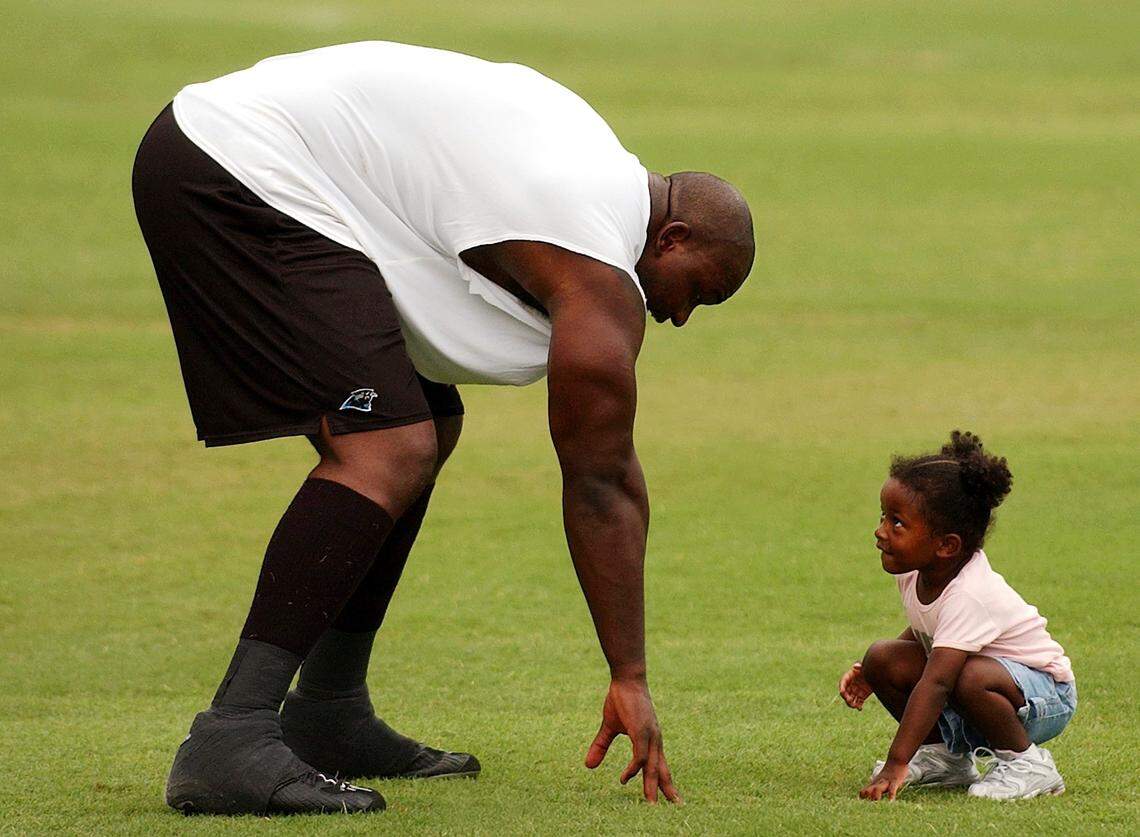
What the Panthers might do at pick No. 19
Wallace on what he expects the Panthers to do with their first-round selection:
“I still think the Panthers are still focused on making that offense as good as possible, just shoring up some loose ends,” he said. “And what I mean by that is a playmaker. I think this team still needs a playmaker. They have incredible skill position players, but do you have that home-run hitter? And I think when you look at the draft, there are a couple of positions: Wide receiver I still think is wide open, that playmaker at that position. TMac (Tetairoa McMillan), incredible offensive player, Rookie of the Year, just an incredible job. Jalen Coker.”
He continued: “But now I think you need to address a dynamic tight end, a pass-catching presence at the tight end position is something that the Panthers can still focus on. And being a big guy, playing in the trenches, you can never have too many offensive lineman. So continuing to build depth there.”
Wallace concluded by saying that “instead of looking at a singular position, what I’m really looking at is a dynamic playmaker on the offensive side. (Jonathon Brooks) is still there; you might already have that guy on the roster. But I think you can address that in the draft as well.”
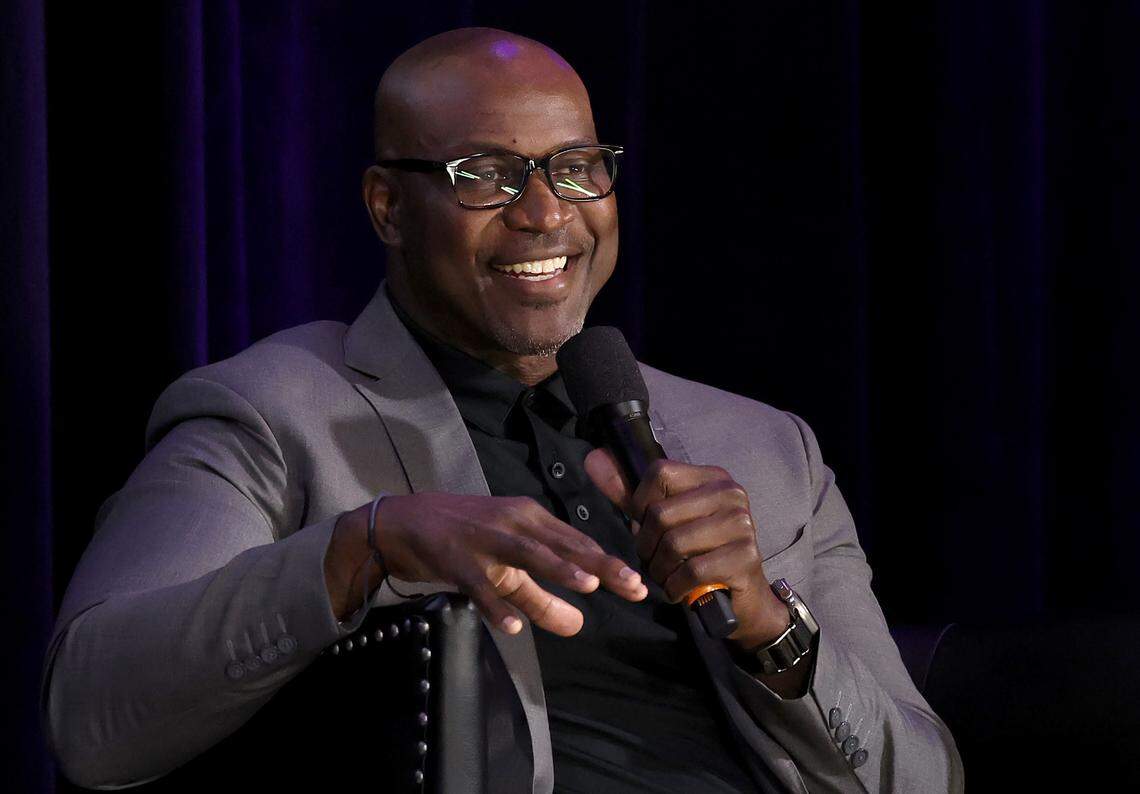
Kris Jenkins and how underrated he was
Kris Jenkins, who played alongside Wallace and Julius Peppers and Mike Rucker on that formidable Panthers line, might just be one of the most underrated Panthers ever. At least, Fowler, who’s covered every season since the franchise’s inception, thinks so.
Wallace agrees, too.
“(Jenkins) was just simply more dominant at his position as an interior defensive lineman than a 21, 20-year-old Julius Peppers was, who was still learning what it meant to be a pro,” Wallace said. “He was trying to absorb things from myself, and Buckner, and Mike Rucker, and he was starting to learn the position. What (Peppers) was: He was the most talented athlete maybe in the NFL at that time, size, weight, athletic ability.
“But Kris Jenkins was a tough pill to swallow for every offensive lineman.”
How Al Wallace looks back on NFL Draft night after going undrafted
Fowler suggested that Wallace should’ve been drafted — considering the defensive end’s tenure in the league and his contributions to the Panthers. But Wallace views that whole experience a bit differently, he said.
“No invite to the Combine (for me); I aced my Pro Day,” Wallace began. “But I’m going to go against you a little bit; I think I was appropriately drafted, or not drafted. Because what I was considered at that time, in 1997, the word was a “tweener.” Now they’re called EDGE.
“EDGE can be 235 to 270. But 255, when I came out of Maryland, I had a 37 inch vertical. I ran two 40s at 4.55 and 4.57. ... Those numbers would’ve garnered me, I think, a first-round draft score I think in today’s game. But in 1997, it was not the wide-open passing game that it was today, so I was considered a tweener. ...
“But what it did was show people what my strengths were, which was outworking the room.”
Check out the episode in full to hear the full conversation with Wallace.
This story was originally published April 8, 2026 at 6:00 AM with the headline "Why these Carolina Panthers remind Al Wallace of the franchise’s early 2000s era."

