
Ron Morris: How USC got Staley
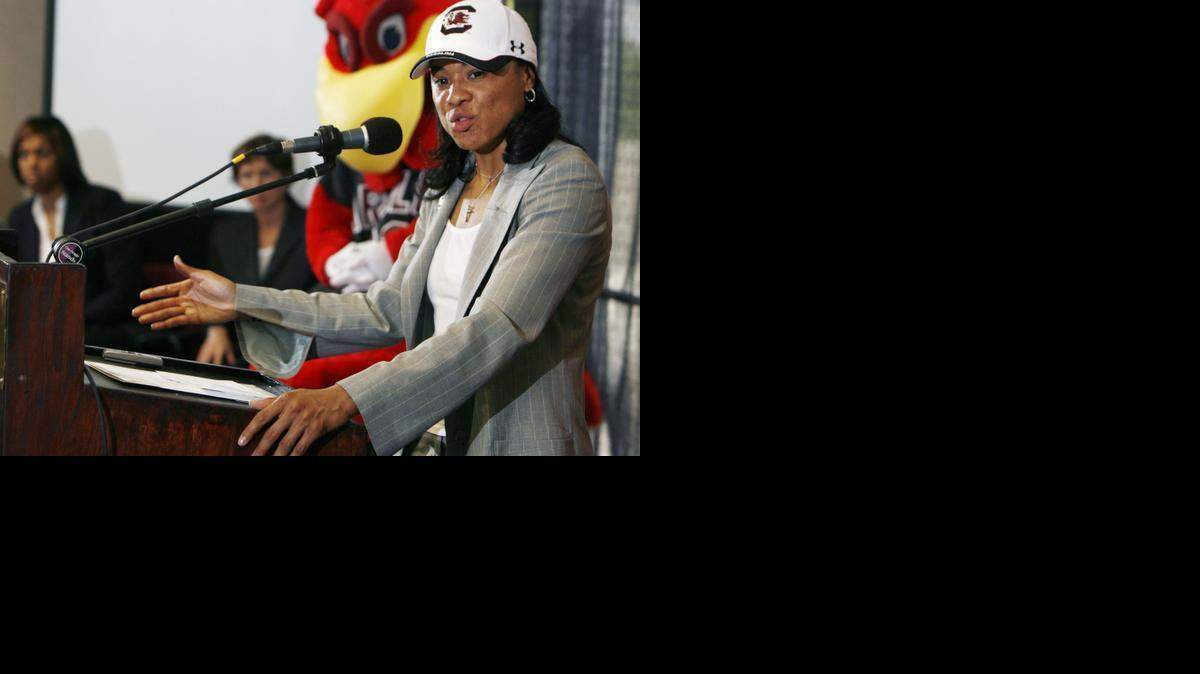
In the week after Susan Walvius resigned as head coach of the South Carolina women’s basketball team in mid-April of 2008, I received an unexpected phone call from an old friend in Dallas, Ralph Cross.
Cross was calling on behalf of his son, Tom, the agent for Temple women’s basketball coach Dawn Staley. Both wanted to know if there was any chance USC and its athletics director at the time, Eric Hyman, might be interested in talking to Staley.
The next day, Hyman added Staley’s name to his list of three finalists for the USC job. Within three weeks, Staley was introduced as the new head coach in what turned out to be one of the boldest hires in USC athletics department history.
Hyman said then that Staley could win a national championship at USC. Now in her seventh season, Staley has the USC program in its first Final Four and within two wins of that national title Hyman foresaw.
“One of hardest things about leaving South Carolina was leaving Dawn,” said Hyman, the athletics director at Texas A&M since 2012. “She’s special.”
Upon hearing of Staley’s initial interest in the job in 2008, Hyman immediately tapped his memory bank of Staley as both a player at Virginia and as a coach at Temple. Both instances left an indelible mark on him.
Hyman was an associate athletics director at North Carolina State in January 1991 when Staley and her Virginia team played in Raleigh in what still is considered one of the greatest women’s basketball games ever played. Second-ranked Virginia defeated third-ranked N.C. State, 123-120, in three overtimes.
As Hyman watched the game from press row, Staley was at her best that night as a junior point guard for the Cavaliers. She produced a rare triple-double, hitting double-figures in points (24), assists (11) and, amazingly enough, rebounds (10) despite her 5-foot-5 stature.
“I’m not saying I watched her (specifically), but I noticed her,” Hyman said. “I was impressed with her. So I knew who she was.”
By 2004, Staley was the head women’s coach at Temple and Hyman was the athletics director at TCU when the two programs played a first-round NCAA tournament game in Philadelphia.
“Wow, it must be hard to recruit to Temple,” Hyman said he remembers saying to himself prior to the game, which TCU won, 70-54. Still, Hyman said he was impressed by the level of talent Staley had assembled at Temple and with her program’s overall success. Staley led the Owls to six NCAA tournament appearances in eight seasons.
So, by the time Hyman brought Staley to Columbia for a job interview that spanned two days, he was well-versed in her history. She was the third coach to interview. Hyman will not reveal the other two candidates, other than to say they have had successful careers in women’s basketball coaching.
For Staley’s on-campus visit during the last week of April in 2008, Marcy Girton, a USC associate athletics director at the time, flew to Philadelphia on one of USC’s private planes. On the return flight, Girton learned that Staley was uncomfortable flying in small aircrafts.
Girton had done homework on Staley and knew of the coach’s affection for candy. When Staley arrived for her one-night stay at the Inn at USC, she found a basket of her favorite sweets – from BB Bats taffy to Sixlets to Hi-Chew – in the room.
Lunch the following day was prepared at Hyman’s home by his wife, Pauline. Attending were the Hymans, Girton, athletics department physician Jeffrey Guy and attorney I.S. Leevy Johnson, one of Columbia’s African-American leaders. Staley proved to be a finicky eater, only picking at her food. To this day she prefers a peanut butter-and-jelly sandwich at the office over fine dining.
Still, Girton was taken by Staley, and the two seemed to bond.
Hyman and Staley did not.
“I didn’t get the kind of connection with her that I would like to have had,” said Hyman, who noted that Staley carried a handful of cellphones – perhaps three – with her during the interview process and it proved to be a distraction. “She had a fortress around herself. It was hard. This was a little bit out of her element. I really didn’t connect with her to the extent you want to connect.”
Staley said she took a listen-and-learn approach to the interview.
“I’m a pretty guarded person,” Staley said. “I didn’t really know Eric besides our conversations during the interview process. . . . I like to get a feel for people. I like to observe. I like to hear where they are coming from, and then form an opinion.”
Hyman said he kept reverting to his two previous encounters with Staley and about how he was impressed that she had carried the American flag for the United States delegation in the Opening Ceremonies at the 2004 Olympic Games in Greece. That honor alone told him there was much more to Staley than he could derive from the interview.
Girton and Hyman met once Staley had returned to Philadelphia. Girton, now on Hyman’s staff at Texas A&M, suggested that Hyman visit Staley on her home turf. Maybe in more familiar surroundings, Girton believed, Staley would drop her guard.
Hyman flew to Philadelphia on Saturday, May 4, and was greeted at the airport by Staley. She escorted Hyman to the north Philadelphia government housing project where she was reared and where she learned to play basketball on neighborhood courts, mostly with and against boys.
For lunch, Staley had planned to take Hyman to Sabrina’s Cafe, but the 24-hour breakfast restaurant was full. So the two took a two-block walk to a Starbucks coffee shop. All along the walk Staley was met with hugs from friends and acquaintances.
Hyman was particularly struck by one man who rolled down his window in a passing car and shouted to Staley: “Dawn, don’t leave us!”
Their talk over coffee at Starbucks was constantly interrupted by well-wishers and old friends who stopped by to chat with Staley.
“I came to realize what a great role model she would be for young women,” Hyman said. “To go through what she had gone through and accomplish what she had accomplished to that point, it showed humble tenacity with a boatload of pride.”
Hyman left Philadelphia knowing he had found his new coach.
Upon returning to South Carolina, Hyman was late attending a birthday party that night in Greenville for Dodie Anderson, a USC benefactor. The following morning, Hyman and Girton gathered again at the Hymans residence and telephoned Staley to see if there was reciprocal interest in the job.
Hyman said there is a courting dance played during every interview process. He was aware that Staley turned down an offer three years earlier to coach the Alabama women’s team. He knew Staley might have some reservations about moving South, although Staley liked the idea of returning her mother to her South Carolina birthplace. At the time, Staley also had a brother living in Columbia and a sister in Raleigh.
Staley said a bigger concern was leaving Philadelphia. Despite her world travels through basketball and her 10 seasons of professional playing experience around the country, Staley had never called anywhere but Philadelphia home.
“I had never moved before,” Staley said. “I had never picked up a house and moved it to another state.”
Nevertheless, Staley said she wanted the job because “it was a great opportunity to tickle my competitive fancy.”
Girton wanted to make certain the two parties came to an agreement that Sunday afternoon because May 4 was Staley’s 37th birthday. Staley was hired on the phone, with details on a contract still to be worked out.
Staley’s belated birthday gift was presented three days later when the USC Board of Trustees approved a five-year contract that, at $650,000 annually in total compensation, made Staley one of the nation’s highest-paid women’s basketball coaches and the third-highest paid employee in the athletics department, behind football coach Steve Spurrier and incoming men’s basketball coach Darrin Horn.
Hyman said Staley’s hefty contract was the subject of much derision from other men’s head coaches within the athletics department as well as many members of the mostly male media.
“Some board members had to swallow hard because it was a substantial commitment, financially,” Hyman said. “To me, it wasn’t about that. I didn’t care. If you could get somebody like Dawn Staley, you have to do it.”
NCAA WOMEN’S FINAL FOUR
Who: South Carolina (34-2, 15-1 SEC) vs. Notre Dame (35-2, 15-1 ACC)
When: Sunday, 6:30 p.m.
Where: Amalie Arena, Tampa, Fla.
TV: ESPN (Dave O’Brien, Doris Burke and Holly Rowe)
Radio: 107.5 The Game (Brad Muller)
Other game: UConn vs. Maryland, 9 p.m.
Championship: Tuesday, 8:30 p.m.
This story was originally published April 4, 2015 at 7:49 PM with the headline "Ron Morris: How USC got Staley."