
Emanuel aftermath: Forgiveness, justice and work to be done
After the June 2015 massacre of nine African-Americans at a historic Charleston church by a white supremacist, relatives’ expressions of forgiveness stunned many in South Carolina and around the nation.
Rather than riots breaking out in Charleston, those expressions of mercy showed a beneficent, gracious face to the rest of the world. Those expressions also prompted a burst of resolve among both black and white South Carolinians to work to better understand one another and work toward better race relations.
Lawmakers quickly removed from the State House lawn the politically charged Confederate flag that had inspired killer Dylann Roof.
But some are having a hard time reconciling a desire for forgiveness with a need for justice now that they have sat through the trial and stared evil in the eye.
In some ways the trial and death verdict unsettled the state’s evangelicals, for one, because Roof did not regret his actions, said Oran Smith, president of the Palmetto Family Council, a Christian values policy research and communications group. Findings by the jury in giving Roof the death penalty included that Roof showed no remorse and would not change his beliefs if given a life sentence behind bars.
“That puts a Christian in a very difficult bind,” Smith said. “Before we can really forgive someone, we’d like to see contrition – the desire for forgiveness.”
“Christ said, ‘Forgive your enemies,’” Smith said. “At the same time, there is a strong sense of justice in the Christian faith. And Christ had a lot to say about those who refuse to repent.”
LOOKING FORWARD
Acting as his own lawyer, Roof refused to testify. In a statement to jurors, he said killing African-Americans was something he felt he had to do – and he still feels that way, he said.
Roof’s words tested the patience of the victims’ family members who had previously expressed forgiveness. Before the judge formally sentenced Roof to death on Wednesday, 35 family members and friends of those killed addressed him directly. Only a few said they hoped his life would be spared. Some compared Roof with Hitler and Satan.
Tyrone Sanders, father of slain 26-year-old Tywanza Sanders, told Roof he wished there was a law that required a condemned killer to have a limb cut off every time he filed an appeal.
“Instead of taxpayers taking care of you when all four limbs are cut off, let your parents take care of you,” Sanders said.
Sanders’ wife, Felicia, had more mixed feelings. A survivor of the massacre, she had seen had seen her son Tywanza and her aunt, Susie Jackson, 87, killed by Roof during that Wednesday night’s Bible study class.
“I feel sad for you,” she said, her voice seething with obvious contempt as she stared down the killer, who looked straight ahead. “Yes, I forgive you. That was the easiest thing. But you can’t help somebody who doesn’t want to help themselves.”
Clutching her blood-stained Bible, she continued, drawing out each word, her voice rising. “When I look at you, I just see somebody who is cold, who is lost, who the devil came back to reclaim. ... I don’t know what else to say to you, but I am going to end with this: May God have mercy on your soul.”
“It is more about healing themselves than it is him. They refuse to allow the power of hate to dominate their lives by hating him,” Neal said.
Other dynamics are in play, too, said nearly a dozen state leaders in race relations interviewed last week.
Engagement and working on projects that promote better racial understanding are vital, said Riley, who last week began teaching a course at The Citadel, his alma mater, in political leadership. It is centered around his 40 years as Charleston mayor and includes race relations and the church massacre – “the saddest night of my life,” Riley said.
For years, Riley has worked on a major project he hopes will help bring people together – a museum dedicated to South Carolina’s African-American history, from slavery to civil rights. Groundbreaking on the $75 million museum, on the site of the Charleston wharf where hundreds of thousands of African slaves first set foot on the mainland, is set to begin by December, he said.
“It would be wrong if we didn’t ask ourselves how we can honor these people who died,” Riley said of the dead at historical “Mother Emanuel.” “What better way than to keep moving forward?”
Another major outreach backers hope will improve race relations statewide is ongoing at the University of South Carolina. Called the S.C. Collaborative on Race and Reconciliation, the project will send teams trained to initiate discussions between the races out to communities.
Once in place, the teams will work with local groups to foster understanding. They will also come up with projects both races can agree to work for to better their communities, said collaborative coordinator Bud Ferillo of Columbia.
The Charleston church killings have galvanized the discussions about the state’s racial gulf by illustrating what can happen if the races don’t work together, Ferillo said.
A SENSE OF UNEASE?
Meanwhile, a sense of unease pervades some across the state who wonder if other Dylann Roofs, hoping to start race wars, are out there.
“A lot of churches are still asking us to give security classes, and we respond to every one,” said SLED chief Mark Keel. He said when his agents hold “active shooter-type” classes in rural communities, they often teach members of black and white churches in the same session.
“The classes have obviously increased since Mother Emanuel,” Keel said.
In the coming legislative session, there are issues that somewhat will divide lawmakers along racial lines.
Many white lawmakers want to spend $3.6 million to create a place to house the flag and expand the display space at the S.C. Confederate Relic Room in Columbia. That is sure to be opposed by many black lawmakers and some white ones as well, said Neal.
“It is unfortunate, but there are still some in the Legislature who cannot accept the link that Roof forged between racism, hate and the Confederate flag,” Neal said. When the vote to take down the flag was over, some white lawmakers called whites who had voted to take it down “traitors,” Neal recalled.
Roof, who was actually ineligible to buy a gun because of a prior drug arrest, managed to buy his Glock .45 two months before his shooting rampage because the FBI wasn’t able to find his criminal history within three days. So the gun shop sold him the weapon.
Even with Roof’s example, many lawmakers might not want to inconvenience gun buyers by making them wait longer, Kimpson said.
MORE TO BE DONE
Their strength was an example to the state, McAlister said.
“They have had to sit there, day in and day out, and listen to the embodiment of evil,” McAlister said. “Not only did he not apologize, but he underscored justification for his cause.”
First Baptist Church Pastor Wendell Estep said Roof’s actions have pointed to issues the community should explore.
“The basic issue that we have is a spiritual issue,” Estep said. “There is a desperate need in our land for an awakening or a revival where people wake up to the word of God. We don’t like to think of it, but there is evil in the world.”
Among other difficult issues the state has to explore are the roots of inequality in Charleston, said Jon Hale, an education professor at the College of Charleston, who specializes in American education during the civil rights movement.
Charleston, Hale said, was a divided city before the shooting and remains that way. The city faces major economic issues with its people of color; including gentrification of downtown neighborhoods that make it hard for minorities to stay.
The time to explore those issues was right after the shooting, he said. But the country was still reeling from the riots that had taken place in Ferguson, Mo., and Baltimore. When Charleston faced its own tragedy, the narrative of forgiveness was partly imposed on the city, Hale said.
The narrative dismisses the reality for the city’s minority population, by isolating Roof’s actions as an individual act of hatred instead of a symptom of a larger issue, Hale said. “I think people missed the larger picture.”
State Public Safety director Leroy Smith said South Carolina does an exceptional job managing its crises, including the church tragedy and major floods.
Smith said after the shooting he, too, saw people of different races and denominations worship together. And the state set a tone for the rest of the country, he said.
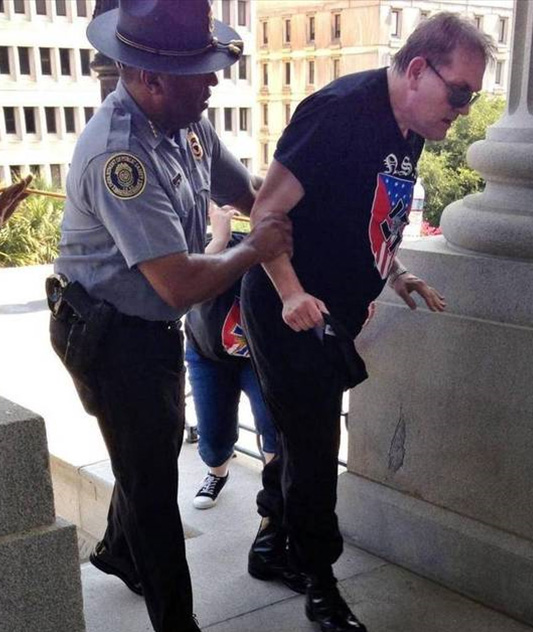
As the loved ones of Emanuel’s slain depended on their faith when expressing forgiveness at the height of their pain, Smith, too, acted instinctively.
Shortly after the killings, Smith was in charge of security during a Ku Klux Klan and neo-Nazi rally at the State House. The white supremacists were protesting the removal of the Confederate flag from the State House lawn. Suddenly, a man wearing a Nazi-themed T-shirt was overcome by heat.
Smith, an African-American, sprang forward to help the man out of the blazing sun. A photograph of the act was shared around the world.
“I saw a gentleman who needed help,” Smith said. “I was definitely going to help him regardless of race, skin, color, beliefs or group affiliation. That’s what law enforcement officers do. We don’t see color. We don’t see race. It’s all about helping someone.”
This story was originally published January 14, 2017 at 6:46 PM with the headline "Emanuel aftermath: Forgiveness, justice and work to be done."