Fairfield County administrator Jason Taylor sits in his small office on the third floor of the leaky 1930s-era former Winnsboro Mill community center, which serves as the county administration offices.
The Fairfield County Government Complex building in Winnsboro, South Carolina. C. Rush online@thestate.com
Around him are plans and drawings for myriad projects the county has been working on for years in anticipation of the $80 million windfall from two new nuclear reactors that were being built by SCE&G and Santee Cooper in Jenkinsville.
There are plans for building water and sewer systems, improving parks, beautifying neighborhoods, renovating the county’s historic courthouse, turning the old Mount Zion school into new county administrative offices and many more.
But most importantly, there are plans to run water and sewer lines to the county’s new 1,200-acre industrial park mega-site on Interstate 77 – a park that county officials hope will land a big manufacturer like Boeing or Volvo, which have built or are building plants near Charleston. Now, after SCE&G and Santee Cooper abandoned the construction project, those dreams have evaporated.
Last week, the two utilities announced they were abandoning the project because of rising costs and because of the bankruptcy earlier this year of the project’s main contractor, Westinghouse. About 5,000 construction workers lost their jobs.
“This has got be one of the biggest disasters in state history,” Taylor said, eyes red from lack of sleep. “But we’re not going to curl up and die.”
At the Fairfield County School District offices, Superintendent R.J. Green had also been formulating plans. He wanted to raise salaries for his teachers above the Southeastern average. “It’s hard to attract teachers to rural areas,” he said Wednesday.
And he would have made improvements to his school buildings, some of which go back to the 1960s. “We were hopeful,” he says.
Although the school district was not part of an agreement that would have allowed SCE&G and SCANA to pay fees to Fairfield County instead of property taxes for the two new reactors, County Council members had indicated the school district would have shared in the windfall.
Former state Rep. Boyd Brown said the $80 million from the new plants was supposed to put Fairfield County back on the map. “They’ve been planning for decades ahead to change Fairfield County forever,” he said.
‘Whales’
In the past two weeks, about 730 residents in the rural county of 22,000 people have lost their jobs. That includes about 500 county residents who worked at the now-abandoned construction site and 230 jobs lost two weeks ago when the DuraFiber Technologies plant that occupied the Winnsboro Mill shut down.
"They didn't even thank us for our work" says former Jenkinsville plant employee Diana Robinson as she speaks to Fairfield County Councilmen about the unprofessional manner in which her and coworkers were advised of the nuclear reactor's closing. C. Rush online@thestate.com
That’s not to mention the 800 or so people the two reactors would have employed when the estimated $14 billion project was completed by 2024.
And people still talk about the last big defection – Mack Trucks in 2002, which shed 600 jobs. Two years ago, even the Walmart on U.S. 321 closed.
Fairfield officials have watched as their neighbors have landed what industrial recruiters call “whales” – large manufacturing plants that can turn a rural county’s economy around.
In Chester County, which adjoins Fairfield to the north, Giti Tire chose Richburg for a $560 million plant that will employ 1,200 workers. It’s set to open later this year and is presently hiring.
To the west in Newberry County, Samsung in June announced it would build a $380 million manufacturing plant that will employ 950 people. It will build large appliances.
And to the south in Richland County, Chinese fiberglass manufacturer Jushi is building a $300 million plant that will hire 400 people, with a second, identical plant to follow.
‘We won’t default’
Ty Davenport, the county’s economic development director, noted that Fairfield is just as well positioned, if not better, to land a whale: It is located on Interstate 77, just about halfway between Charlotte and Columbia, and those cities offer amenities from airports to sports to dining to the zoo.
Any company locating there would also have access to an ample labor force between Charlotte, Rock Hill and Columbia.
Also, the cost of homes and property in Fairfield County is very reasonable. And the county has two lakes.
“You can’t find a negative in this county except water and sewer capacity,” Davenport says.
So the county purchased the I-77 mega-site for $8.9 million. Bringing water and sewer to the site was planned to be a partnership between Fairfield County and the S.C. Commerce Department, estimated at $30 million to $50 million.
And just last week, only days before SCE&G pulled the plug on the two reactors and sent about 5,000 workers home, County Council had given initial approval to build a second industrial park – 508 acres on Interstate 77 between S.C. 41 and S.C. 200 — for about $2 million.
Whether those projects go forward now is uncertain, Davenport said. But Fairfield County still receives $28 million a year in taxes from SCE&G for the one operating reactor.
County officials in 2010 agreed to to borrow $24 million, and about half of that has been spent on two fire stations, two EMS stations, water and sewer projects and a police and fire communication system.
Taylor says the county has the money to cover the bond debt without raising taxes. “It will stress us, but we won’t default,” he says.
Whether the county will go forward with plans for the other $12 million — fixing up the county courthouse and renovating Mt. Zion school — is uncertain. “We have to start to evaluate options,” Taylor said.
‘Promises were broken’
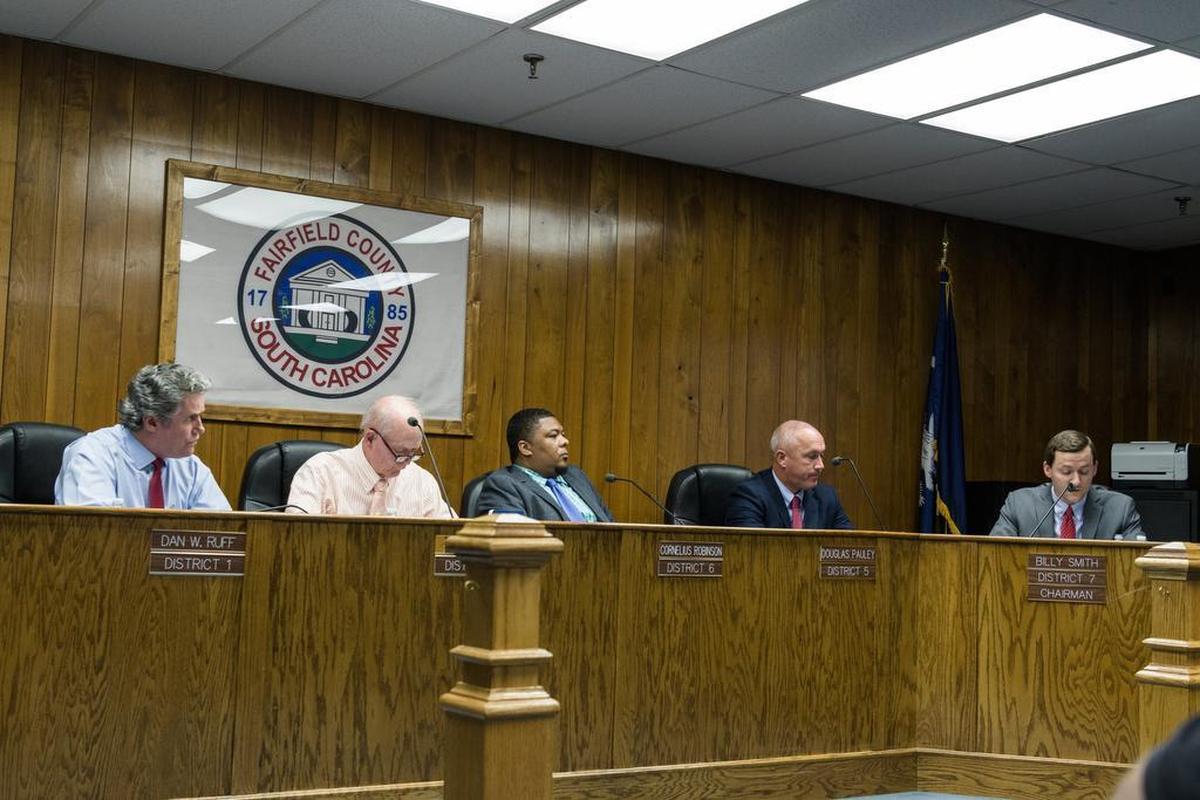
The Fairfield County Council holds an emergency session to discuss community concerns about the failed Jenkinsville nuclear reactor. C. Rush online@thestate.com
County Council held an emergency meeting Wednesday to huddle privately with attorneys and consultants to determine if any legal action could be taken against SCE&G.
Prior to going behind closed doors, Chairman Billy Smith Jr. called the shutdown a “sucker punch,” a “betrayal” and “reprehensible.”
“This could evolve into a serious legal matter,” he said.
Council Chairman Billy Smith of District 7. C. Rush online@thestate.com
Council members and citizens all expressed solidarity with each other and the community. But fingers were pointed squarely at SCE&G. “Promises were made,” said council member Cornelius Robinson, whose wife, Diana, worked at the site. “Promises were broken.”
Councilman Cornelius Robinson of District 6, left, and former Jenkinsville plant employee Diana Robinson C. Rush online@thestate.com
No action was taken after the huddle with attorneys. But Smith, the chairman, said Fairfield’s efforts to deal with the disaster are just beginning. “We’re just starting to scratch the surface,” Smith said.