Charleston removed the Calhoun statue. Now comes the hard part: Deciding where it goes
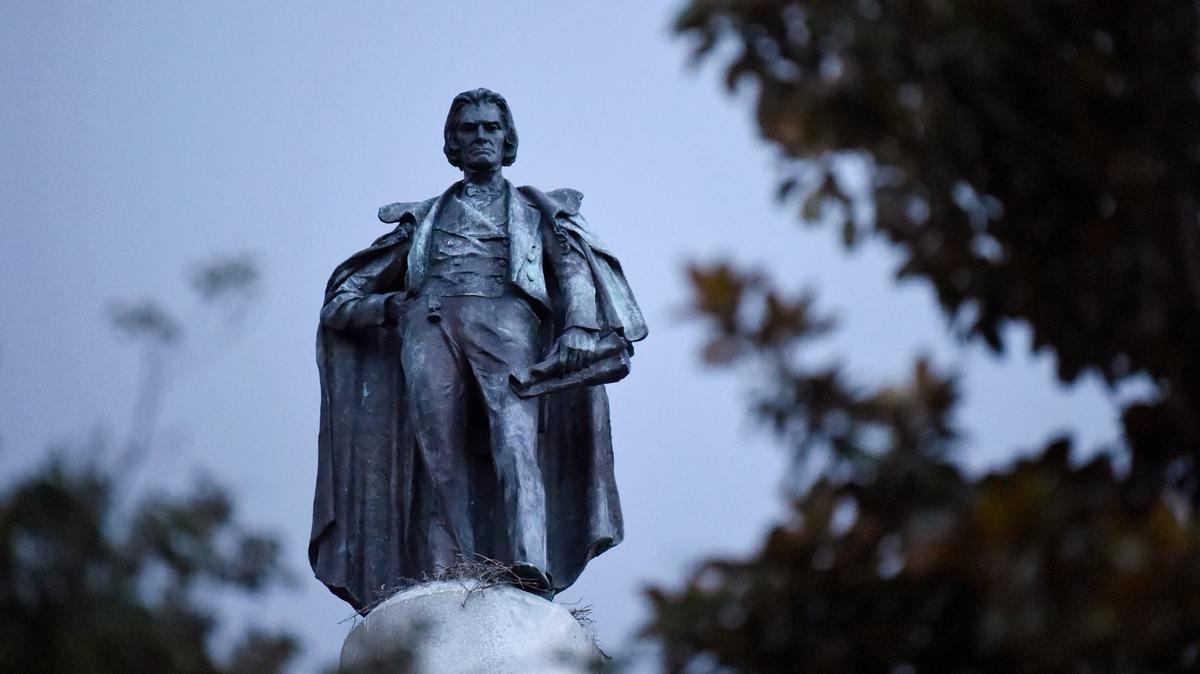
On a humid summer night, in the middle of a pandemic and during a national moment of racial reckoning, leaders in this old port city last year all agreed it was time to evict a statue of John C. Calhoun from its elevated place of honor.
The Calhoun monument’s undoing would take more than 17 hours, as crews struggled to detach and lower the towering testament to the nation’s seventh vice president and one of the 19th century’s most influential defenders of slavery.
Yet more than a year after the 12-foot, 8-inch statue was placed on the flatbed of a semi-truck and hauled away, Charleston is still struggling to define Calhoun, his legacy and how the city thinks America should view the South Carolinian now.
The past is complicating a possible future for the Calhoun statue.
In an almost two-hour meeting Wednesday, the city of Charleston’s history commission wrestled with a request from two art curators who want to include the 3-ton statue in a Los Angeles art exhibit.
The exhibit, slated for fall 2022, will display decommissioned Confederate and Civil War monuments that have come down since 2015 amid America’s racial reckoning over which symbols should still be honored in the public square.
The proposal was met with a stream of questions from commission members: Who decides what is said about Calhoun and the monument? Which scholars are involved in the project? Will the monument be treated with respect?
Hamza Walker, the art curator who presented the idea to the history commission over a Zoom meeting, emphasized that the art show is not about shaming the South.
“This exhibition is about the soul searching we have to do as a country,” Walker said.
It did not convince commission member Robert Rosen.
“There are people living in Charleston whose ancestors raised the money to build this and saw Calhoun differently than some other people see him,” Rosen said, later adding, “So I’m really not on board, you know, with this whole political correctness, let’s shame everybody.”
During his presentation, Walker tried to make the case that this exhibit at the Los Angeles Museum of Contemporary Art would be of national importance. He said it will be an opportunity to create a space for civil and honest exchange in an increasingly divisive time.
Then, Walker pleaded, “We can’t do it without you.”
Calhoun concerns resurface
For now, the commission in Charleston has decided to delay its vote on the curator’s request. The group said it will take at least a month to get more information about the exhibit, how the Calhoun statue fits into the art show and whether it’s a suitable temporary home for the monument.
However, the initial and wary reception the proposal has received underscores how difficult it may be for the city to find a permanent home for the bronze statue that towered over Marion Square for nearly 124 years, signaling that the fight over this monument is far from over.
Commission member David McCormack said he had heard enough. Reading from his notes, McCormack said he does not want the Calhoun statue to become “a pawn” in the hands of people and organizations over which the city has no control and, therefore, would not support the request.
“Like him or not, John C. Calhoun was and is one of the most important South Carolinians in our state’s history, and one of the most important and influential Americans of the 19th century. Yet the current view of him largely ignores his accomplishments and focuses myopically on one issue, which is slavery,” he said, concluding that he believes the exhibit would “continue to propagate this unnuanced view of Calhoun.”
“The fact that he was pro-slavery and foreshadowed the Civil War is, I would say, pretty big,” Walker fired back, his voice rising up into a laugh that cut the note of tension on the call. “And this (exhibit) is the occasion where we want to open that up.”
During his presentation, Walker had described Calhoun, the man, as a “complicated figure” and Calhoun, the statue, as a “complicated piece.”
In a sign of how fraught these monuments remain even after their removal, Walker said it would be “easier for me to contact a museum in Italy to ask them to borrow an old masterwork” than it is for him to call municipalities like Charleston about their controversial statues.
‘We have to call a spade, a spade’
The national reckoning over Confederate symbols and monuments began in 2015 after a white supremacist shot and killed nine Black parishioners at Charleston’s Emanuel AME Church.
The country renewed its focus on Confederate and segregationist symbols again in 2017, after the deadly “Unite the Right” rally in Charlottesville, Va., and again in the summer of 2020 following the police killing of George Floyd in Minneapolis.
The death of Floyd, however, inspired the greatest action. According to an annual tally by the Southern Poverty Law Center in Montgomery, Ala., some 168 Confederate symbols were removed from public spaces across the U.S. or renamed in 2020 after Floyd’s killing.
Though the Calhoun statue was also brought down that year, it is not considered a Confederate symbol because Calhoun predates the Civil War.
Now, in 2021, cities are grappling with what to do with the troublesome honorifics they’ve publicly removed.
Last month, a museum dedicated to Black culture and history in Charlottesville, Va., said it would like to melt down a statue of the Confederate general Robert E. Lee. The Jefferson School African American Heritage Center said it would then commission an artist to use the melted bronze to create new works of art.
Charleston, meanwhile, has struggled to find a new home for its Calhoun monument — permanent or otherwise.
Rosen said the city had hoped the monument would find a new and appropriate display in either the South Carolina State Museum in Columbia or at the Charleston Museum. So far, though, there have been no takers.
The art exhibit proposal on Wednesday was the first public discussion about what should happen to the Calhoun monument.
Commission member Willmot Foster said he once thought the best place for the Calhoun monument would be in a Confederate graveyard so that “he could get credit for the many lives that were lost in the Civil War.”
“When you look at these works that were meant to aggrandize folks who were dehumanizing other folks, we have to call a spade a spade,” Fraser said. “We have to look at who these figures really were and what they mean.”
And after hearing Walker’s presentation, Foster said he would “wholeheartedly” support the statue’s inclusion in the exhibit and reminded his colleagues that City Council would still be the ultimate decider of the statue’s fate if the history commission approved the request.
“It gives the statue a new life and allows it to perhaps begin to redeem itself of the evil that it represents in the minds of many,” Foster said, “because we can learn from it, because it can make us better people.”
Council member Harry Griffin, who is also a member of the history commission, suggested delaying the vote. He predicted that the conversation will be the “first of many” about the fate of the Calhoun monument.
Reached for comment after the meeting, Walker told The State that he welcomed the discourse he heard during Wednesday’s meeting.
He also said he he understands why cities like Charleston are protective of their statues.
“Behind that knee-jerk reaction, there is a very real kernel of consideration about who are these figures in the round,” Walker said.
Other cities, he said, aren’t ready to go there, as evidenced by an email he received from another city’s administrator who told him, “No, it ain’t happening.”