SC living in two different worlds as normalcy and chaos try to co-exist during COVID
There is an unsettling disconnect in the rhythms of South Carolina these days, when normalcy and crisis clash and co-reign.
More than a year and a half into the coronavirus pandemic that has killed some 12,000 South Carolinians — nearly 1,900 dead in the past month alone, as the fatality rate speeds up — early fall life looks much like it always has for many people who crowd into restaurants, sporting events, concerts and church services.
While tens of thousands gather in college football stadiums, hospitals strain under a worsening surge of COVID-19 patients. While one community mourns the deaths of two schoolchildren, among COVID’s youngest victims, passionate crowds fill school board and council chambers to protest mask mandates. While lines of cars wait for hours at a drive-thru coronavirus testing site in the state capital, half of the state’s eligible residents still wait or refuse to be vaccinated.
The discord is striking in that each of these moments coexist with the others — the mirth alongside the sorrow, the fear alongside the vitriol.
As the pandemic worsens, these clashing moments mingle across the Palmetto State.
‘Back to normal’ under a Carolina sky
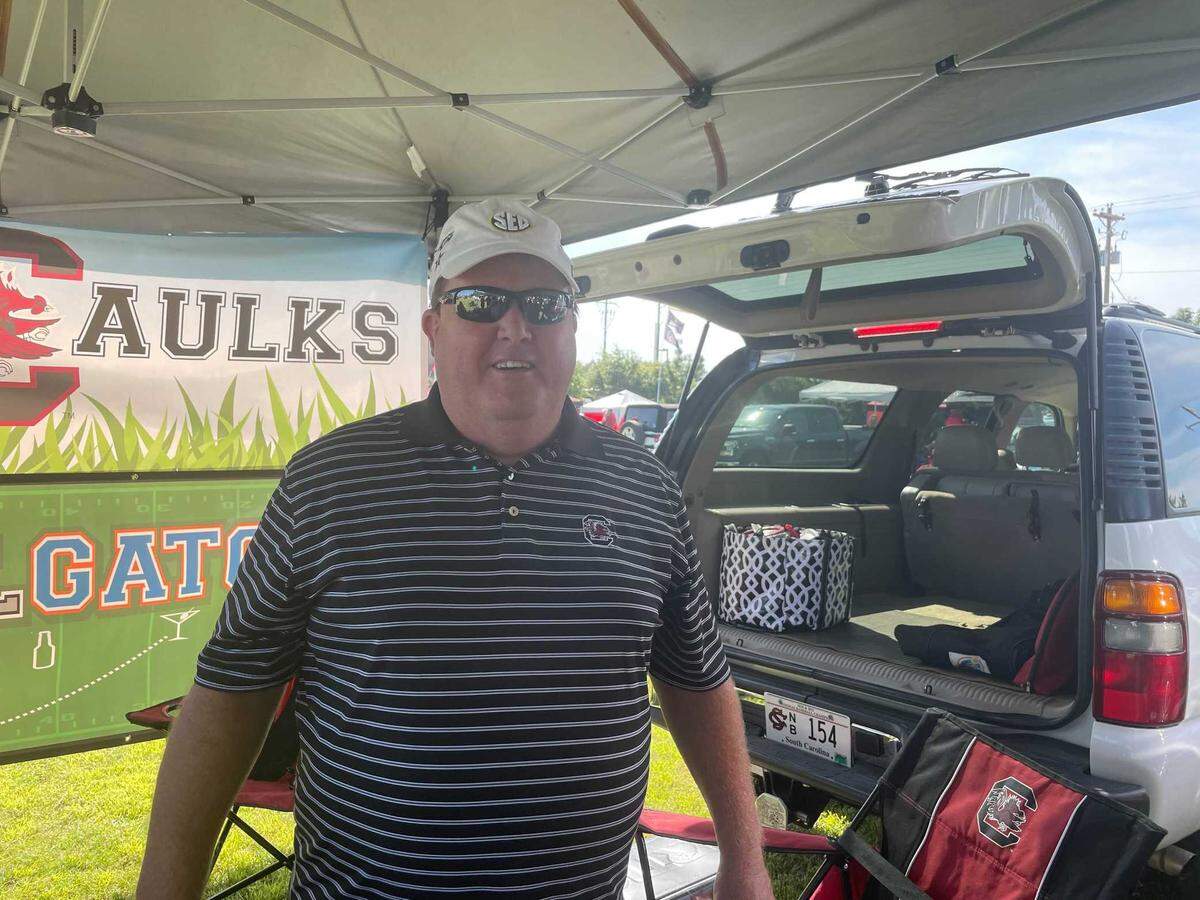
Grills and garnet spread across the grassy area of Gamecock Park in front of Columbia’s Williams-Brice Stadium on a recent Saturday. The tents and tailgates have returned for the first time in two years for South Carolina football’s 2021 season opener on Sept. 4.
Country music blares from parked trucks, where friends and families set up lawn chairs, eat hot dogs and sip beer. Footballs and cornhole bags fly through the hot September air.
The thrill of football’s return is almost palpable in the air, mixing with the smell of freshly cut grass and barbecue sauce.
Fans haven’t just missed out on football. They’ve missed out on the connections it brings.
“This is as much about our friends and being together,” says Jay Ratterree of Columbia, as he and his friends break in a new parking spot for their tailgate.
Their traditions, put on a shelf last year, are back in full force — a themed cocktail for each game, a snack spread with slaw, dips and deviled eggs and old friends walking up to say hello.
“This is about getting back to normal,” Ratterree says.
A short time later, the city of Columbia passes a mask requirement for fans inside the stadium.
City officials say it’s a mandate born of necessity. Some 12,000 South Carolinians were dead from COVID-19, 726 of which lived in Richland County.
But the message does not seem to resonate.
At the next home game, throngs of fans cheer and hug, their arms rubbing they stand so close. No masks are in sight.
A parent’s fear realized
Charlie Starkey wakes in the middle of the night and can’t get back to sleep.
He wanders out to the darkened family room and sits down lightly next to his daughter, Abbie, who is sound asleep on the couch.
He checks his phone and sees the results have come in for the COVID-19 test his daughter took earlier in the day. He refreshes the page and checks it again. He picks up his glasses to make sure he’s reading correctly.
“I was stunned,” he says. “There was this little bit of disbelief because we had been so careful over the months.”
Abbie was positive for coronavirus.
Suddenly in a panic, Starkey returns to to the bedroom to wake his wife, Nicole, to form a plan. Their daughter, Abbie has Down syndrome and a history of respiratory illnesses, two factors that can make her more vulnerable to complications from the virus.
COVID has already stolen too much from the family. Charlie lost both his parents to the virus just eight months earlier, just two days apart.
He won’t let it take one of his children, too.
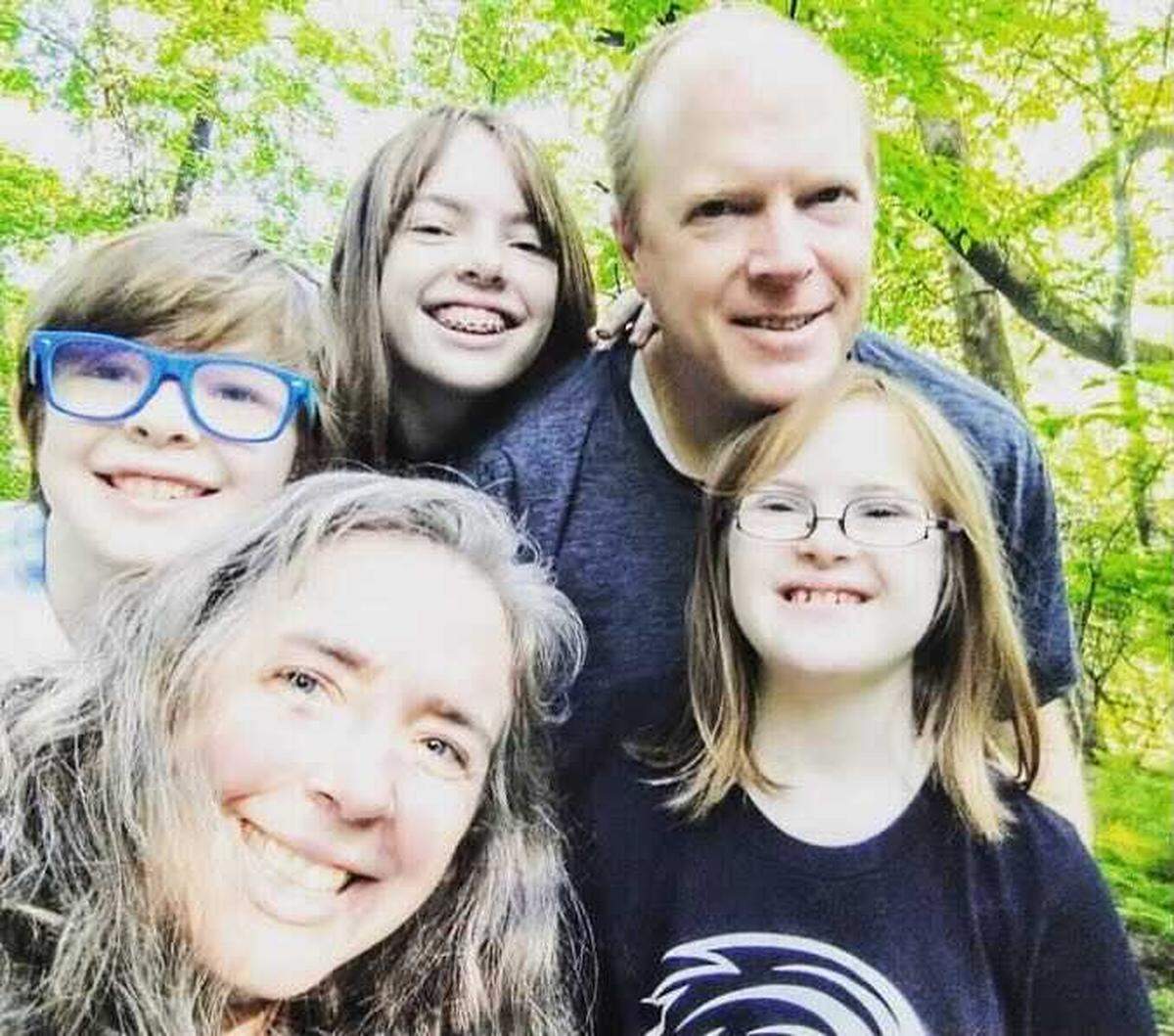
The next day, the couple scurry around the house, grabbing blankets and pillows, doing their best to separate their three daughters to different parts of the house.
Emma, 9, takes the dining room; Abbie, 12, stays in the living room; Maddie, 14, sleeps in her bedroom. Nicole keeps her room, while Charlie makes a bed in his office. Within days, the mom and youngest sister test positive, too.
For the next two weeks, the Starkey family, who live in Clemson, do their best to quarantine, even wearing masks inside their home. Charlie and Maddie, who never test positive, make meals and set them outside the doors of each room.
“It kicked up ‘shelter-in-place’ to a whole new level,” Charlie Starkey says.
The girls experience cold-like symptoms, including stuffy noses, coughing, fatigue and stomachaches. Mom’s symptoms are worse, though, and include a sinus infection, blistering headaches and bronchitis that requires nebulizer treatments.
The Starkeys believe Abbie caught the virus at school. Lax masking requirements in Pickens County schools made it more difficult for the family to avoid the virus, despite trying to do everything possible to protect themselves, including cutting out after-school activities, limiting outings and wearing face masks around others.
“It was scary,” says Nicole Starkey. “We thought (the kids) would be returning to a relatively safe environment.”
After consulting with doctors, Abbie is luckily able to receive monoclonal antibody treatments and is feeling better within days.
Alicia Tolbert, a family doctor in Clemson who works at a COVID testing site where the Starkeys got their results, says the family is a small sample of the roughly 100 people who test positive at the site each day.
Tolbert watched as COVID numbers significantly decreased when masks were mandated in many schools and public places last year. When the mandates were lifted, cases shot up again. Pickens County schools were the among the first to close and go virtual after only a few days of classes. The county currently leads the state for the most cases per capita.
“We are at the epicenter of the outbreak here,” Tolbert said.
Racing back to traditions
The smell of burned rubber and engine noise linger in the air as excited fans begin arriving early on a Sunday morning for a Labor Day weekend tradition: racing at Darlington.
“Everyone around us was having a great time in the Pearson Tower. My friends in the infield were having a blast,” John Wall, of Hartsville, said. “There seemed to be a little normalcy.”
Past races at Darlington Raceway have attracted fans from all 50 states. Jackson Baumgartner says he drove all the way from Ohio to be at the track where the grandstands looked to be about three-quarters full, out of a 47,000-seat capacity.
There is no restriction on the number of fans allowed to attend the race — not like in the spring, when NASCAR limited attendance to 35% of the track’s capacity, or last Labor Day, when South Carolina officials restricted Darlington to fewer than 10,000 fans.
Back in May, the last time fans came to Darlington, the state was posting some of the lowest coronavirus infection numbers since the early days of the pandemic. Now, the state is recording some of its worst statistics since the start of the pandemic, including hundreds of COVID-related deaths each week.
Even so, there’s no face mask requirement, although some fans wear them in the stands.
Vaccinations were available at the track thanks to a partnership between Darlington Raceway and the state’s health department. A similar event back in May resulted in 5,000 people getting a shot.
Four months later, only about half of South Carolinians are vaccinated. The state has one of the lowest vaccination rates in the country, and one the highest recent rates of COVID-19 infections among all states.
The vaccination question
After finishing his Friday afternoon route, Lexington-Richland 5 school bus driver Gary Feltman steers home to pick up his son, Matthew. It’s the child’s 12th birthday, and the two have an unconventional trip planned.
“We went straight to Walmart,” Feltman said.
En route, Matthew peppers his father with questions about the birthday outing.
Why did he have to get a COVID shot? Matthew wants to know. Many of the kids in his class aren’t vaccinated.
Feltman, a vaccinated Chapin resident who has an underlying health condition that makes him more vulnerable to severe complications, tells his son it’s the right thing to do, and that people who are vaccinated rarely get seriously ill if they catch the virus.
The shot also means protection for schoolchildren. The delta variant, about twice as contagious as the original version, has spurred an increase in cases among kids. They are now being infected at nearly triple the rate they were at the height of the pandemic between December 2020 and February.
He couldn’t speak for why other parents declined to vaccinate their kids.
“I’m only responsible for you,” Feltman, 65, tells Matthew. “And your mother and I have decided that this is what needs to happen, and that’s it.”
The wait for a COVID vaccine at the Dutch Fork Walmart this day is lengthy.
Matthew burns off nervous energy, running a shopping cart around the expansive pharmacy area.
When the boy’s name finally is called, the pair step behind a portable partition where a pharmacist meets them for the inoculation.
“What are you going to do when your hair falls out?” Feltman quips, hoping to put his son at ease.
Matthew doesn’t appreciate the joke, but he loosens up after the pharmacist offers some words of reassurance.
He slips the collar of his light blue long-sleeve shirt over his shoulder and looks away as the pharmacist quickly sticks the needle into his left upper arm. Afterward, he rubs the arm a bit and complains of a little pain, but for the most part is in good shape.
Feltman breathes a sigh of relief.
His son is now on his way to being protected against the coronavirus.
“My sole goal in life right now is to stay alive until Matthew graduates from high school,” Feltman says. “That’s what I’m working towards. This pandemic is not helping.”
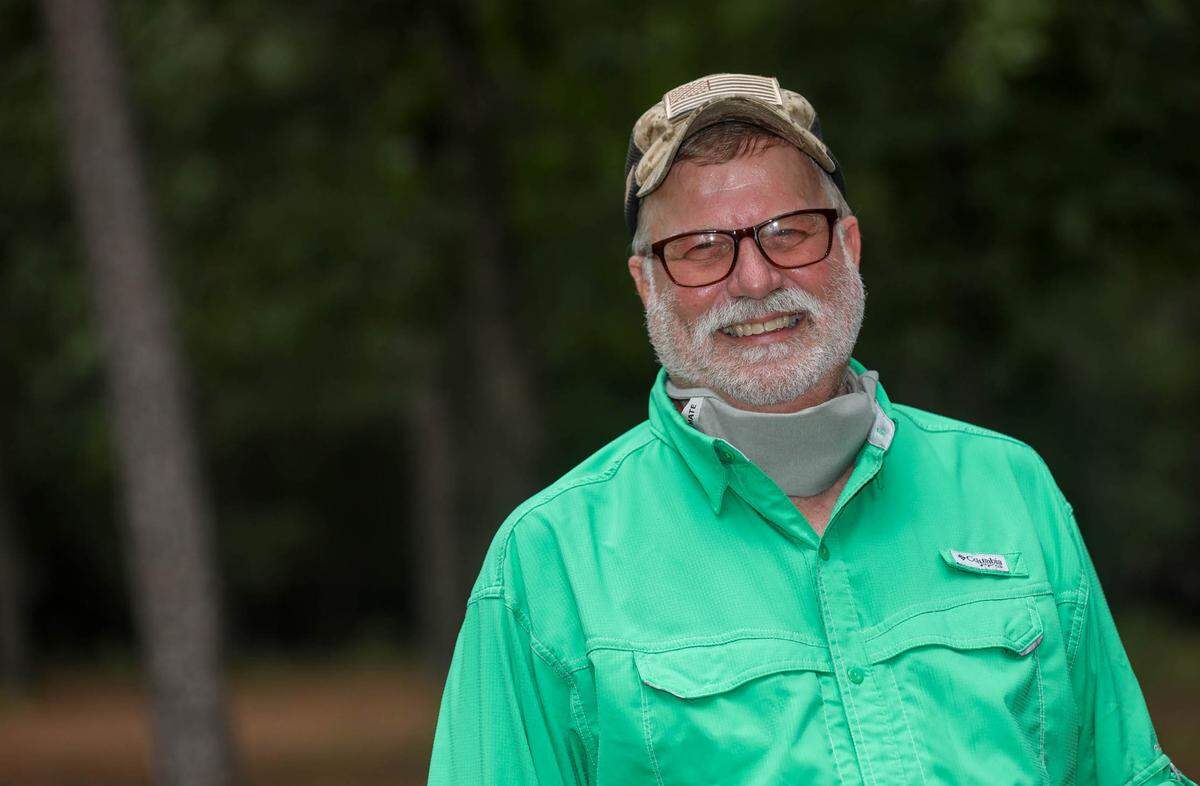
‘This is America,’ where mask wars rage
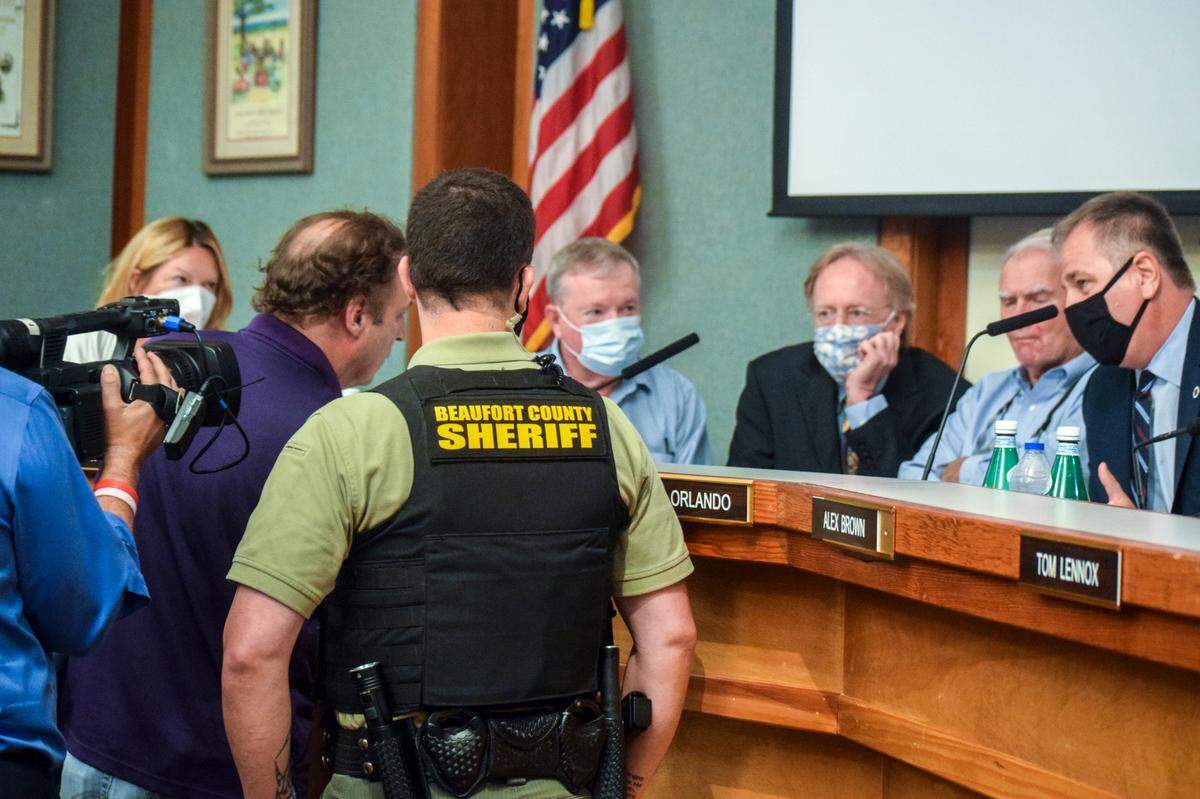
The Hilton Head Island Town Hall is filled with jeering taunts, as anti-mask activists mock the mayor’s pronunciation of “agenda.”
The maskless group, for the better part of two hours on Aug. 17, berates the town council. The agitated crowd argues that the town must not pass a local COVID-19 state of emergency order because it could be used to implement a new mask mandate on Hilton Head.
The activists shout down bewildered politicians, wander around the council chambers, spread COVID-19 misinformation and carry handmade signs reading, “FREE THE SHEEPLE,” “NO MASKS” and “CHOICE NOT MANDATE.”
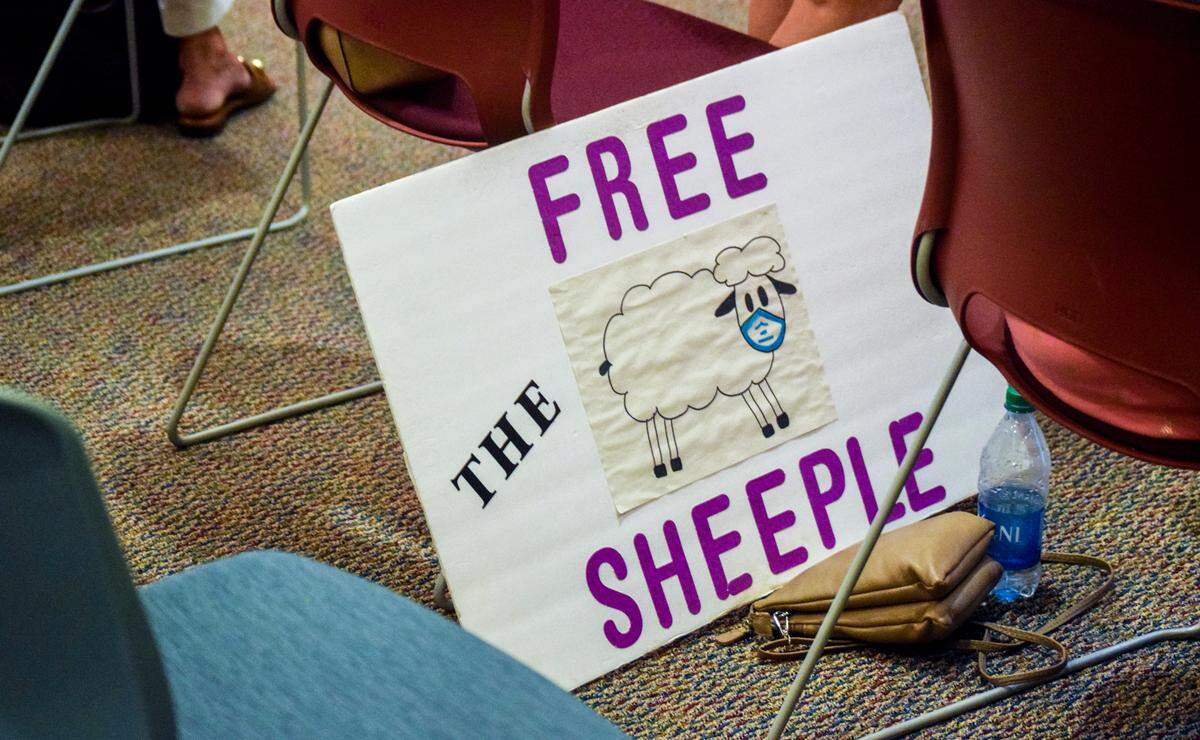
“You are killing our children. You are making them depressed,” one woman tells council members, adding that school face covering rules were driving kids to “hate life.”
“You are promoting something that is not good for humanity,” another person says, angrily pointing at local leaders.
“This country is being attacked and destroyed,” adds a man who is wearing a white shirt decorated with birds and flowers. “You have the opportunity to show the state, the world, a precedent for right versus wrong. Good over evil. God versus Satan.”
The council eventually has enough.
It votes 5-0-1 to support the state of emergency order, ending the meeting early. Elected officials leave the chambers flanked by deputies from the Beaufort County Sheriff’s Office and later work to tighten security at Town Hall.
But council member Glenn Stanford notes that the chaotic meeting is far from unique.
As the super-contagious delta variant sweeps the South, “this is not a Hilton Head-specific phenomena,” Stanford says.
He’s right. Pandemic-weary residents are clashing again and again over basic facts about COVID-19.
Mask opponents blasted the Charleston City Council on Aug. 17 during a heated meeting. The Newberry County school board faced similar pushback on Aug. 30.
Meanwhile, Richland County and the Charleston County School District, among others, recently forged ahead and implemented mask mandates, and a federal judge has ordered the state to temporarily cease its enforcement of a one-year law that blocked school districts from using state funds to support mask mandates.
As one anti-mask activist put it during the Hilton Head protest: “This is America.”
Preaching the vaccine
Rev. L. Vanessa Johnson grabs her phone and starts to record herself as she walks.
She has to get the message out.
“You guys, c’mon now. If you haven’t had the vaccine, it’s time. It’s way past time for you to get it,” Johnson tells her congregation via Facebook Live.
“I mean, look at what we’re going through. Look at what our community has been through.”
Johnson, the pastor at St. Stephen AME Church in rural Jasper County, is using social media on this September day to promote a coronavirus vaccine clinic at her church.
But fewer than 10 people from her congregation ultimately show up to get their first doses of the Pfizer-BioNTech vaccine, even though state health workers offered to award one random attendee a 50-inch television.
The low turnout was not a surprise.
Roughly 70 to 80% of St. Stephen AME members, excluding kids, have been vaccinated, Johnson said in a recent interview.
Some young adults, however, have been particularly wary of the shots and have lacked a sense of urgency about being inoculated, she said.
“It’s a continuing battle,” she said.
On Sept. 10, for example, Johnson had begged her congregation’s vaccine holdouts to drop by St. Stephen AME from 4 to 8 p.m.
“Look at what our church has been through,” said Johnson, who wore a T-shirt reading, “BLACK LOVE MATTERS.”
Her congregation had been hit hard in recent weeks. A church member had died of COVID-19 in August and there had been an uptick in infections, forcing Johnson to delay the church’s return to in-person worship, which was originally set for September.
The church had not held its regular in-person services since March 2020, and that had taken its toll.
At a funeral in August, a 7- or 8-year-old member of the congregation had not recognized Johnson.
“She didn’t know who I was.”
Johnson now plans to resume worship inside the church sometime in October.
But will that actually happen as the coronavirus continues to spread across Jasper County, which has one of the state’s lowest inoculation rates?
“It is very disheartening,” Johnson said. “You hope, you pray for the best.”
In the ICU, ‘this is not political, this is real’
Haley Larreur sobs as she steers her car home after her shift at Prisma Health’s Sumter intensive care unit.
Usually, she would be listening to music during the 50-minute drive or processing all she had learned that day at Tuomey Hospital. A graduate student at the University of South Carolina’s College of Pharmacy, Larreur, 23, has spent much of her rotation time in pharmacies.
But on this day, she can’t stop thinking about a patient she had helped treat.
She had believed he was recovering. Yes, he was suffering from COVID but he was on the mend. His labs were improving. His heart rate and blood pressure were stable. There were no signs of an infection and he was finally taken off a ventilator.
Then suddenly, he took a turn for the worse.
Numbers on a monitor began erratically changing, prompting a head nurse to rush to his room. Larreur, sitting at a desk beside the nurses’ station, overheard the others talking.
Ultimately, his organs failed.
Days later, another patient Larreur tried to help dies too. This time, it is a young, unvaccinated mother. Her young children couldn’t be in the hospital room with her as she lay fighting for her life.
Larreur knew her training would be challenging, but she wasn’t prepared for the emotional toll that COVID was taking.
“I’ve seen more death in one month than I have seen my entire life,” she says.
By the end of her rotation, she said, roughly half the people coming into the ICU were patients being treated for COVID-19, the vast majority of whom were unvaccinated.
“It’s very hard to figure out what’s going to happen to a patient with COVID, because one day they’re good, then one day they’re not,” Larreur said.
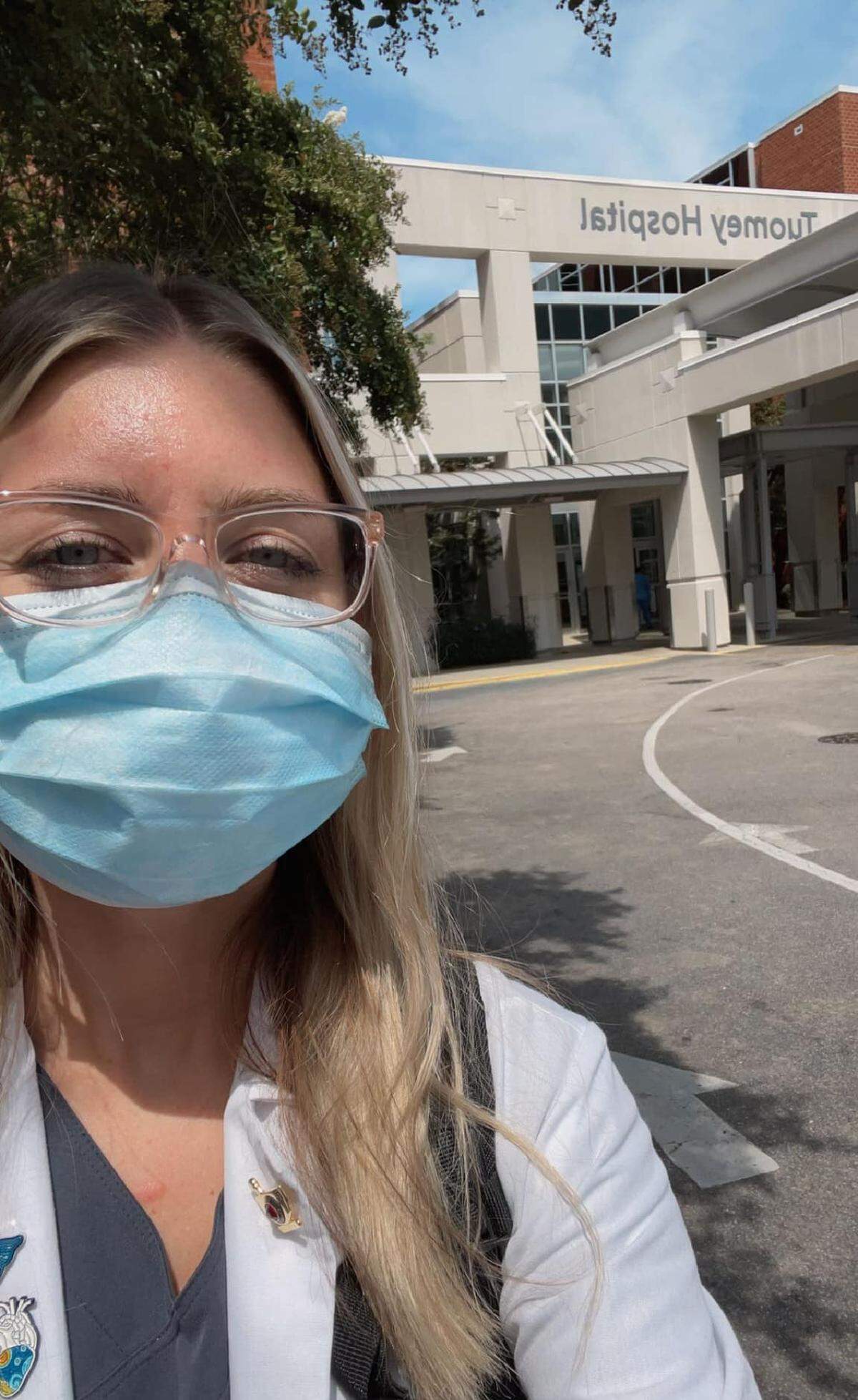
Following her time at Prisma, she took to Facebook to recount her experiences with friends and family, some of whom have been reluctant to get the vaccine.
“I watched as family members stood on the other side of glass doors while their loved one dies on the other side,” she wrote through tears. “I’ve seen children have to watch as their parents die. I’ve seen spouses who are being hospitalized on another floor come and watch as their husband or wife dies and they can’t even be there to hold their hand or give them one last kiss or hug. COVID is a disease that has no remorse for anyone and doesn’t seem to be letting up anytime soon … This is not political, this is real — people are DYING.”
Nurses, doctors and even fellow grad students entering the field, are exhausted, scared and anxious of catching the virus themselves, she said. But regardless of how they feel, she says they stay calm, patient and are consistently sacrificing their own safety to ensure patients are given the best care to help them recover.
Some days are more difficult than others. Some days, she drove home crying while trying compartmentalize what she witnessed that day.
“You have to be brave, you have to be strong,” Larreur says. “You have to be willing to deal with anything that comes to your floor.”
This story was originally published October 4, 2021 at 5:00 AM.