Columbia, attorney general’s office argue school mask case before SC Supreme Court
READ MORE
COVID-19 mask news in Midlands schools
Curious to learn what local schools are doing about face masks as COVID-19 rises in South Carolina? Here’s a roundup of the latest updates from elementary schools to universities around the state.
Expand All
For several weeks, officials with the city of Columbia and Republican Attorney General Alan Wilson’s office have been firing shots at one another over the city’s requirement of face masks in some schools.
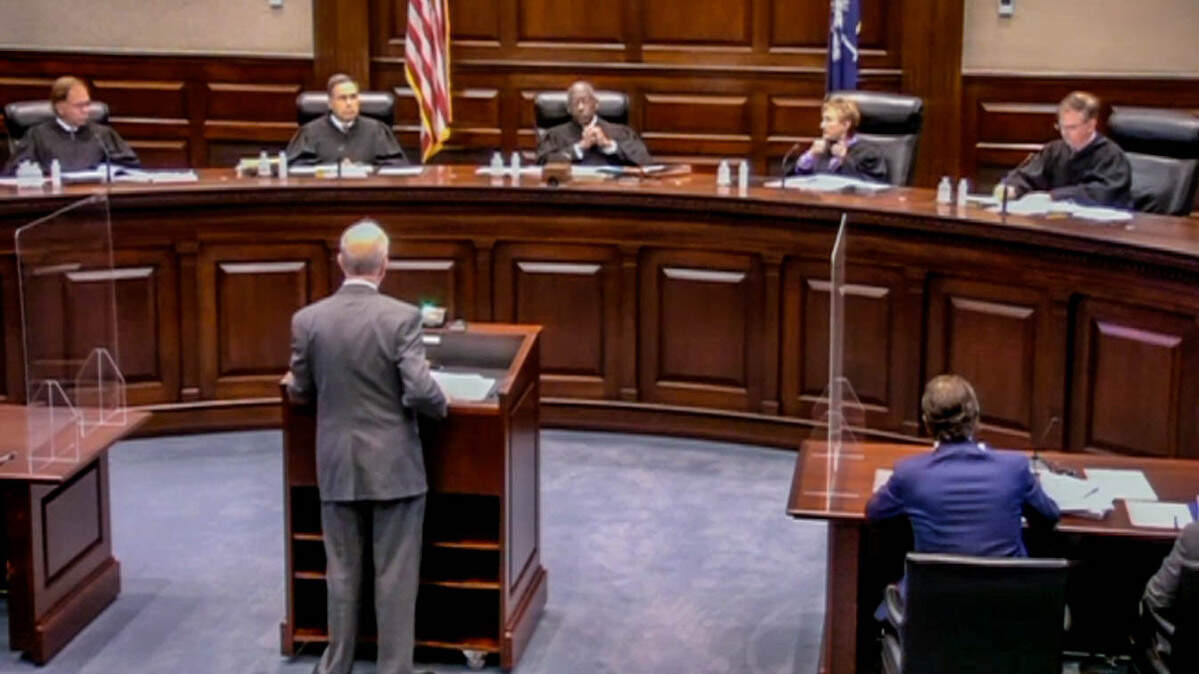
On Tuesday, the matter landed in the state’s highest court.
The South Carolina Supreme Court heard arguments in Wilson’s lawsuit against the city’s mask law. The attorney general’s office argued that the city’s ordinance violated a one-year state budget law that prohibits money from this year’s appropriations bill from being used for the enforcement of a mask mandate in schools. Meanwhile, the city argued, among other things, that the budget proviso about masks is misplaced, as it has little to do with taxing and spending state dollars.
The court did not rule on the issue Tuesday morning.
Earlier in August, Columbia City Council passed a measure that requires students and faculty at 43 elementary and middle schools and day cares in the city to wear masks as COVID-19 cases have risen sharply in South Carolina.
Wilson subsequently filed a lawsuit saying he wanted the state Supreme Court “to resolve a dispute over the controlling effect of a legislative proviso regarding mask requirements so that all jurisdictions will be informed about what law governs.”
During the hearing, Deputy Solicitor General Emory Smith Jr., from Wilson’s office, argued that funding from this year’s state budget would have to be used to enforce mask mandates in school.
“The city’s ordinance would conflict with the (state) proviso,” Smith said. “It calls upon and penalizes the employees who fail to comply with the ordinance. Those employees are state funded.”
The city’s ordinance lays out $100 fines for violations of its school mask requirement, and says the person receiving the fine could be a “a principal, vice principal, administrator, staff, owner, manager or supervisor.”
Chris Kenney, an attorney with Democratic state Sen. Dick Harpootlian’s law firm, argued the case on behalf of the city. He noted that the city has addressed the funding element of the mask ordinance.
“What the city of Columbia has done here is taken the obligation of funding and enforcement upon itself,” Kenney said. “With respect to what the General Assembly has done in (the one-year budget law), all they have said is ‘Do not spend our money on a mask mandate.’ And the city’s ordinance complies with that entirely.”
Kenney said Columbia Fire Chief Aubrey Jenkins and 11 of his inspectors have been visiting local schools and conducting an education campaign about masks. Any tickets for mask violations would come from the city’s fire marshals. The city also has committed to providing masks for students.
The one-year budget law in question reads as follows: “No school district, or any of its schools, may use any funds appropriated or authorized pursuant to this act to require that its students and/or employees wear a facemask at any of its education facilities. This prohibition extends to the announcement or enforcement of any such policy.”
Also central to Kenney’s argument was that a proviso dealing with masks in schools has little to do with the central purpose of state budget spending.
“Mask mandates have nothing to do with the appropriations act,” Kenney said. “It is not in furtherance of or rationally connected to the raising and spending of money. Certainly the General Assembly could come back next week and pass a blanket prohibition of mask mandates. They have the power to do that.
“What they cannot do, what the Constitution forbids them from doing, is to roll up an across-the-board prohibition into a one-year budget instruction that legislators may not have even known was there.”
Kenney also noted that state budget appropriations aren’t the only dollars received by public school districts, saying they also receive a large chunk of local and federal funding.
But Smith was strident in his argument that teachers receive at least part of their salary from state appropriations, and thus state funds would be used if those teachers spent time dealing with the mask requirement in school.
“It’s not too much to conclude teachers would be on the front lines of this,” Smith said. “In their classrooms, the teacher could say, ‘Put your mask back on’ or ‘You didn’t respond to my request to put your mask back on, go down to the assistant principal.’ And there’s a line forming at the assistant principal’s (office) of students being sent down there.”
The South Carolina Municipal Association, the City of Charleston and the South Carolina Education Association each filed supplemental briefs in the case, supporting the city of Columbia’s position.
Aside from the city of Columbia, Richland County Council also passed a mask mandate for elementary and middle schools in the unincorporated areas of the county, and several school districts in the state, including Richland One, have put in mask requirements despite the state budget law.
Wilson said on Aug. 19 that he intended the lawsuit to “apply to all cities, towns, counties, and school boards that have passed or are seeking to pass mask mandates.”
The state Department of Health and Environmental Control has continued to report bushels of new COVID-19 cases. Over a four-day period from Saturday to Tuesday, the agency reported more than 20,000 new cases and more than 130 new deaths.
This story was originally published August 31, 2021 at 12:23 PM.