High taxes decimate Columbia’s small businesses, experts say. Changing SC law could help
Donna Green for years ran her art gallery and studio Southern Pottery out of an old house on a quarter-acre plot on Devine Street. While there, she paid $14,000 a year in property taxes.
“If I had lived there, my taxes would have been $3,500,” Green, who’s since relocated her business, told a room of developers and small business owners Tuesday.
Her experience underscores a common problem for businesses, developers and landlords across Columbia: Taxes on commercial properties here are prohibitively high.
To fix the problem, city leaders want the state to pass legislation to cut taxes for commercial payers if a county opts in to a special program. Without some solution, experts say Columbia’s economy risks withering away.
A city committee led by councilman and former state secretary of commerce Joe Taylor, along with Mayor Daniel Rickenmann,Councilman Ed McDowell and representatives from various local business and housing interests believe they will have a final plan to present to all Richland County leaders within the month.
The problem
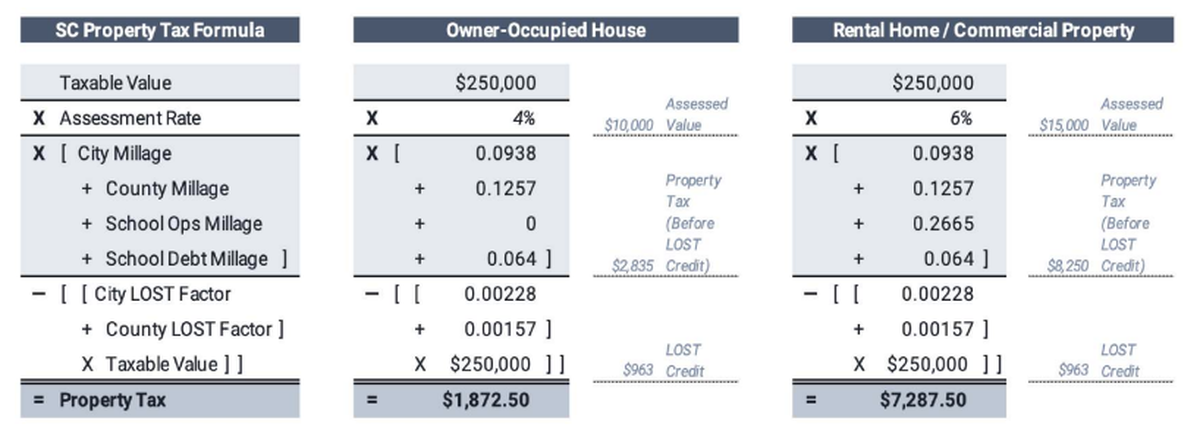
The problem for commercial properties is twofold: The state tax rate for non-residential properties is higher than for primary residences (6% compared to 4%); plus, primary residences don’t pay all the taxes levied by school districts, while commercial properties do.
Green’s real-life example is further illustrated by looking at her neighbor’s taxes. A residential property right next door to her former store paid less than $5,000 in property taxes last year, while her former building was charged just under $14,000, according to assessor data.
Rebecca Gunnlaugsson, an economist and president of the local firm Acuitas Economics, outlined an example taking two $250,000 properties but labeling one residential and one commercial.
The commercial property’s taxes were nearly $5,500 more than the equally-valued residential property.
Green and other small business owners have said not only does this structure make it hard to turn a profit, but it is nearly impossible to improve a property — both because of the expense and because it would raise the taxes even higher.
Green shared her story during a public hearing hosted by the city’s tax committee Tuesday. Others who spoke during the meeting had similar frustrations.
Stephen Gilchrist, chair of the South Carolina African American Chamber of Commerce, said his 15,000-body membership across the state deals with two major problems: Not enough access to capital, and high taxes. The majority of the businesses in the chamber have fewer than 10 employees.
The high tax rate is an imminent threat to Black-owned businesses, Gilchrist said, explaining that already the chamber has lost 41% of businesses over the course of the pandemic.
“We don’t want the tax structure within our communities across the state to become another pandemic for our small businesses,” he said.
The problem is exacerbated in Columbia by a high number of government and otherwise public, and as such tax-exempt, properties. Many local leaders say high tax rates set by local school districts are also a contributing factor.
Taylor in an interview said he hasn’t discussed the proposal to lower commercial property taxes in detail with school district or county officials, but he said the mayor will do so when a final plan is outlined by the city committee.
The city’s hired economists say the high taxes will drive a disinvestment crisis in Columbia if left unchecked.
One of those hired economists is Stephen Walters, chief economist at the Maryland Public Policy Institute. He and Gunnlaugsson have worked with Rickenmann and Taylor since early 2020 to study Columbia’s tax climate and assess how to fix it.
“Without a healthy investment climate, a city will wither away,” Walters has said. “It’s not just a business problem. It’s not just a landlord problem. It’s an everybody problem.”
Walters explained that if the trend continues, Columbia will see money leave. There will be fewer jobs, and landlords who choose to stay will raise rents.
“If you’re paying for your schools exclusively through business and rental tax receipts … and they are fleeing, that’s going to make it harder to have high-quality schools,” he said, emphasizing the potential domino effect.
The plan
The proposed fix would create a tax credit effectively reducing the tax rate for commercial properties to be the same as for residential. But it can’t happen overnight, and it would require a change in state law and the adoption of county legislation to opt in to the would-be program.
“It does take a little bit of special legislation,” Taylor said in an interview. “But we’re not creating anything new. There’s no physical impact to the state whatsoever.”
He said it would work similarly to a plan passed in 2017 for manufacturing properties, and he believes if a proposal was presented to state lawmakers they would support it.
If those boxes were checked, Columbia would still need to save some money on the front end before cutting taxes. Gunnlaugsson outlined a 10-year plan for how to do that.
The first two years, the tax rate would stay the same and the city would squirrel away money in an escrow account. Beginning in year three, the tax rates for commercial payers would begin to decline. The escrow account would pad any revenue losses from the decreased taxes.
The idea is that over time, the tax base would grow as more businesses came to Columbia to take advantage of the more competitive property tax rates. Even without that assumption, Columbia would see revenue growth over 10 years according to Gunnlaugsson’s projection.
But at least anecdotally, the plan is inspiring confidence. At one point during Tuesday’s tax committee meeting, Rickenmann asked how many developers in attendance would have investors lined up tomorrow if the tax rate were equal to residential properties in Columbia. Hands went up around the room.
Matt Poindexter, a housing developer with Proffitt Dixon Partners and a project manager for the under-construction Bennet at BullStreet apartment complex, said his company won’t be looking to Columbia for future projects.
“Our company is, sadly, not pursuing a new opportunity here in Columbia,” Poindexter said, after explaining that the property taxes for the BullStreet project are 40-60% higher than any of their other similar developments across the South.
The only reason they were able to develop the apartments is because of a special tax credit.
“If we heard that a tax reduction had been put in place that would get us in line with other markets, we would immediately begin a site search for a new multi-family project here.” he said.