Columbia postpones conversion therapy vote under threat of losing state money
AI-generated summary reviewed by our newsroom.
- Columbia deferred a vote on its conversion therapy ban amid state budget uncertainty.
- The state could withhold $3.7M if the policy remains in place.
- Nearly two dozen people testified to Columbia City Council asking it to keep the ban.
The future of Columbia’s ban on conversion therapy, which the state Attorney General Alan Wilson has threatened legal action over, remains up in the air. The council voted to defer its decision to a later meeting after nearly two dozen people urged the city council Tuesday to keep the ordinance in place.
LGBTQ-rights groups said they see the council’s choice to postpone the vote as a victory.
“We have witnessed the smallness of men with big titles trying to use fear and fiscal threats to force this city into retreat,” said Matthew Butler with the ACLU. “But Columbia has not flinched.”
A major factor in the city’s decision to delay the Tuesday vote comes down to the state budget. Roughly $3.7 million Columbia has been told to expect from a state fund for local governments could be withheld if the city maintains its conversion therapy policy.
“There’s a significant amount of money in the proviso, so we need to know where that lands,” Columbia Mayor Daniel Rickenmann told reporters after the meeting Tuesday.
A committee of state lawmakers Wednesday passed their version of the budget, which now will go before the general assembly and then to Gov. Henry McMaster’s desk, That budget includes a specific amendment penalizing municipalities that ban conversion therapy. Conservative state lawmaker Josh Kimbrell attached that measure. Columbia is the only city in South Carolina with such a policy.
The uncertainty of those funds also affects Columbia’s effort to compile a balanced budget, which must be finished before the next fiscal year starting July 1. Because the city doesn’t know if it can rely on the state dollars, the city is sequestering money from its hospitality and accommodations funds to ensure it can advertise an accurate and balanced budget in time to meet the state-set timeline.
But money was not the sole reason for the deferred vote, Rickenmann added.
The deferral decision came after more than 20 people spoke at the council meeting, asking the government body not to repeal the ordinance prohibiting licensed therapists from practicing conversion therapy. All but one person who spoke on the conversion therapy ordinance at Tuesday’s meeting were in support of keeping the ordinance in place. Council chambers were so full Tuesday the city had to open an overflow room elsewhere in the building.
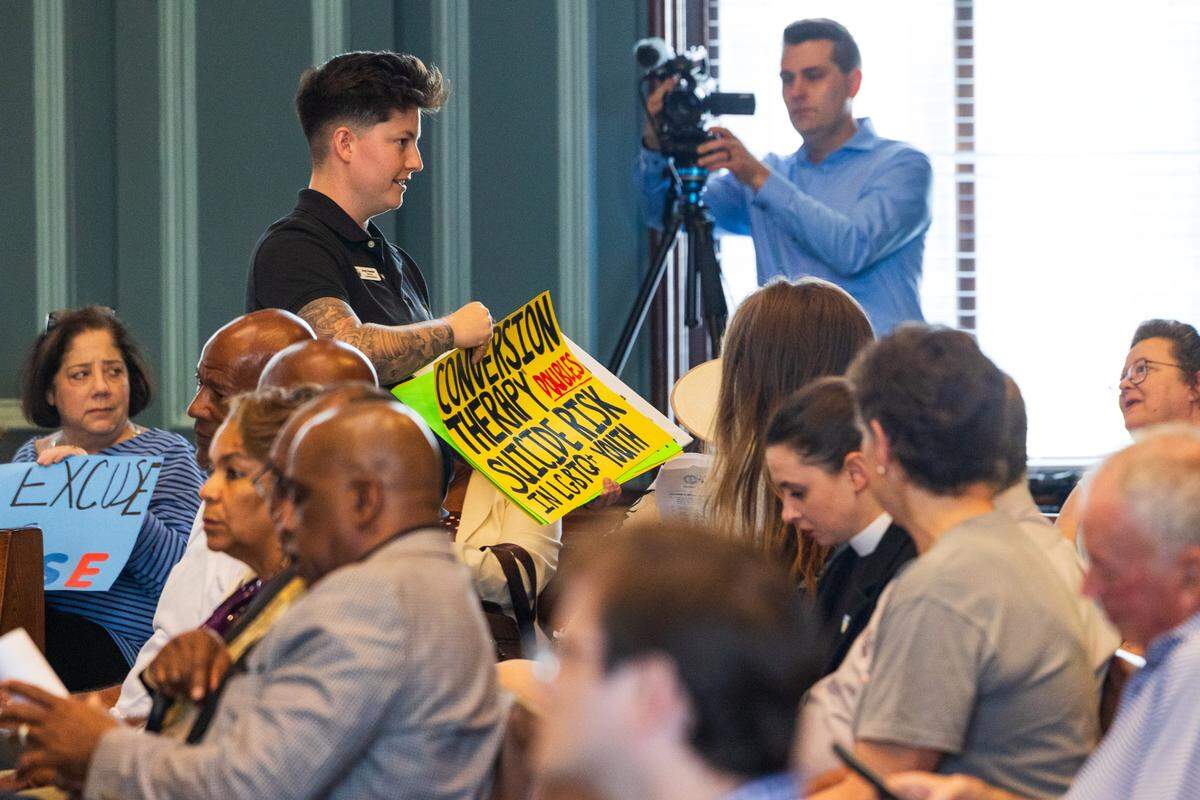
“We had an outpour of folks who wanted to be heard,” Rickenmann said, adding that in addition to those who spoke Tuesday the council had also received a lot of emails on the issue. “Just like other things, we take public input now ... we’ll see whenever we finish gathering (input) and everybody’s comfortable to move forward.”
The City Council will vote on the issue — though exactly when is unclear. The Attorney General’s office earlier this month gave Columbia until July 7 to take action on the ordinance else face legal repercussions.
Rickenmann rejected the idea that deferring the vote is a signal that Columbia is preparing to defy Wilson, saying “I’m not preparing for anything, I’m preparing to legally put the budget out, and that’s what I’m doing.”
A years-long debate
Columbia passed its ordinance banning conversion therapy for minors on a 4-3 vote in June 2021, with Rickenmann and former Mayor Steve Benjamin both voting against it at the time. The other no vote was Councilman Rev. Ed McDowell, who along with Rickenmann has remained on the council since that vote.
Of the four council members who voted in favor of the conversion therapy ban in 2021, just Will Brennan is still on the council.
Conversion therapy is a controversial counseling practice meant to change a person’s sexual orientation or gender identity. It’s opposed by prominent medical and psychology organizations across the globe, but some faith organizations have supported the practice, and several argued against Columbia’s ban in 2021.
Groups like the American Medical Association and the American Academy of Pediatrics oppose conversion therapy and say it is ineffective and dangerous.
Multiple conservative state officials have wanted the local ban repealed since it went into effect.
In 2022, state Sen. Kimbrell, R-Spartanburg asked the Attorney General’s office for an opinion on the local law. Wilson’s office issued an opinion arguing that the ordinance was not constitutional and would not survive a legal challenge.
But no legal challenge followed and Columbia’s law has remained intact.
Then in late April, Wilson revived the issue by sending a letter to Columbia leaders demanding that the ordinance be repealed if the city wants to “avoid any future legal action.”
In response to that letter, Columbia Mayor Daniel Rickenmann asked, “Why now?”
“This hasn’t been an issue for four years,” Rickenmann told reporters last month. “Is it just a reminder or ... is it political season?”
Wilson and Kimbrell are both considering runs for Governor in 2026.
In addition to Wilson’s legal threats, Kimbrell added the proviso to the state budget that would withhold state money from cities that have such an ordinance as Columbia’s.
If the measure is not vetoed by McMaster,and if Columbia keeps the ban in place, the city could lose an estimated $3.7 million it expects to receive from the state’s local government fund in the coming fiscal year.
Local control?
No city council member agreed to comment on the record ahead of Tuesday’s vote, but at-large Columbia City Councilman Tyler Bailey penned an op-ed for The State newspaper on the topic, which was published Tuesday morning. In it, he raised questions about how much freedom local governments have to set their own course.
“The Legislature’s use of financial leverage by threatening to withhold funding unless we comply with its demands sets a dangerous precedent. Today it’s conversion therapy in Columbia, but tomorrow it could be any policy where local communities and state lawmakers disagree,” Bailey wrote.
Kimbrell also wrote an op-ed for The State Tuesday, arguing why the city’s ordinance should be repealed. He called the policy a “draconian assault on free speech,” adding that it violated the First Amendment.
“When the city of Columbia implemented its therapy ban in 2021, it set up a system that would persecute, and in certain cases prosecute, cases against therapists for simply holding deeply held beliefs about human sexuality, gender and identity that have been civilizational cornerstones for millennia,” Kimbrell wrote.
The city’s ordinance does not establish any criminal penalties, but would fine a licensed counselor up to $500 for using the specific practice of conversion therapy. The ordinance has never been used.
Several people who spoke at the Tuesday meeting shared personal stories about the pain they endured while undergoing conversion therapy. At least one person told the city it should meet Wilson in court, if the Attorney General did decide to sue.
This story was originally published May 21, 2025 at 5:00 AM.