Did Columbia ask SC lawmakers to withhold $4M over conversion therapy ban?
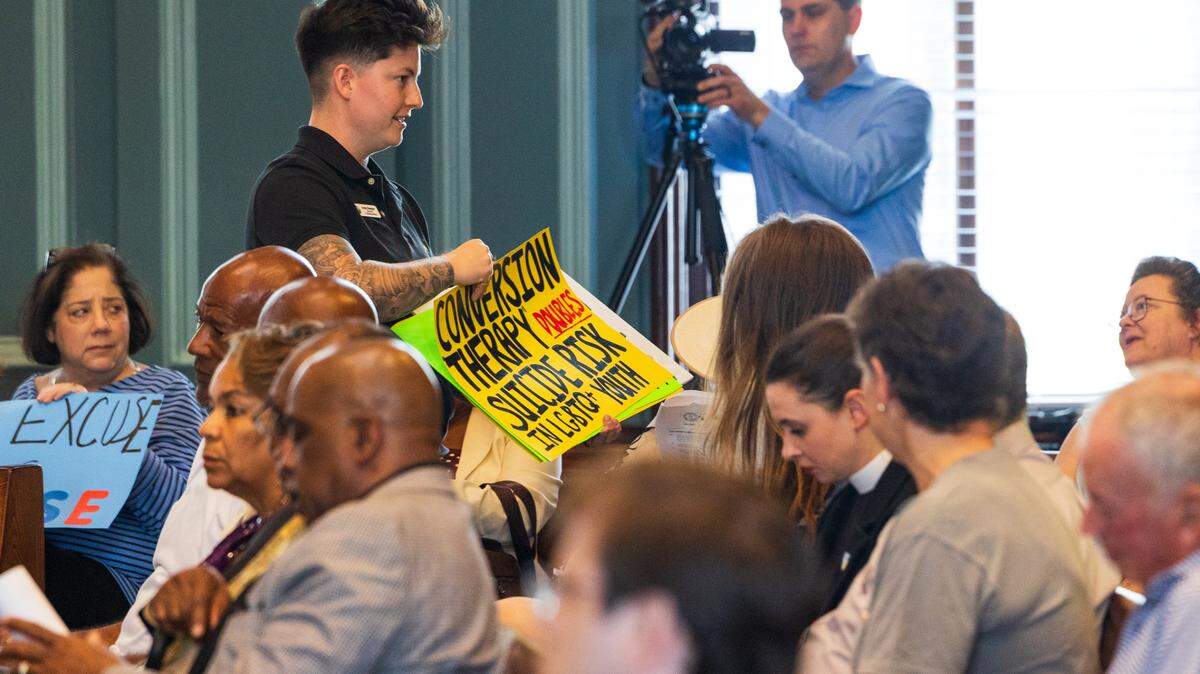
The city of Columbia is staring down a “gaping hole” in its budget, and a difficult decision over an ordinance banning conversion therapy, a widely condemned practice meant to change a person’s sexual orientation or gender identity.
If the ordinance stays, the city will lose nearly $4 million in state money this year. If it goes, advocates say LGBTQ+ youth will be harmed, and the choice would come as hundreds of residents have urged the city to keep the ban. Attorney General Alan Wilson has also threatened to sue the city, calling the ordinance unconstitutional and a violation of a 2022 state law.
The issue is further complicated by a provision in the state budget signed by Gov. Henry McMaster on June 3, which specifically withholds certain state dollars from cities and towns that ban conversion therapy. Columbia is the only municipality in South Carolina with such a policy.
Speculation has swirled around the city’s decision, which council has yet to make after deferring two separate votes on the ordinance since first taking it up on May 20. Bruce Bannister, chairman of the S.C. House Ways and Means Committee, previously told reporters that city council members had asked lawmakers for help with the matter, which some took as meaning city council members lobbied for the budget proviso, effectively sabotaging their own budget over the conversion therapy ordinance.
Columbia Mayor Daniel Rickenmann and multiple state legislators say that is not true. The State caught up with lawmakers and local leaders about who said what about the controversial ban that could cost the city millions.
What was said?
Rickenmann returned a missed call from Bannister, R-Greenville, at 7:55 a.m. May 21, the day after the city deferred a vote on repealing the conversion therapy ordinance, and the same day the six-lawmaker conference committee met to finalize the state’s 2025-2026 budget.
It was a brief conversation, Rickenmann and Bannister both confirmed.
In an interview with The State, Rickenmann characterized the conversation like so: “Hey, we understand what’s happening. We don’t have the votes. We’re going to have to get there sometime, and we’ve got to deal with this and the lawsuit.”
Bannister said conference committee members spent less than 10 minutes discussing the conversion therapy proviso, including discussions with staff, conference committee time and the phone call he had with Rickenmann.
Bannister said his phone call with Rickenmann did not last long and he asked the mayor what was the city’s position.
“I got the impression that it would make their life easier if it stayed in because they had the votes to take the ban out, and everybody would move on,” Bannister told The State.
Those votes have not come, as the city has twice deferred a decision on the ordinance, with the city council again delaying a vote when it met May 27.
Rickenmann didn’t ask Bannister to take a certain action, but advised what would happen under each scenario, Bannister said. Keeping the proviso in would have led to the city removing its ordinance and the thought was no one would be harmed financially, was Bannister’s understanding, he said.
The conversion therapy proviso was one of roughly 130 measures attached to the state budget lawmakers in the conference committee had to consider. Every year provisos, or one-year laws, are attached to the budget that direct how state money can and can’t be spent.
During the proviso review with staff, staffers and committee members determine which ones will be insisted on, whether they would create a problem during negotiations if they weren’t approved, and whether it would be better to deal with the issues through traditional legislation.
“Which is sort of how those conversations happen. What do you care about? What’s important? What’s not?” Bannister said.
“Those discussions happen on all the different provisos,” he added. “Some we insist and say absolutely not we’re voting against that, the Senate will just let it go, some they say we need a vote on the record.”
He said the Senate conferees insisted the proviso stay in place. House members didn’t feel strongly enough to fight it. Conference committee members did vote on whether to keep the proviso in place. The lone “no” vote was state Rep. Leon Stavrinakis, D-Charleston.
Bannister did not learn that the proviso had been pushed by state Sen. Josh Kimbrell, R-Spartanburg, until after the budget conference committee approved the draft spending plan.
Bannister and Columbia Councilman Peter Brown also texted about the proviso and spoke over the phone. At 5:52 a.m. May 21, Brown texted Bannister, “Hey Bruce, I will call you later about the conversion therapy vote on city council. We will get there.” This was the day after the city deferred a vote on whether or not to repeal the ordinance.
Brown said he wanted to explain to Bannister why the city hadn’t taken a vote. Later that morning, Bannister replied to Brown saying, “On the road, call when you can.”
Brown attempted to call Bannister but did not connect. He texted “tag,” to which Bannister replied, “Will keep Senate proviso.”
Brown’s response to Bannister after receiving that text on May 21, the day the conference committee finalized the budget draft, read, “Yep, I know. I will tell you where we are when we talk.”
The pair talked at around 8:45 that morning, Brown recalled. He said it was a similar conversation to Rickenmann’s talk with Bannister.
Rickenmann and Brown each provided information about their calls and texts. They told The State they did not coordinate calls or any communication on the topic prior to the interview, or prior to speaking with Bannister.
“The money is very serious. Getting sued by the state of South Carolina is also very serious … and I wanted Bruce to know that we know this is serious,” Brown said. “But I also don’t have the ability, at that date, we didn’t have the ability to – we don’t have the votes. It’s just that simple, we don’t have the votes.”
Brown also stressed that no one with the city had advocated for the budget provision, but he said that he also wanted to face “reality” amid the legal threats and risk of losing state dollars.
“Anything that we’re doing is merely reactive to the things that are happening outside of our purview and control,” Brown said.
Tyler Bailey, an at-large city councilman who has said he plans to vote in favor of keeping the conversion therapy ordinance, told The State that he would give his colleagues on council the benefit of the doubt, and he believes that any conversations had with lawmakers would have been to better understand “state of play,” and how the city would need to move forward.
“I do understand why citizens would be concerned, thinking if there’s a council member who has asked for this to stay in there,” Bailey added. “I love and respect all my colleagues in the General Assembly, but … they put this issue on us, and now we have to do what’s best in addressing the situation by principle, that’s the biggest thing,” and also the financial element.
Political football
Kimbrell told The State in an interview that no one on the city council asked him to push the proviso during the budget debate in April when the the Senate agreed to the provision, nor did they coordinate efforts on the issue.
He only proposed the claw back provision after state Attorney General Alan Wilson threatened to sue the city.
Both Kimbrell and Wilson are considering runs for the Republican nomination for governor, and trying to convince Columbia to repeal the ordinance has become a political football as they shore up their conservative credentials.
Kimbrell took issue with the city’s ordinance after it passed in 2021. Several years ago, Kimbrell wrote to the attorney general asking for an opinion on the legality of the city’s conversion therapy ban. The attorney general eventually issued an opinion saying that the ordinance was likely unconstitutional and a violation of the First Amendment. But the attorney general did not take any further public action until this year.
In late April, Wilson issued city leaders a letter demanding the ordinance be repealed, or else the state would sue Columbia for violating state law and the constitution.
Kimbrell told the State that this is why he proposed the budget proviso – he was frustrated that Wilson waited until 2025 to threaten the lawsuit.
Kimbrell conceded that the ordinance has not been an issue in Columbia. But pushing the proviso into the budget provided a possible off-ramp for the city.
“In my opinion I thought going through a massively expensive legal battle would be worse and so I did not want to go through a legal battle, I did not want Columbia to spend millions of dollars trying to fight with the attorney general on this. I did offer the proviso to try to short circuit a legal fight I thought was counter-productive,” Kimbrell said.
Kimbrell spoke to Rickenmann after the proviso was added.
“I explained to the mayor why I did it,” Kimbrell said. “I’m sure he was frustrated he had to go through this, but I explained to him my move was based on the attorney general’s decision to sue him.”
Rickenmann shared frustrations over the city’s budget being used in this political back-and-forth. He also pushed back against speculation that he himself has a strong ideological opposition to the ordinance, which he voted against in 2021.
“If that was true [then] when I got elected in 2022 and we had a brand new council … would this have not just been one of the first things we did?” he asked in an interview, adding that until Wilson’s letter, no one on city council had even talked about the ordinance since it was passed.
Outcome uncertain
Having been deferred twice, it’s not immediately clear when the ordinance will again go before city council, but Rickenmann said the goal is to vote before the end of June.
The city is expected to have a public hearing and a first vote on the budget at its next council meeting, June 10.
Columbia must pass a balanced budget before the new fiscal year begins on July 1. If the conversion therapy ordinance is still on the books when that budget passes, Columbia will lose $3.7 million this year from a special state fund reserved for local governments.
Conversion therapy is a controversial counseling practice meant to change a person’s sexual orientation or gender identity. It’s opposed by prominent medical and psychology organizations across the globe, but some faith organizations have supported the practice, and several argued against Columbia’s ban in 2021.
Prominent organizations like the American Medical Association and the American Academy of Pediatrics oppose conversion therapy and say it is ineffective and dangerous.
The city council has heard testimony from people who were traumatized after undergoing conversion therapy, from licensed mental health providers who attest it is no “therapy” at all, from lawyers who argue against Wilson’s legal opinion on the matter, and from parents, business owners and other community leaders who have urged the council to do what is “right and decent.”
A handful of others told the city council to repeal the ordinance, but the vast majority of those who have come to City Hall for this issue have urged the city to keep the ban on conversion therapy in place.
For Bailey, the vote is about the ordinance, but it is also about home rule, and how much say Columbia has over its own future.
“We’ve been talking about the risk and all, but I think that we just have to do what we have to do,” Bailey said, adding that the state “could withhold funding, it could be legal battles, they could do whatever, but we have to stand up, sometimes we have to just stand up to a bully.”
This story was originally published June 5, 2025 at 5:00 AM.