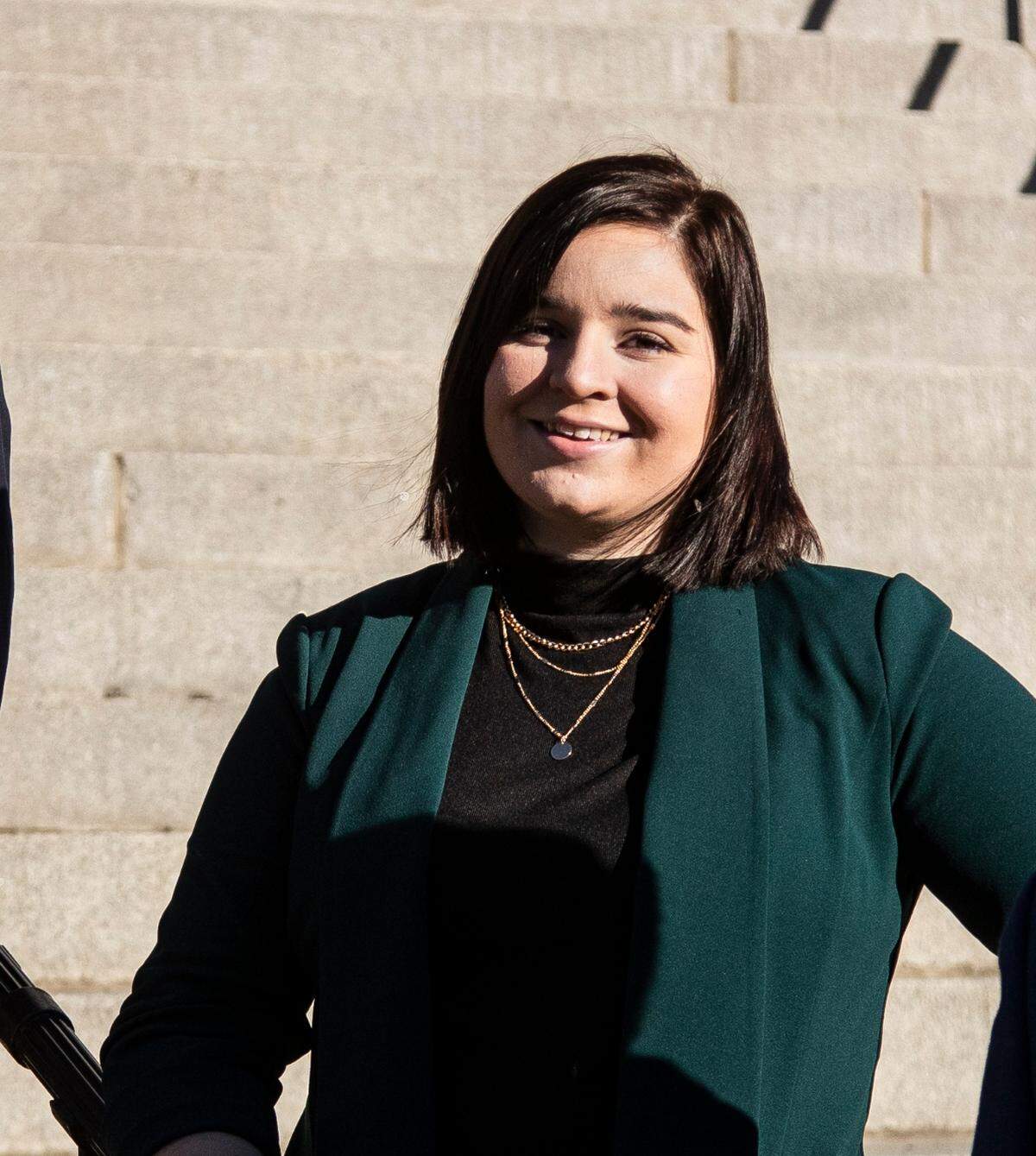
South Carolina’s schools chief Molly Spearman won’t run for reelection in 2022
South Carolina’s education chief Molly Spearman, who in the last two years shepherded the state’s schools through the challenges of COVID-19, announced Wednesday she will not seek reelection to a third term in 2022.
“Until the end of my term in January 2023, I will continue to work diligently to help us rise out of the pandemic stronger than before while advocating for the needs of our students, educators, and families,” said the Republican superintendent of education.
In a statement, Spearman, 67, credited her parents, family, neighbors and friends for her career in public service.
“I am humbled that a little girl from a dairy farm in Saluda County has had the chance to serve her community and state for over forty years,” she said. “My husband — Bill, children — Mitchell, Katie and Lee, and grandchildren — Molly Brooke and Marilyn Ann now deserve my full attention.”
Spearman was first elected to the statewide superintendent role in 2014, succeeding another Republican, Mick Zais, who shifted the seat back to GOP control. Spearman came to the job with education experience as the former head of the South Carolina Association for School Administrators, a former educator and a former Education Department employee under former Democratic Education Secretary Inez Tenenbaum.
She also served in the Legislature, representing a House district that included parts of Lexington and Saluda counties.
That background, Spearman and legislators credit, helped her immensely as she navigated the state’s education system.
“Honestly, I’m a little sad because I love this work and I care so much about our education in the state,” Spearman told The State on Wednesday. “It’s a little bittersweet, but I’m excited about the next chapter and committed. (I’m) glad to know I’ve got a year left still do some work.”
Spearman’s retirement opens up a likely competitive field for Democratic and Republican candidates. The job opening comes at a politically charged time when COVID-19, teachers, vaccines, whether to mask students and the subject of critical race theory have slid to the forefront of education conversations.
The state’s Democratic and Republican party leaders, Trav Robertson and Drew McKissick, respectively, were quick to weigh in on Spearman’s legacy.
“More than most, Molly recognizes the power a strong education has on a child’s life. Education empowers our next generation, regardless of their zip code, gender, race, or income, and she’s worked hard to ensure children receive that education,” McKissick said. “We are grateful for her contributions to our state and Party and wish her well in this next chapter.”
In a statement, Robertson said, “We learned through this pandemic and the discussions that ensued about student health and safety that Molly Spearman had the best interest of teachers and students in mind while Henry McMaster and other South Carolina Republicans did not. After almost two years of being ignored, overlooked, and scorned by the extreme elements of the Republican establishment, I understand why she would not seek re-election.”
So far, one GOP candidate, Lexington County’s Kizzi Staley Gibson, has filed a 2022 fundraising report for superintendent. She has about $3,568 in her campaign account.
“They don’t make many like (Spearman),” said Senate Education Chairman Greg Hembree, R-Horry. “They’ll have big shoes to fill.”
From consolidation to COVID
Spearman is credited with leading a handful of major initiatives in South Carolina.
Though, those initiatives did not leave her without critics.
In 2015, when she was became superintendent, “South Carolina was using nationalized Common Core State Standards, had one of the lowest teacher pay rates in the country, had a dangerous, antiquated school bus fleet, our small, rural school districts were operating inefficiently, and the needs of our state’s workforce were not being met,” Spearman said.
During her tenure, those education policy standards were rewritten. The starting teacher pay has since increased from about $28,000 a year to more than $36,000. The state has replaced thousands of aging, fire-prone school buses. And, while controversial, Spearman touted the 15 school districts that will have consolidated services completely by July 1, 2022.
“That was really the most difficult piece, because no one would even say the word ‘consolidation’ until I said it in a Senate Finance Committee meeting in 2015,” Spearman told The State.
Spearman also sat at the helm of an agency in 2018 when Republican State House leaders sought to reshape the state’s education system, sparking thousands of teachers and their allies to embark on the Capitol grounds and protest low pay and poor working conditions.
Though she supported teachers speaking out, Spearman said then she could not support teachers leaving the classroom.
Over the last roughly two years, she’s been focused on the challenges created by COVID-19 — an international pandemic that shut down schools and forced teachers and students online and, in the past few months, fueled frustration over whether students and teachers should be masked in schools.
“I was very disappointed that she had decided not to run again, I certainly understand,” said state Rep. Rita Allison, R-Spartanburg, chairwoman of the House’s Education and Public Works Committee. “She certainly has been instrumental in the movement and improvement of education in in South Carolina. Of course, she’s gone through some of the best of times and some of the worst of times in the pandemic. She will be missed in the family of education in South Carolina.”
As an elected official, as opposed to a member of the governor’s Cabinet, Spearman has been able to plot her own path.
Last summer, she headed a task force to draft recommendations for how schools could safely reopen in the fall. Those recommendations advised districts to push for in-person instruction but remain open to hybrid or fully virtual learning.
And she often broke with Gov. Henry McMaster and other Republicans, including when it came to policies on face masks and on transgender student athletes.
After state lawmakers attached a measure to the budget aiming to prevent school mask requirements, setting off a court battle, Spearman broke with Republicans and said local school boards should be able to make choices about masking.
Her position was in direct opposition to McMaster, who maintained that masks in schools should be a parental choice.
“The last two years have been very challenging with COVID, and I think she’s handled that extremely well,” Tenenbaum said. “She’s been independent, stood up for the schools and their desire for students to wear masks. She really has shown leadership.”
Earlier this year, Spearman spoke out against bills that would have banned transgender women and girls from participating in high school and middle school women’s sports. The legislation was ultimately voted down.
“My responsibility as state superintendent is to make sure every child feels protected when they are in school and when they’re on the athletic field,” Spearman said in a legislative hearing earlier this year. “I believe this bill does damage to that.”
On Wednesday, McMaster told reporters that Spearman texted him the news Wednesday morning.
Noting her family’s “legacy of public service” — Spearman’s father was in the Legislature — the governor said Spearman has done a “good job” in her role and “been very transparent.”
‘There’s a lot to be done’
The classroom obstacles created by COVID-19 will be an ongoing challenge that Spearman told The State she intends to continue confronting until she retires.
“I’ll spend the next 14 months to make sure everything is in the best shape possible for my successor, including giving support to teachers and students,” from academic to social, emotional and infrastructure support, she said.
Who her successor might be will not be known until next November.
Spearman said the candidate will need to be understanding of what goes on inside a classroom, considering, for example, students who are potentially dealing with the loss of parents during the COVID-19 pandemic or even their teacher. Some of them may have had the virus themselves, keeping them from coursework and the classroom.
“There’s a lot to be done,” she said.
Though the superintendent is a down-ballot position that can often be ignored in elections, Hembree stressed the position deserves voters’ attention. He was and is still supportive of making the superintendent position appointed by the governor, rather than elected. Efforts to do that have failed, but Hembree said lawmakers should revisit the measure.
It’s a particular concern for Spearman, who said it’s one of the reasons it was difficult to announce her retirement.
“Because you’re a great campaigner or candidate,” Hembree said, “does not make you a great leader or chief executive of such a complex system.”
Reporter John Monk contributed to this article.
This story was originally published October 27, 2021 at 10:21 AM.