
Man posts photo of ‘iridescent’ critter on website. It’s a new species in Brazil

Social media and the internet have connected different parts of the world more than ever before. And while some people use online platforms to share fun vacation pictures or late-night thoughts, others have taken to a specific platform to share their love of animals.
iNaturalist is a website and app for amateur researchers to share photos of creatures from around the world with other like-minded citizen scientists.
But amateurs aren’t the only ones taking a look at the catalogue of images. Now, photos from Brazil have been used to identify a new species.
In 2023, a man identified as S.M. Martins took a photo of a katydid in his hometown in the Caatinga of northeastern Brazil and posted it on iNaturalist, according to a study published Aug. 19 in the peer-reviewed Journal of European Taxonomy.
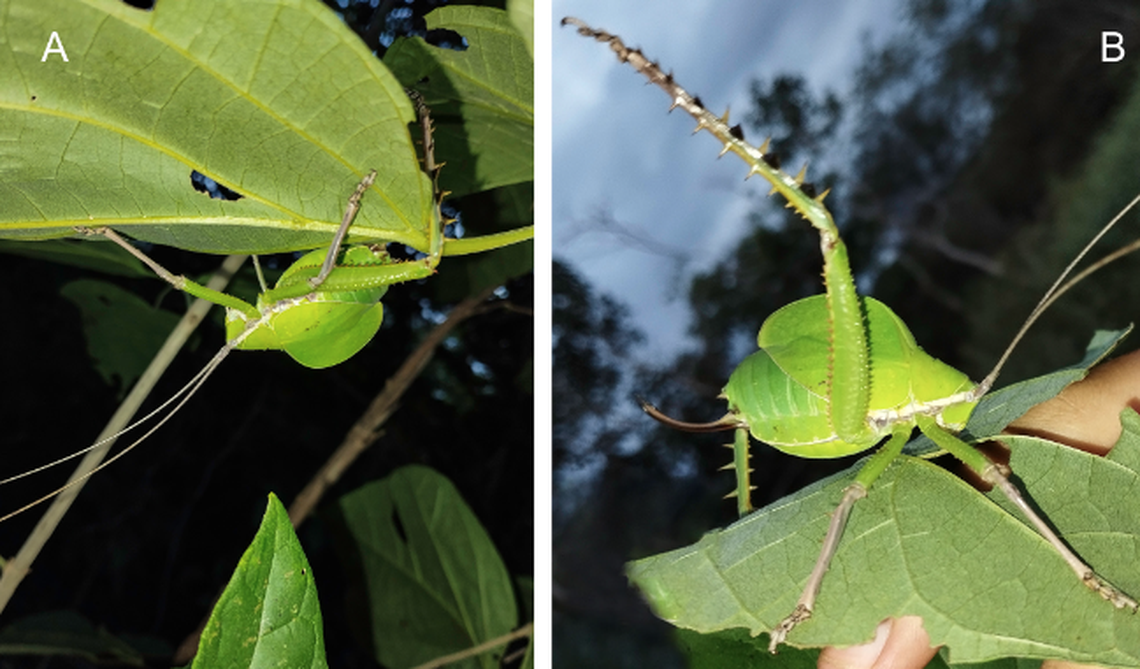
A group of researchers noticed the “uniqueness” of the insect and reached out to the man to arrange an opportunity to collect a specimen of the katydid, according to the study. With the insect in hand, they knew they had a species that had never been described before.
They weren’t the only ones.
Unbeknownst to the research group, another group of scientists had also reached out to the man and came to the conclusion of a new species themselves, causing a hiccup in the ability to be first to publish the discovery, according to the study.
The groups connected, and “after discussions, we respectfully decided to merge the studies, thereby enhancing the significance of the material and promoting collaboration among researchers of orthopteroid insects in Brazil,” researchers said.
The new species is the first of its genus, or group of species with similar physical characteristics and evolutionary history, and it was named Metallacantha, according to the study.

They can be identified by the “large and wide spines with a metallic iridescent shine” on the back legs of the katydid, researchers said. The genus name is derived from Latin words meaning “metallic” and “spines.”
The katydid was given the species name aculeata, “meaning ‘spiny’ in reference to the many distinct spines of this katydid, especially the enlarged ones on its hind legs,” according to the study.
Metallacantha aculeata, the metallic-spined katydid, is generally light and dark green with “terracotta pink” coloration on the antennae and parts of the legs, researchers said.
The insect has a white stripe and a “dark salmon to purplish” strip while the feet are light brown.
Like other katydids, the new species is “generally camouflaged with coloration and shape matching their environment,” with some “possessing a very realistic leaf appearance,” researchers said.

The katydids were found on top of bushes or under the foliage, either foraging or calling into the night, according to the study.
“Their green color matches with the color of the leaves, showing some camouflage despite their large body size,” researchers said. “When handled, the individuals presented a warning display, raising their hind legs, ready to strike and push with the tibial spines if touched. Both sexes of (the metallic-spined katydid) produced strong hissing sounds when disturbed.”
The species also has “significantly reduced hind wings” which may be a product of their dry and arid environment in the Caatinga, according to the study.
The region is poorly explored, researchers said, so there is a high likelihood other species live in the area and are yet to be discovered.
The Caatinga is in eastern Brazil.
The research team includes Victor M. Ghirotto, Phillip W. Engelking, Marcos Fianco, Samuel M. Martins, Rafael Sobral, Alberto M. da Silva-Neto and Diego M. de Mello Mendes.
This story was originally published August 20, 2025 at 1:08 PM with the headline "Man posts photo of ‘iridescent’ critter on website. It’s a new species in Brazil."
