SC students, residents go without fast internet despite millions committed to companies
In the spring of 2020, Cooper Lee needed to take an Advanced Placement exam.
Except the now 17-year-old Woodruff High School student and his family had one big problem.
In order for Cooper to get online and take the exam, his family — which includes a teacher, a pharmaceutical salesman and another high school student — had to stay off the internet to ensure the test would go through while using a mobile hot spot.
“That was stressful,” said Amber, Cooper’s mother.
Like the Lee family, an estimated 400,000 South Carolinians and 190,000 occupied and unoccupied dwellings do not have fast internet access — a known problem that only became more magnified throughout the COVID-19 pandemic when people were forced to stay and work from home.
The cost can be expensive for the average family.
“I know it’s not a basic utility, but it’s 2021,” said Amber, who said the cost of extending the Charter Spectrum line to their Woodruff home was going to run them about $30,000. “Internet should be a basic utility at this point.”
To fight this dilemma, the state and the federal government have stepped in to help subsidize broadband expansion projects.
But those efforts — which include a federal commitment of billions of dollars to extend internet throughout rural areas — is slated occur over the course of six years, a timeline that isn’t fast enough, state leaders told The State.
While some progress was made last year, some internet providers have already backed out of the planned federal investment.
Adding to that concern, South Carolina’s smaller internet providers say they’re worried larger providers, who won large amounts of federal support to expand broadband in the state, won’t actually carry out projects.
“We live and work here,” said Von Todd, the chief executive of corporate strategy for Horry Telephone Cooperative. “That decades of experience in providing these local networks really allows that local provider to get that broadband deployment, in our opinion, at a quicker pace.”
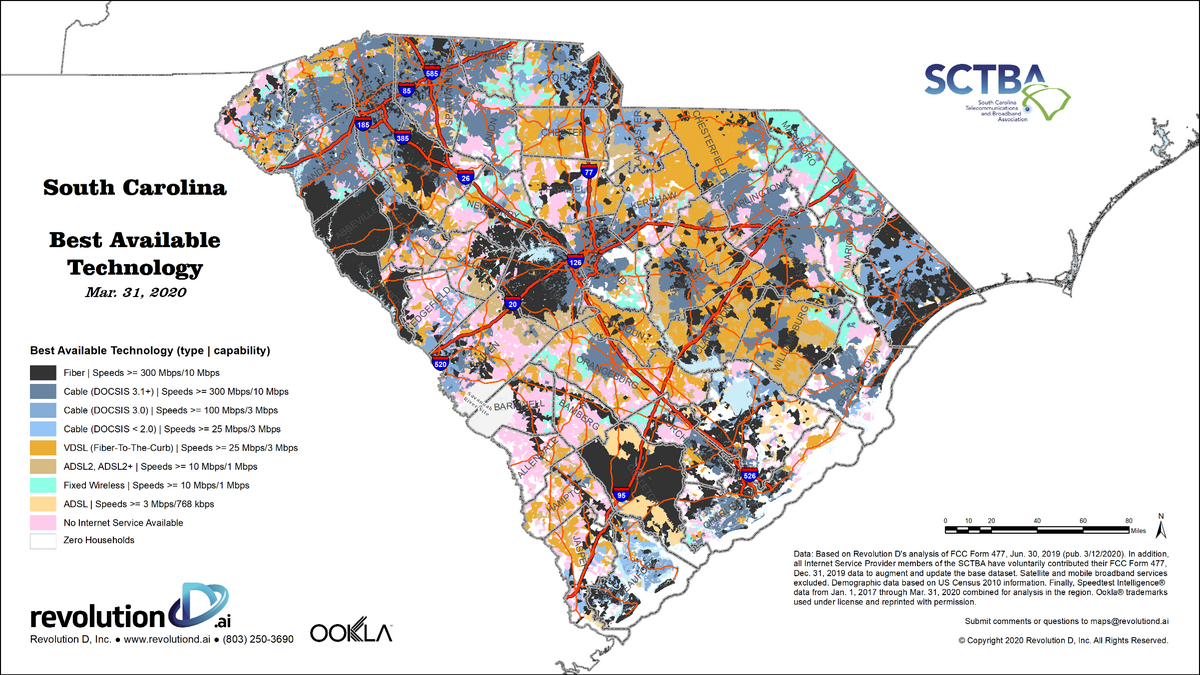
Fight over broadband dollars
In the race for broadband dollars, companies flocked at the chance to have a hand in the expansion.
In December 2020, the Federal Communication Commission’s Rural Digital Opportunity Fund committed $121 million to South Carolina to extend high-speed internet access to 108,000 potential customers.
Breaking that down, $112 million was promised to Charter Spectrum, $6.2 million was allocated to Elon Musk’s Space Exploration company — which recently launched a rocket into space — and $2.5 million worth of FCC support was split among seven other companies and local telephone cooperatives.
Even with money on the table, no FCC projects in South Carolina have gotten money yet.
Providers only get the cash once they’ve been reviewed and have secured letters of credit to ensure they complete the program’s buildout requirements, FCC spokeswoman Anne Veigle said.
Providers also have to meet certain service milestones over the course of three to six years. If a company doesn’t follow through, it faces losing that money. If more than 50% of the promised locations aren’t served, the provider also could be forced to give money back.
That disproportionate split has the state’s smaller broadband providers worried, concerned the larger companies’ promises to carry out projects at a lower cost will squeeze them out.
“I’m not saying they will do this, they could go and opt to build to a very populous unserved area in one part of the state and they will meet their obligation,” said Jason Dandridge, CEO of the Palmetto Rural Telephone Cooperative. “Just because they were awarded (federal assistance) in all these areas is not a guarantee all these areas are going to get it.”
Dandridge’s Walterboro-based telephone cooperative put in bids for six to eight areas in the auction. But, he said, as the larger companies bid lower prices, it took away the financial feasibility of working in some areas.
“It’s hard to understand how in the time frame we’re talking about how some of these other companies who don’t have a facility nearby, at least any facility nearby that I’m aware of, how are they going to meet that obligation in that period of time?” Dandridge said.
Charter, for instance, has already backed out of $2.5 million worth of work it was originally awarded by the FCC.
But the company told The State it chose to drop those locations because the areas already had broadband available before the FCC awarded cash for those projects sites.
“Every American should have access to high-speed internet, and to accomplish the goal of getting 100% of the country connected, support dollars should be preserved for deployment in truly unserved areas where no federal funds have been committed,” said Scott Pryzwansky, a spokesman for Charter Spectrum.
Charter also pushed back against criticism that it was trying to squeeze out smaller providers.
“Charter has long been committed to extending our network to reach more unserved communities, and we look forward to connecting tens of thousands of South Carolina families and small businesses ... in the coming years,” Pryzwansky said. “Other broadband providers had the same opportunity Charter did in the ... auction to bid competitively and commit to the significant investment we have to expand broadband access.”
A Space Exploration representative did not respond to a request for comment.
SC companies look for footing
Sandhill Telephone tried to get money to serve 47 areas with 1,500 potential customers.
But after the FCC’s auction, the telephone cooperative won support for only one census block in Chesterfield County.
That block has one potential customer.
Sandhill CEO Lee Chambers said the companies who won the auctions for certain blocks priced it so low that there is no way they could carry out the projects and instead chose to back out of some.
“All that wound up doing, by them defaulting in my opinion, was delay getting internet access to some of those people that needed it by at least a year,” Chambers said.
Another company, Horry Telephone Cooperative, which serves Horry, Georgetown and Marion counties, was confident going into the auction. But company officials were surprised to see Charter agreeing to take lower amounts of financial support for projects than the Horry cooperative would have taken.
By bidding low, Sarah Bonnoitt, the cooperative’s government and policy strategist, said, Charter forced many providers out.
“What it does after the fact is block other local providers that we know and love from being able to get future funding for service areas more quickly,” Bonnoitt said. “It essentially gives them squatters rights for those areas.”
The cooperative itself bid low on some areas, and backed out on $173,000 of $730,000 in federal support it had won. However, it doesn’t mean the projects they committed to carry out won’t happen. The cooperative also got money through a U.S. Department of Agriculture grant program, where the grants were substantially higher.
“It lets us go further. It lets us serve twice the number of locations,” Bonnoitt said.
Not every broadband leader is concerned.
Gary Bolton, president and CEO of the Fiber Broadband Association, is one of them.
Charter, he said, will spend $1.2 billion in federal dollars to supplement $3.8 billion of its own investment to reach one million unserved homes in 24 states, Bolton said.
“Anybody served by Charter will be very happy ... because they will be putting in fiber to the home,” Bolton said. “Maybe some of the rural carriers that didn’t bid on this or didn’t win these areas, they will have to make sure that they will be able to compete with the fiber network. If you’re in a rural community, and you are a RDOF (Rural Digital Opportunity Fund) recipient from Charter, you’re going to get fiber to the home.”
Bolton did, however, question whether Space Exploration will be able to provide reliable service.
Space Exploration wants to do it via satellite, a concept that is not widespread and an idea that doesn’t require a large investment of extending fiber optic cable through the ground.
“The problem is, right now, there’s very few subscribers, and this is all a shared service. So, just like you have in your cable network, the more subscribers, the more contention you’re going to have,” Bolton said.
While companies go slow, SC’s need remains
Gaffney resident Kristine Schaffer, 54, works at the Adidas warehouse in Spartanburg, processing orders.
She doesn’t have internet access at her house, and, last year, it caused her to drive to a nearby McDonald’s to use the restaurant’s Wi-Fi to apply for jobs, check on medical test results or look over her retirement account.
Now, at least three days a week after work, she visits the Spartanburg library, about 30 miles from home to use the internet.
“You’re limiting the opportunities for people in the rural counties,” Schaffer said.
The South Carolina Office of Regulatory Staff, overseeing its own pot of money for broadband expansion, is watching in- and out-of-state companies closely. In the last year, the state agency helped fund broadband expansion using COVID-19 relief.
The agency, through another 50-50 cost share program, is helping to pay for a set of projects with money from the state Department of Commerce. Those projects have to be completed by October 2022, taking place in 14 counties with high poverty levels and 15 adjacent counties listed by the commerce department as underserved.
It’s an entirely different timeline compared with the FCC’s plan. And the state agency coordinating broadband deployment wants the federal agency’s timeline moved up, even though they have no say over those projects.
Nanette Edwards, the office’s executive said, said they know which areas have the federal dollars, but they don’t know when a company will carry out work.
“If you want that to be respected, you have to step up the deadline,” she said. “It acts as a way of pushing up broadband projects forward that otherwise have a longer time horizon.”
Edwards said her agency is agreeing not to provide any money for competing projects in areas with federal money as long as those projects are completed by October 2022. If not, they’ll look to help pay for projects in those areas, but only if the locations are within the 29 counties they’re already using state money in.
“We’re a huge fan of RDOF (the FCC plan) and just federal investment in general, but we need transparency on the timeline,” said Jim Stritzinger, director of the agency’s broadband office. “That’s the hardest thing for us to wrap our brains around, and we have to be able to predictably promise a resident that they’re going to get internet soon.”
Meanwhile, families, teachers, students and many rural residents are still waiting.
Peter and Torie Tourtellot live in a rural part of Anderson County, about 7.5 miles from Clemson University and about a quarter-mile away from their nearest neighbor.
They don’t have high-speed internet in their house and instead rely on cell phone data to access the internet.
“Most of the time it’s adequate,” Peter said.
The irony, they said, is their house is about a quarter-mile to a half-a-mile away from a Charter Spectrum line.
Though another company is looking to extend broadband in his area, Peter still said he expects it to be years before they get access.
“Everyone on the road would sell their soul to get it,” he said.
This story was originally published September 30, 2021 at 10:18 AM.