
SC House redistricting plan, criticized as ‘extreme gerrymander,’ up for debate Tuesday
South Carolina’s House redistricting panel could advance a voting map proposal this week, roughly a week after taking public testimony on its plan.
Dozens of residents, advocacy organizations and Democratic party officials have weighed in on the proposal since it was released earlier this month, with many raising concerns about how lines were drawn and the way lawmakers have conducted the once-a-decade process of ensuring all districts have equivalent populations.
Lawmakers, who control the process in South Carolina, attempt to adhere to certain redistricting principles, but because there’s a great deal of subjectivity in the process, any map is virtually guaranteed to upset some constituency or another, and often ends up being challenged in court.
House officials say their map heeds to redistricting guidelines, provides minority groups an opportunity to elect leaders of their choice and refrains from excessively splitting counties, cities and voting precincts.
But many of the individuals who testified about the maps last week questioned whether those principles were superseded by partisan concerns or subsumed by lawmakers’ selfish interest in guaranteeing their own reelection.
The issues residents raised about the recent House proposal ranged from allegations of racial discrimination to claims that lawmakers split communities of interest to stave off competition for incumbents.
The House redistricting subcommittee is set to meet 10 a.m. Tuesday, with the House Judiciary Committeescheduled for noon Tuesday and again Wednesday morning, if necessary.
Both the House and Senate, which has its own redistricting panel, plan to adopt maps by year’s end, officials have said.
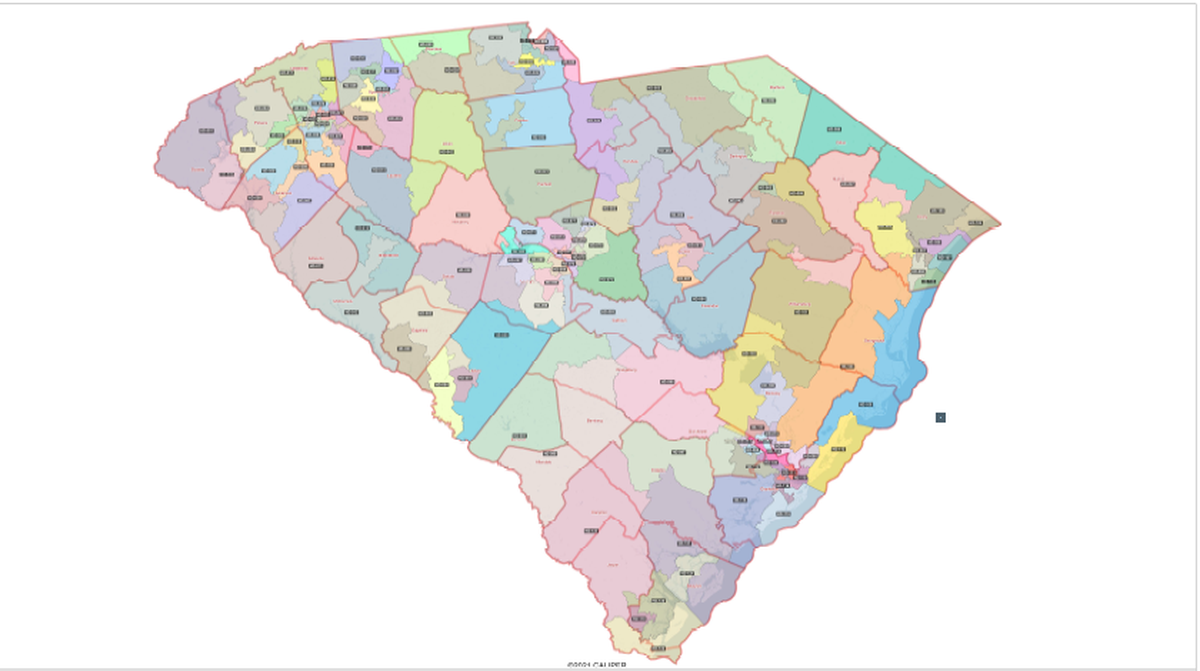
House map called an ‘extreme gerrymander’
The House redistricting proposal, released Nov. 8, creates 124 voting districts with 41,278 people each, plus or minus 2.5%.
The plan, which came under bipartisan criticism during public testimony last Wednesday, splits 33 of South Carolina’s 46 counties and 368 voting precincts.
It has 20 districts where minorities comprise a majority of the population, according to Rep. Neal Collins, R-Pickens, who said he viewed the considerable number of majority-minority districts as a major strength of the map.
“The Black caucus would do just as well and probably above their weight statewide because of that,” he said.
Princeton University’s Gerrymandering Project, which analyzed draft House and Senate maps in all 50 states, projects that South Carolina’s proposed House map would produce an 83-41 partisan split, leaving Democrats with two fewer representatives than the 43 they currently have.
Only six of the 124 House districts are expected to yield competitive races, defined as a vote share between 45% and 55%, according to the Gerrymandering Project.
The League of Women Voters of South Carolina, which also evaluated the House and Senate redistricting proposals, determined the House map would create twice as many competitive districts as Princeton’s analysis found, but still bemoaned the relative dearth of competition built into the plan.
“Noncompetitive districts deprive citizens of a meaningful vote,” the League wrote in its submitted testimony on the plan.
A complex statistical analysis the organization performed to measure partisan bias found the House proposal was more biased than all but 1,410 of 1 billion simulated maps, according to Lynn Teague, vice president for issues and action with the League of Women Voters of South Carolina.
Another test of partisan bias found that only 130 out of 1 billion simulated maps were more extreme than the House’s map, Teague said.
“On the face of it, the House proposal appears to be an extreme gerrymander,” she testified last week.
The League’s written testimony, obtained by The State, reiterates that the map is an extreme partisan gerrymander that goes out of its way to protect incumbents and urges the House redistricting panel to “completely rethink this unfortunate plan.”
State Rep. Jay Jordan, R-Florence, who chairs the House redistricting subcommittee, did not respond to requests for comment on the draft map. He stressed at last week’s hearing that the proposal was a “work in progress” and said the panel would take under advisement any suggestions from the public.
Some of the most vociferous complaints about the map came from residents of Districts 90 in Bamberg County and 95 in Orangeburg County, portions of which the House proposal combines in a redrawn District 90.
A group of Bamberg County residents, some of whom identified themselves as Republicans, questioned the realignment of District 90, which currently comprises all of Bamberg and parts of Barnwell and Colleton counties.
The House proposal would pull District 90 out of Barnwell and Colleton counties and into Orangeburg and Allendale counties, transforming it from one of the most competitive districts in the state into a 60% minority district that would highly favor incumbent Justin Bamberg, D-Bamberg.
“Bamberg County has basically nothing in common with Orangeburg County, and I question the intentions of whoever proposed this gerrymandering of a district that has served us well,” Bamberg resident Nancy Kemp Watson said. “I, for one, fail to see the reason or the wisdom of a plan that drops Barnwell and Colleton counties, while adding basically 30% of the city of Orangeburg.”
Bamberg County resident Sharon Carter also said she was disappointed in the way District 90 had been drawn to remove the counties that House redistricting committee member Justin Bamberg lost in the 2020 election.
“I don’t believe it’s coincidental that the proposed lines negated both Barnwell and Colleton counties,” she said, speaking directly to Bamberg at last week’s hearing. “Those proposed changes, it really only seems to benefit you personally. It doesn’t seem to benefit us, the hardworking taxpayers of Seat 90 in any way.”
Justin Bamberg responded that the map was a work in progress and said District 90, which had at one point included parts of Orangeburg County, needed to add residents.
“Different districts need population. We happen to live in a part of the state where that is reality, unfortunately,” he said. “There are very valid justifications for why that part of the state is drawn up the way that it is.”
Orangeburg County residents also took issue with the House proposal, which would split the city of Orangeburg into four separate districts and set up a primary between Democratic Reps. Jerry Govan, of Orangeburg, and Russell Ott, of Calhoun, in a redrawn District 93.
If Ott, the assistant House minority leader, were to win that seat, which he currently holds, much of the city of Orangeburg would be represented by residents of Barnwell (District 91), Bamberg (District 90) and Calhoun (District 93) counties.
“I’m just appalled with the way the lines have been drawn,” said Liz Keitt, an Orangeburg native and longtime Orangeburg City Council member. “Orangeburg is just too large and productive a county to say that we will not have a representative here. … We are too, too important not to have a representative.”
In addition to Govan and Ott, at least 10 incumbents are “double bunked” and would have to face off in primaries under the House plan, if they chose to run again, according to an analysis by the League of Women Voters.
Other House lawmakers who have been drawn into the same district are Reps. Vic Dabney, R-Kershaw, and Brandon Newton, R-Lancaster, in District 45; Reps. Sandy McGarry, R-Lancaster, and Richie Yow, R-Chesterfield, in District 53; Reps. Lucas Atkinson, D-Marion, and Roger Kirby, D-Florence in District 59; and Reps. Wendy Brawley, D-Richland, and Jermaine Johnson, D-Richland in District 70.
Correction: An earlier version of this article stated incorrectly that Reps. Kambrell Garvin, D-Richland, and Ivory Thigpen, D-Richland, also had been drawn into the same House district.
This story was originally published November 16, 2021 at 5:00 AM.