
Concerns over splitting SC’s coastal communities take center stage at redistricting hearing
Residents concerned with proposed changes to South Carolina’s 1st Congressional District dominated the discussion at Thursday’s House redistricting panel.
The specific issues raised and solutions proposed varied, but the overwhelming sentiment was the same: the redrawn coastal district splits too many interconnected communities and should be reconsidered, speakers said.
The hearing, which lasted about 50 minutes, was the first of at least two the House redistricting committee plans to hold to solicit public input on its recent congressional proposal. After taking the public’s temperature, the House and Senate, which released its own proposal last month, plan to come together in January to finalize the state’s new congressional map.
State Rep. Jay Jordan, R-Florence, who chairs the House redistricting committee, said during Thursday’s hearing the map was a starting point and he hoped to get more public input after the Christmas holiday.
The House plan, released late Monday, makes major changes to the geography of four of the state’s seven U.S. House districts, including the 1st, which needs to shed more than 80,000 people to rightsize its population as part of the redistricting process. Each district must have as close to 731,204 people as possible.
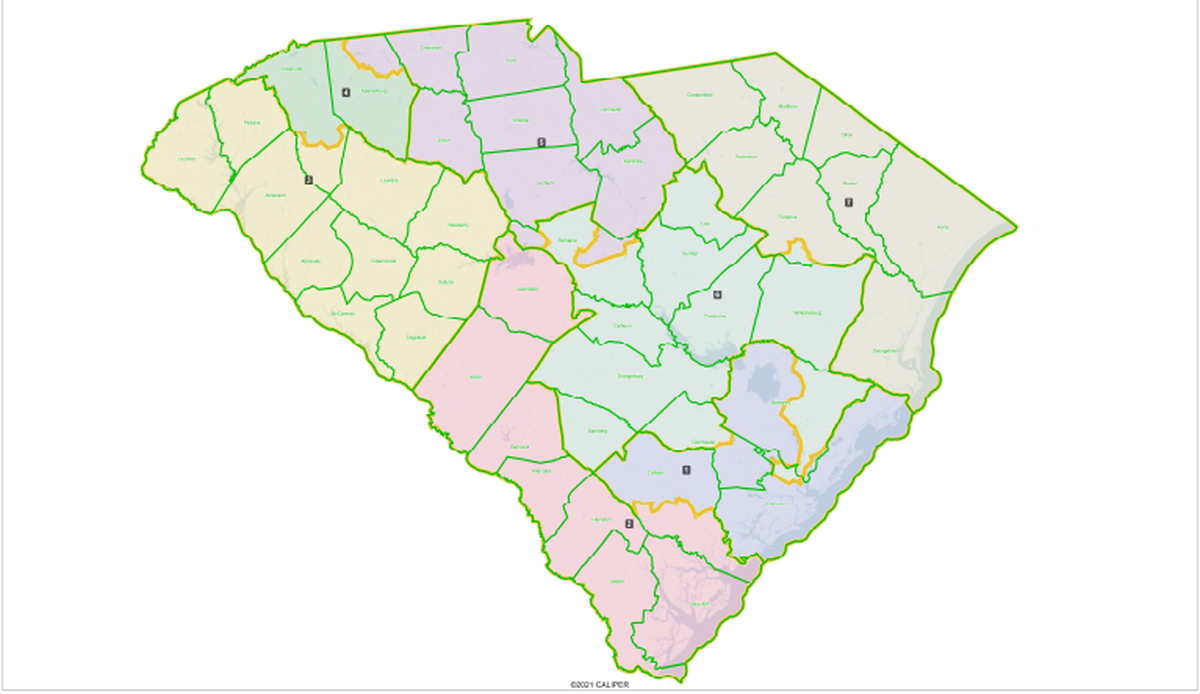
The proposal improves upon the current map and previously-released Senate map in a number of respects, including on measures of competitiveness and proportionality, according to Dave’s Redistricting, a popular map drawing and analysis tool, but has garnered criticism for neglecting communities of interest.
Under the proposal, all but the 1st District, represented by U.S.Rep. Nancy Mace, R-Daniel Island, would be uncompetitive, with Republicans virtually assured of winning five seats and Democrats with a stranglehold on the majority-minority 6th District.
That differs from the Senate plan, which would transform Mace’s district into a reliably red seat and give Republicans a clear-cut 6-1 advantage in the state.
While the League of Women Voters of South Carolina applauded the 1st District’s continued competitiveness, it took issue with how the House map maintains that balance.
“We acknowledge that (the 1st Congressional District) as drawn in the current House proposal is within a competitive range,” Lynn Teague, the League’s vice president for issues and action, said in written testimony provided to The State. “But that outcome is not achieved in a way that accurately reflects regional economic and social relationships.”
Rather than drawing a compact 1st District centered around Charleston County to create a naturally competitive and cohesive district, House mapmakers designed a contrived, three-headed district that carves out majority-minority North Charleston to accomplish the same goal, critics argue.
North Charleston, excised from its geographic neighbors in the House map, winds up in the 6th, a majority-Black, largely rural district that stretches all the way to Columbia, more than 100 miles away.
The pairing of the two cities is historical — both the current congressional map and the Senate proposal place North Charleston and Columbia in the 6th District — but unnecessary to achieve the committee’s aims, the League argues.
Former Democratic Congressman Joe Cunningham, who represented the 1st District from 2019 to 2021 and now is running for governor, echoed the League’s concerns at Thursday’s hearing.
“If I come here today with just one question for this committee, it’s this: What does the Legislature not like about North Charleston?” he said. “There’s something downright bizarre about the Legislature’s obsession with making sure that North Charleston is separated from the rest of Charleston County and put into another district.”
Cunningham, who recently launched an advocacy campaign called “Keep Charleston Together,” said racial gerrymandering is the obvious explanation.
“The goal, clearly,” he said, “is to pack as many Black voters into one enormous Black district so that all the other districts around it are lily white.”
The 6th District, which was created in the early 1990s to serve as an opportunity district for Black voters to elect candidates of their choice, has more than twice as many African American residents as any other district in the state.
In addition to complaints about the map’s racial dynamics, Lowcountry residents from Beaufort and Charleston counties testified Thursday that the House map, as proposed, problematically splits areas with shared coastal interests.
The relocation of Beaufort County — which contains Hilton Head Island — from the 1st District to the more inland 2nd District, represented by U.S. Rep. Joe Wilson, R-Springdale, was of particular concern.
Multiple Hilton Head residents testified Thursday that Beaufort County should remain in the 1st District with Charleston County because the areas have much in common, such as beautiful waterways, resorts and susceptibility to extreme storms.
While issues with the 1st District occupied much of Thursday’s discussion, the map’s redrawn 5th District also raised the ire of multiple speakers.
The House plan stretches the 5th District, a suburban Charlotte district represented by U.S. Rep. Ralph Norman, R-Rock Hill, all the way down into Richland County.
Both Cunningham and Teague questioned the connection between the areas.
“There’s no reason whatsoever that the 5th Congressional District should extend all the way into Richland County,” Cunningham told the committee. “What does western Cherokee County have in common with Forest Acres in Richland County? Nothing. Absolutely nothing. If you simply kept Richland whole, it would solve all your problems.”