
How will redistricting impact SC’s political balance in years to come? Here are highlights
After months of public meetings and several weeks of legislative hearings about the decennial redistricting process, South Carolina’s state voting maps are set.
Barring a successful legal challenge that forces lawmakers or the courts to redraw district lines, the state House and Senate maps adopted earlier this month will remain on the books for the next 10 years.
The new maps ensure that South Carolina’s House and Senate districts, which had gotten out of whack due to uneven population growth over the past decade, once again contain an equivalent number of people.
To get the state’s 124 House districts and 46 Senate districts within an allowable population range, lawmakers had to shrink some jurisdictions while expanding others. Districts with modest or nonexistent population growth over the last 10 years were merged or relocated so that districts in parts of the state that experienced explosive growth could be created.
As is true in any reapportionment process, there were winners and losers.
To get a sense of the political impact of redistricting, The State analyzed the demographic and partisan makeup of the redrawn districts and spoke with some of the lawmakers likely to be most affected by South Carolina’s shifting boundaries.
Growing counties gain new seats
South Carolina added about 500,000 people in the past decade, according to the 2020 census, but that growth has not been uniform.
To account for swelling populations, lawmakers compressed burgeoning districts and enlarged districts with stagnant or diminishing populations. In some cases, whole districts were moved from one part of the state to another.
The new House map includes three such moved districts and the Senate has one.
On the House side, districts in Florence (61), Orangeburg (66) and Richland (80) counties were excised from the map and inserted into Horry, York and Charleston counties, respectively — three of the fastest growing counties in the state — to accommodate population shifts.
The Senate map moved District 20, represented by Sen. Dick Harpootlian, D-Richland, to Charleston County.
While some counties gained districts and others lost them, the relocations did not necessarily change the total number of legislative districts in a given county.
Florence and Orangeburg counties, for example, still have the same number of House districts because, in addition to losing seats, both counties also gained partial districts.
Some counties that added seats, like York and Charleston, actually will have smaller House delegations — albeit ones with more resident representatives — because districts that previously stretched into those counties no longer do.
Incumbents paired in redrawn districts
Fourteen state lawmakers — 10 representatives and four senators — were drawn into districts with other incumbents, setting up potential primary challenges in future elections.
At least one double-bunked legislator, freshman Rep. Sandy McGarry, R-Lancaster, already has said she does not plan to seek reelection as a result.
McGarry, who last year unseated four-term Democratic Rep. Mandy Powers Norrell, said she would not challenge her longtime friend Rep. Richie Yow, R-Chesterfield, after being drawn into his district.
In at least two cases, legislators who were drawn out of their districts plan to relocate to avoid a primary against a colleague.
Sen. Billy Garrett, R-McCormick, and Rep. Vic Dabney, R-Kershaw, were drawn into new districts, but are expected to establish residency in their former districts in time for their respective reelection campaigns.
Rep. Jerry Govan, D-Orangeburg, also left open that possibility, but said this week he hadn’t yet cemented his future plans.
If he seeks reelection while retaining his current residence, Govan would face a primary against Rep. Russell Ott, D-Calhoun. He could, however, establish residency in districts represented by Reps. Lonnie Hosey, D-Barnwell, or Justin Bamberg, D-Bamberg, and challenge one of them.
“I have the capacity to do that,” Govan said. “It’s just a matter of whether it will be convenient, because then I have to disrupt my situation in terms of my personal life.”
Rep. Roger Kirby, D-Florence, who currently holds a competitive but Republican-leaning seat, has been drawn into a solidly blue district represented since 2014 by Rep. Cezar McKnight, D-Williamsburg.
House mapmakers originally slotted Kirby, of Lake City, into a Marion County district represented by Rep. Lucas Atkinson, but changed course after he appealed to the redistricting committee to keep his hometown whole.
“Lake City is a vibrant and important community to our area and it just didn’t seem appropriate for it to be split into several districts,” Kirby said.
The 6,000-person city was made whole in the final House map, but the resulting redraw shifted Kirby into McKnight’s district in a move that could hurt his reelection prospects. He said he’s alright with that.
“I still feel like it’s better for (Lake City) to be represented as a whole, and we’ll see what happens with reelection,” Kirby said this week. “I am currently certainly planning on seeking reelection. But it’s not going to be an easy lift by any means.”
Reps. Wendy Brawley and Jermaine Johnson, whose districts were merged following the elimination of a lower Richland County seat, are also gearing up for reelection campaigns.
“Neither of us wanted this situation,” said Johnson, whose district jumps to Charleston in the new map. “My prayer is that no matter the outcome of the election, that we can continue to work together for the betterment of the lower Richland community.”
Johnson, a freshman legislator, said he wouldn’t resort to mudslinging in his primary campaign with Brawley because he has enormous respect for her and knows they both only want what’s best for their constituents.
“I call her my sister,” he said. “Before I got in here, I called her my favorite rep. So we are committed in being united for our communities.”
The only incumbent senators currently slated to face off in the future are Harpootlian and Sen. Nikki Setzler, D-Lexington, the chamber’s longest-serving member.
Harpootlian said he doesn’t take issue with the redraw, which bumped his district to Charleston County to accommodate coastal growth, because it made the district more compact, aligned with the state’s population trends and guaranteed Richland County another resident senator.
“However,” he said, “it obviously puts me and Nikki (Setzler) in the same district,” which is “something we’ll have to resolve.”
Shifts in the political balance
The new legislative maps are expected to increase Republicans’ already-large advantage in the State House in the years to come.
Prior to the recent suspension of Rep. Rick Martin, R-Newberry, and resignation of Rep. Mandy Kimmons, R-Dorchester, Republicans held an 81-43 House majority and will have a supermajority if they flip at least two seats in next year’s elections.
That scenario is looking increasingly likely based on an analysis of partisan voting trends that found as many as five Democratic House seats at risk of going red.
Districts 61, 66 and 80, three Democrat-held seats that were moved into fast-growing parts of Horry, York and Charleston counties all now appear to be reliably red seats without an incumbent.
The new District 61, which runs along U.S. Route 501 from Myrtle Beach to Conway, favors Republicans by 30 points, according to Dave’s Redistricting, a map drawing and analysis tool.
District 66, which moved from Orangeburg to an area of York County west of Interstate 77 that includes Tega Cay, and District 80, a lower Richland-turned-Mount Pleasant district, will be slightly more competitive, but are still projected to give Republicans large double-digit advantages.
The other two House seats Democrats currently hold that appear precarious are Districts 55 and 117.
The popularity of retired longtime Dillon High School football coach Rep. Jackie Hayes may allow him to run unopposed again in 2022 — the 12-term incumbent hasn’t faced a general election challenge in 15 years despite living in a competitive district — but a Republican eyeing that seat would likely stand a better chance now than ever before.
Hayes’ District 55, which already was slightly Republican-leaning, gets considerably redder in the new map as it stretches deeper into Horry County, according to a partisan lean analysis that uses the composite results of recent presidential, senatorial, gubernatorial and state attorney general races.
District 117, a competitive Lowcountry district that Ladson Democrat Krystle Matthews won by 5 points in 2020, underwent an even starker partisan shift in redistricting. The district, which had included a sizable chunk of North Charleston, is now located entirely within Berkeley County and projects as a safe Republican seat.
Matthews, who flipped the seat in 2018 and said she plans to seek reelection, bemoaned the redraw but downplayed its implications for her political future.
“They tried to load me up heavily with Republicans, but honestly, my district was already heavily Republican,” she said. “People don’t care about that. They honestly just want solutions and the fact that I’m able to help them work through so many of the problems that we’re facing during the pandemic has yielded well for me.”
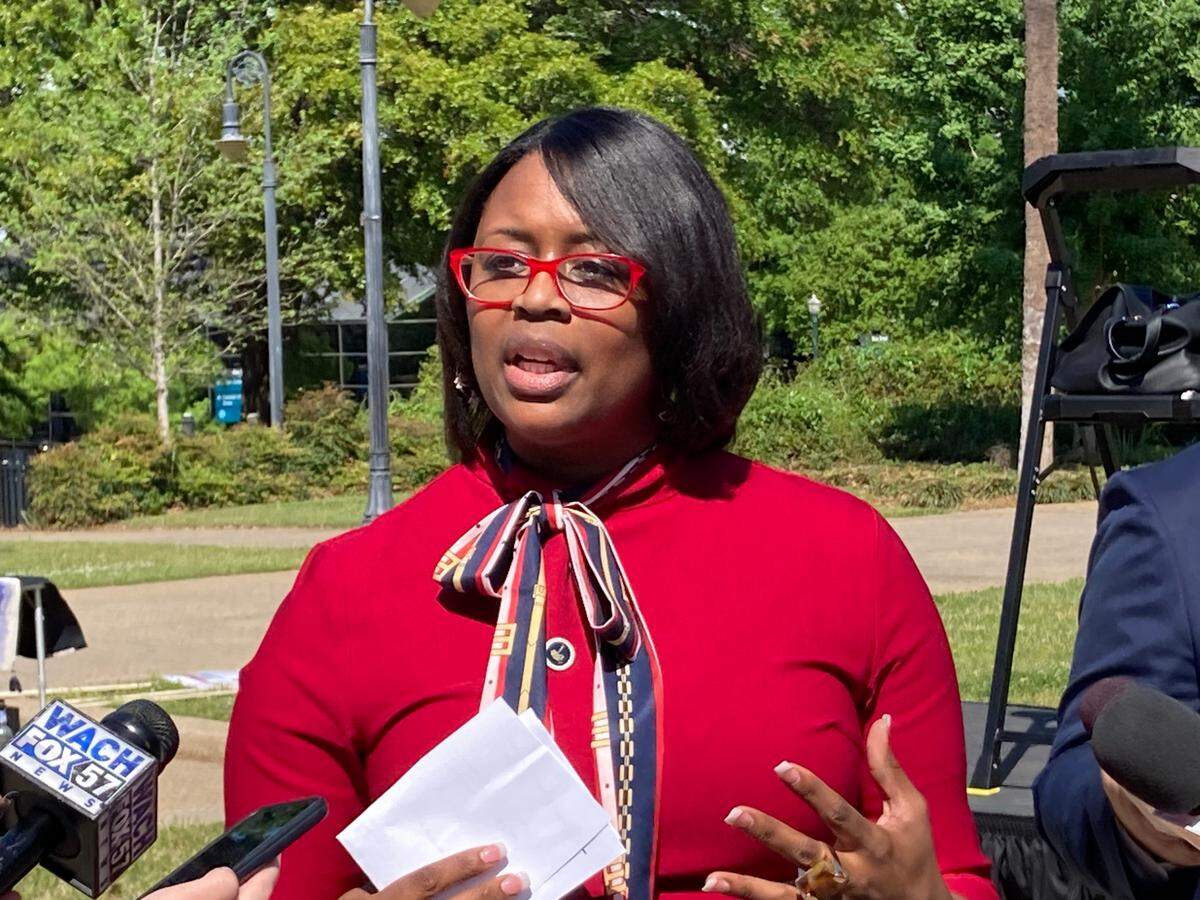
Matthews, who also is a candidate in the 2022 U.S. Senate race, said she believed residents moving into Berkeley County were people to whom she appealed and could relate.
“It’s working families,” she said. “People who just want their quality of life to be good. They don’t want to have to jump over a million barriers to get there. And that’s what I represent. As a single mom of five, that is my bread and butter.”
Senate is stable, for now
Unlike the House’s redraw, the new Senate map isn’t expected to immediately change the 30-16 Republican advantage in the upper chamber.
However, as the decade progresses, the Senate’s balance may shift to the right if present demographic trends hold, the League of Women Voters of South Carolina has said.
The nonpartisan organization singled out Districts 17 and 39 as two areas where minority voters can currently elect candidates of their choice, but may not hold the same sway going forward.
Sens. Mike Fanning, D-Fairfield, and Vernon Stephens, D-Orangeburg, who represent those districts, were the only two senators who opposed the new map.
Stephens’ district, which now extends farther into Berkeley County and picks up the rapidly growing areas of Nexton, Carnes Crossroads and Cane Bay, is likely to get increasingly competitive in the years ahead as it takes on a whiter, less rural character.
The Black Orangeburg Democrat said he’s not sure whether he’ll still be electable by the time he’s back on the ballot in 2024, but believes his ability to work with diverse populations, honed over his nearly 20 years as a school board member, will serve him well if he chooses to run again in District 39.
Two other rural Democrat-held seats that have been solidly blue but could get more competitive now that they’ve expanded geographically into more Republican areas are Districts 30 and 36, represented by Kent Williams, D-Marion, and Kevin Johnson, D-Clarendon.
Williams’ district, in particular, which now extends well into Horry County, shifts from one that favored Democrats by more than 20 points to one that favors them by less than half that margin, according to Dave’s Redistricting.
This story was originally published December 26, 2021 at 5:00 AM.