SC Democrats vie for gubernatorial nomination. Here’s where McLeod, Cunningham race stands
South Carolina’s two leading Democrats running for governor are spending their weekends trying to woo voters in parts of the state where Democratic voters say they’re often ignored.
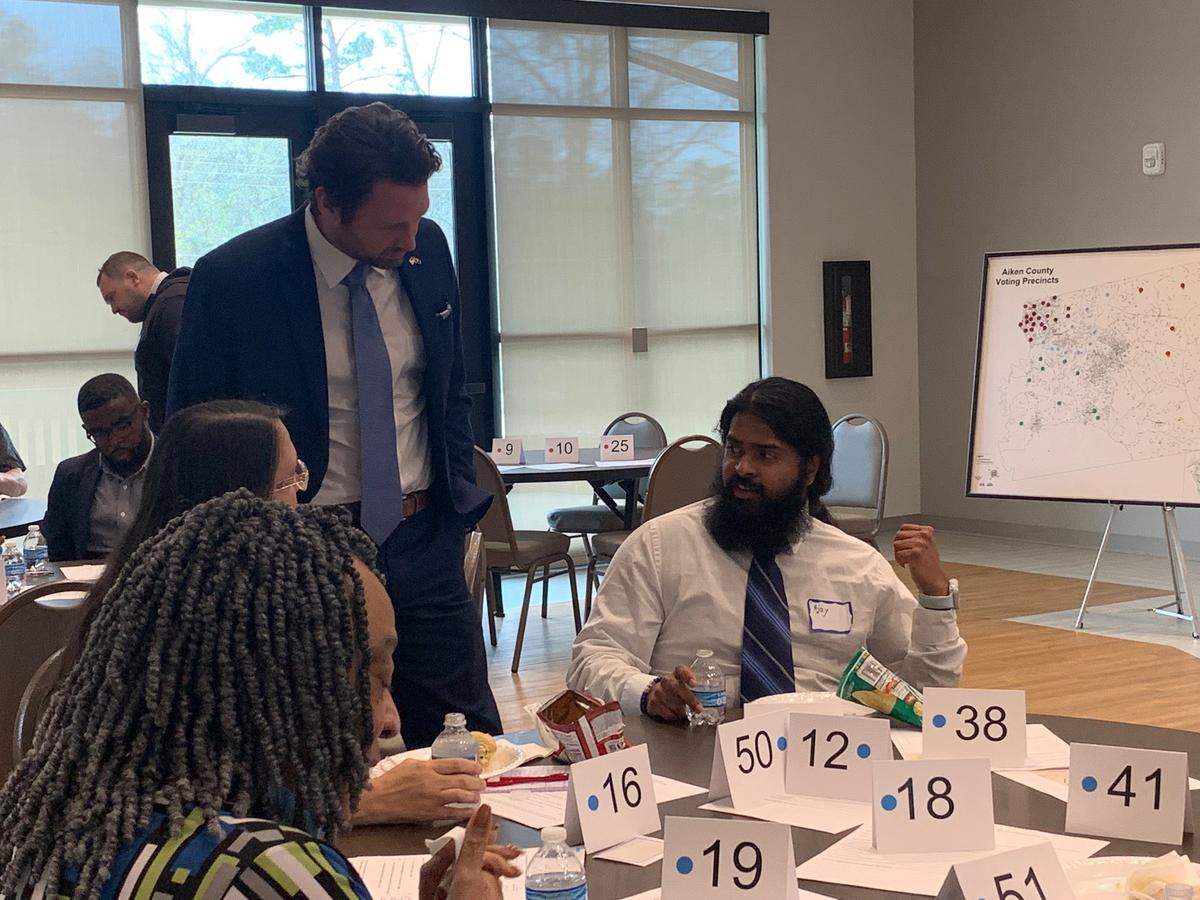
On one Saturday, former Lowcountry Congressman Joe Cunningham stumped in Aiken County, a traditionally red county, speaking to about 80 voters. Across the state on the same day, state Sen. Mia McLeod, D-Richland, stood outside of the Commons, a gathering space with food stands and shops, in Greenville County, another red area of the state where Democrats have tried for years to chip away at Republicans’ advantage.
These types of visits have been going on for months, with little fanfare, as two of the so far five Democrats vying for the Governor’s Office try to electrify a voting base roughly three months before the statewide June 14 primary.
They are Columbia’s Carlton Boyd and Calvin McMillan and William Williams of Florence.
Whoever gets through the primary will likely go up against incumbent Gov. Henry McMaster, who holds a fundraising and name ID lead in a reliably red state where Democrats have been unable to win a statewide seat since 2006. McMaster is being challenged in the Republican primary by Harrison Musselwhite, of Greenville, and Mindy Steele of Moncks Corner.
The problem for candidates like Cunningham and McLeod is an apathetic base in parts of the state, who still do not know, less than three months out, who they’re planning to vote for in the June 14 primary.
Some voters say they’re still unaware who the candidates are — one the first Black woman to run for governor and a state senator for more than five years and a white former U.S. House member who stunned voters in 2018 after he flipped a GOP seat — and what they want to achieve if they win November’s election.
Neither of the candidates are airing television advertisements, leaving primary voters to learn about the candidates at meet and greet events.
McLeod declined to get into specific plans about when she would go on the airwaves, but said there are digital strategy plans coming. Cunningham said plenty of time remains for candidates to take to the airwaves, saying ads typically come at the very end of the campaign.
Cunningham leads McLeod in fundraising. He has brought in $1.3 million during the cycle, and McLeod has brought in about $359,000. They both trail McMaster, however, who has raised $4.4 million through the end of 2021. Updated fundraising figures are expected in April.
“Each campaign has got their own strategy as to how they’re doing things and that’s just the way that goes,” said Trav Robertson, chairman of the South Carolina Democratic Party. “I also think that we’re dealing with a unique electorate to the extent that we’re coming out of a pandemic. When you start campaigning as early as our candidates started campaigning, there are peaks and valleys.”
Cunningham, McLeod try to energize the primary base
Cunningham and McLeod are running into a serious challenge: Exciting the Democratic base and the overall electorate.
While active party loyalists pay attention and might be excited about the election, they acknowledge the race has yet to garner a lot of energy.
Ann Willbrand, the second vice chair of the Aiken County Democratic Party, said at the county’s party convention in early March it’s still early in the primary process, and the primary election itself is what will energize voters in the race.
But it will take more than television advertising and going to events to energize voters, Willbrand said.
“The only way we could beat him (McMaster) is to have candidates who have a vision, have a message, who are energetic and people want to get out and vote for them,” Willbrand said. “If it’s another one of these (2018 Democratic governor nominee) James Smiths, (with) his little laundry list, I’m going to protect women’s rights, I’m going to do Medicaid expansion, that’s nothing, that doesn’t to excite people.”
Robbie Stone, 66, of Beech Island in Aiken County, is a retired federal employee, who’s voted in previous elections but is only now getting active in county party politics.
She’s not been following the primary race.
“To be honest, I didn’t know it was coming up,” Stone said.
Ajay Krishnakumar, 27, of Aiken, said he is excited about the race, but conceded Democrats are in a tough spot.
“The pandemic properly ending and this inflationary spiral going on is pretty bad. Gas prices is the biggest thing,” Krishnakumar said. “I think for Democrats to do well, I think Ukraine needs to be resolved.”
Krishnakumar is still undecided on who he’ll support in the primary.
“I like Joe Cunningham, I think he’ll be a good candidate,” he said. ”But Mia McLeod is more progressive.”
‘Take a herculean effort’
Cunningham, 39, is a moderate from the Charleston area, who stunned voters in 2018 when, for the first time since the 1980s, he beat a Republican to win the 1st District race.
McLeod, 53, is a state senator who runs a public relations firm and has served in the General Assembly since 2011.
While in Congress, two of Cunningham’s bills — one dealing with allowing veterans to participate in Board of Veterans’ Appeals hearing from their personal computers and one dealing with land and water conservation — made it through the Democratic-controlled House and Republican-controlled Senate. They were signed by former President Donald Trump.
He voted against making Nancy Pelosi speaker of the House when Democrats gained control of the chamber, and he voted against a $15 minimum wage.
McLeod, who has supported a $15 minimum an hour wage, has touted working under both major parties.
She has worked for former Republican Attorney General Charlie Condon and for former Democratic Gov. Jim Hodges, helping to create protocols for law enforcement, solicitors, judges and victim advocates to combat with domestic violence.
McLeod, who describes herself as pro-business, also has pushed for more progressive policies in the state. In 2015, she unsuccessfully tried to regulate men’s access to Viagra and other erectile dysfunction medication. In 2020, she filed legislation to decriminalize marijuana in the state and another bill to add a ballot referendum to see if voters supported legalization of weed for recreational and medicinal purposes.
But are their credentials enough to sway voters on the other side of the aisle?
“If you gave them a left-wing progressive, the answer would be ‘no,’ and Henry would win easily,” said Danielle Vinson, a Furman political science professor. “In South Carolina, a Republican is going to win until they don’t. It would take a herculean effort for a Democrat to win against McMaster, but is it completely out of the realm of possibility? No. It’s politics.”
Some said they perceive Cunningham as the Democratic frontrunner.
He’s leading in fundraising, and has, for months, been aggressive in his campaign messaging and announcements. It’s not pleasing every progressive voter.
“Joe Cunningham is the Democratic frontrunner, but I am not very much enthusiastic about him,” said Jonah Simmons, 30, and the second vice chair of the Young Democrats of Greenville County, citing Cunningham’s $12-an-hour minimum wage stance. “It’s great that he’s a young person, but he doesn’t get people excited and we’re not going to get young people out to the polls if they’re not excited about the person running.”
Cunningham told reporters he’s doing enough to appeal to all wings of the party.
“We’ve been at this for almost a year, putting out policy after policy and they’ve gotten great feedback, and so I think we’re stirring up a lot of excitement all across, and it’s a big tent party,” Cunningham told reporters after he filed to run, pointing to campaign promises that he’d work to raising starting pay for teachers to $50,000 by 2030 and legalize marijuana and sports betting.
McLeod, meanwhile, pointed to her work as a co-sponsor on the medical marijuana bill that recently passed the Senate and her efforts to raise the minimum wage.
“What we’re seeing is people who know my work are already excited,” McLeod said. “They’re helping to spread the word as I get to counties I have not been to yet.”
But McLeod admits the party faithful might be worn out.
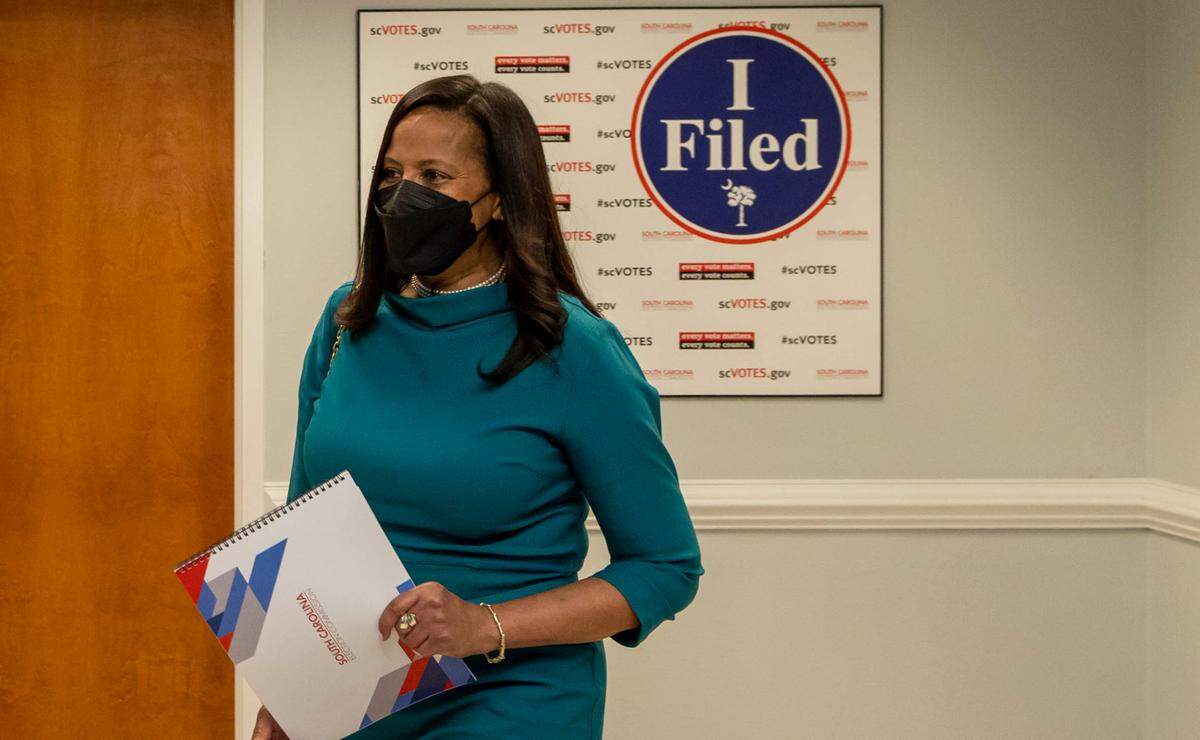
“There’s definitely a lot of fatigue from grassroots Democratic voters,” said McLeod, who still wears a mask in public because she has sickle cell anemia. “They gave their all to try and help defeat Lindsey Graham, and while they’re excited about (President Joe) Biden’s victory, it took a lot.”
Jessica Winters, 39, of Taylors, said she’s read about Cunningham and McLeod through general web searches.
But she wants the candidates to be doing more.
“I do know a lot about Joe, he seems to have a lot more presence,” Winters said after attending an event for McLeod set up by the Greenville County Schools Advocacy Facebook group. “I would like to see more information out there, more campaigning because I didn’t know she was running until they brought it up in our group.”
Black SC voters key in Democratic primary
McLeod is the first Black woman to seek the governor’s office, a contrast that could play a role with how the Democratic electorate sees the two candidates.
In the last four primary elections, when both major parties held elections, non-white voters made up more than 60% of South Carolina’s Democratic primary base. In June 2020, non-white voters comprised more than 70% of the Democratic electorate.
But Vinson said she doesn’t see candidates’ race being the key factor in who wins the nomination.
Voters in the Democratic primary are pragmatic and want to support someone who they think can win, Vinson said.
In 2008, South Carolina Democrats seemed to be on the path of nominating Hillary Clinton for president, but after Barack Obama won the Iowa Caucus, “they went, ‘Oh, maybe he could win in a general election,’” Vinson said. “So they shifted at that point.”
In 2020, then-U.S. Sen. Kamala Harris from California and New Jersey U.S. Sen. Cory Booker, both Black candidates, dropped out of the Democratic presidential race well before the South Carolina primary because they weren’t gaining ground in the crowded field.
“The fact they weren’t gaining traction in the state and that state voters weren’t turning to them because of race suggests Democratic voters in the state, African American voters in the state, actually think things through and make their mind up a little bit more deliberately,” Vinson said.
How are the candidates working to distinguish themselves?
McLeod, who has proposed more progressive policies while in the State House, and Cunningham, who was a moderate member during his one term in Congress, both agree on key issues Democratic voters find favorable.
They agree on Medicaid expansion, protecting access to abortions and raising teacher pay.
Now they have to try to find a way to distinguish themselves from each other beyond race.
McLeod last year came out with a plan to address COVID-19 and demanded the state formally request federal COVID-19 relief for small communities in the state.
She recently released an agenda she said will improve the lives of Black South Carolinians.
In recent months, Cunningham called for legalizing sports gambling, a suspension of the gas tax, and has been a vocal critic of the congressional map redrawn by the Legislature this year.
He also rolled out a proposal to legalize marijuana in South Carolina, and, as senators debated whether to pass a medical marijuana bill, he made a State House appearance to show his support for the legislation.
“Welcome to the fight, Joe,” McLeod tweeted at Cuningham in February. “Hate that I missed you today, but as a cosponsor of the (medical) marijuana bill we’ve been debating in the Senate for 3 weeks now, I’m just curious about why you didn’t sponsor a bill to declassify marijuana during your 2 years in Congress. Nancy Mace did.”
Cunningham has largely avoided criticizing McLeod, instead setting his sights on McMaster. McLeod also has done the same.
“She and I are on the same mission, to defeat Henry McMaster and make South Carolina a leader again in education, health care and economic opportunity,” Cunningham said.
But that challenge won’t happen until November, and, until then, voters say the candidates need to pick up the pace.
“I know we still have some time,” said Jodi Herrin, ia 56-year-old, Graniteville voter who said she’s supporting Cunningham in the primary. “(But) they have to hit on issues that talk to the people.”
This story was originally published April 1, 2022 at 5:00 AM.