
SC’s Graham says he could support US no-fly zone over Ukraine if Russia takes this step
The war raging between Ukraine and Russia is about more than one country in Eastern Europe, two members of South Carolina’s congressional delegation told a crowd at the University of South Carolina on Monday.
“This is about the rule of law versus the rule of the gun,” U.S. Sen. Lindsey Graham, R-S.C., said.
To deter Russian President Vladimir Putin’s aggression against his neighbor from evolving into a victory of international authoritarianism over a fledgling democracy, Graham said there are conditions under which he would support the U.S. using direct military action to enforce a no-fly zone over Ukraine, including if Russia deploys chemical weapons.
“If (Putin) uses chemical weapons, it destroys the international regime around chemical weapons we’ve tried to build up since World War II,” Graham said. “If he goes down that road, it’s an even larger war crime.”
If the U.S. doesn’t take action to “protect Ukrainians from a miserable death,” then Putin and other authoritarian leaders out to shake up the world order would conclude the U.S. is “all talk,” he said.
Setting up a no-fly zone would be an escalation of U.S. engagement in Ukraine, experts say, and could lead to a direct military confrontation between U.S. forces and Russia, a country that has placed its own sizable nuclear forces on high alert since it invaded Ukraine on Feb. 24.
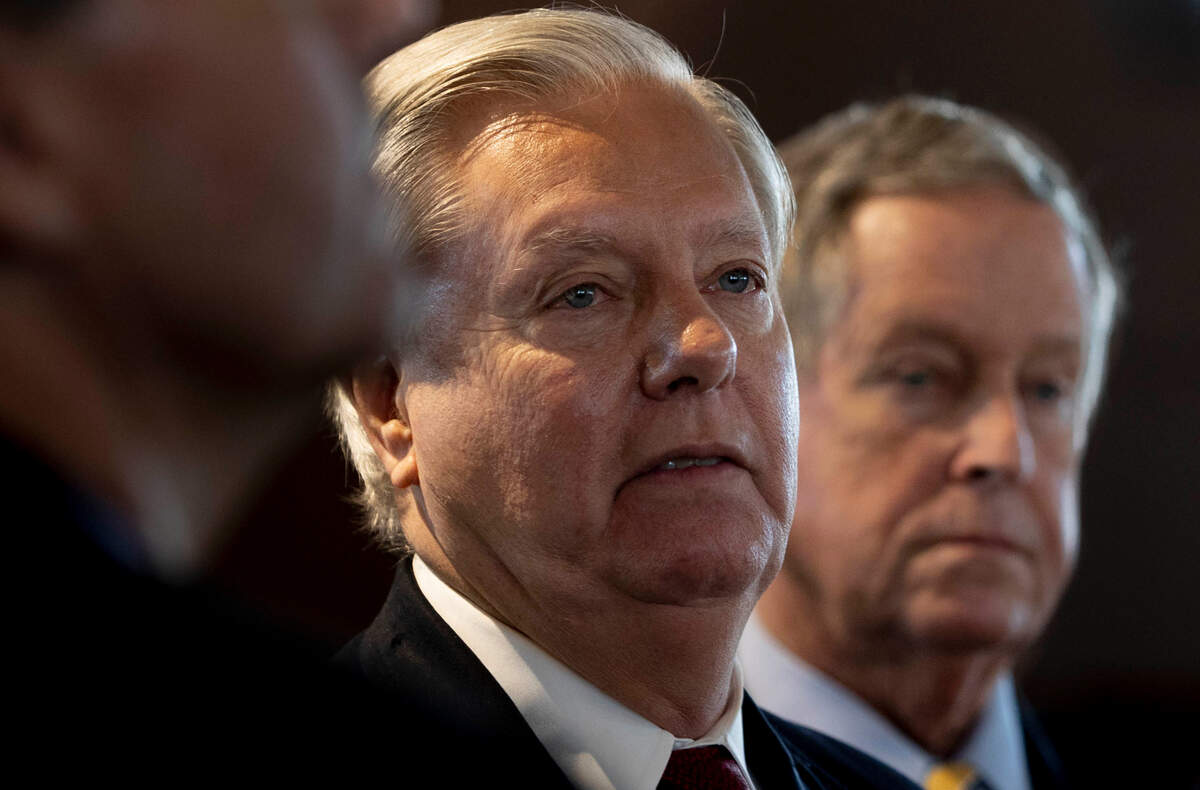
Graham said he’s not in favor of U.S. troops being deployed to Ukraine because the country is outside NATO’s mutual defense alliance. But he also said Putin is unlikely to retaliate with a nuclear strike.
“He’s a murderer, he’s not suicidal,” Graham said, hinting that Russia’s military leadership might not back Putin in such a scenario. “If he makes that decision, I think the Russian general staff will take care of the problem.”
‘A place worth defending’
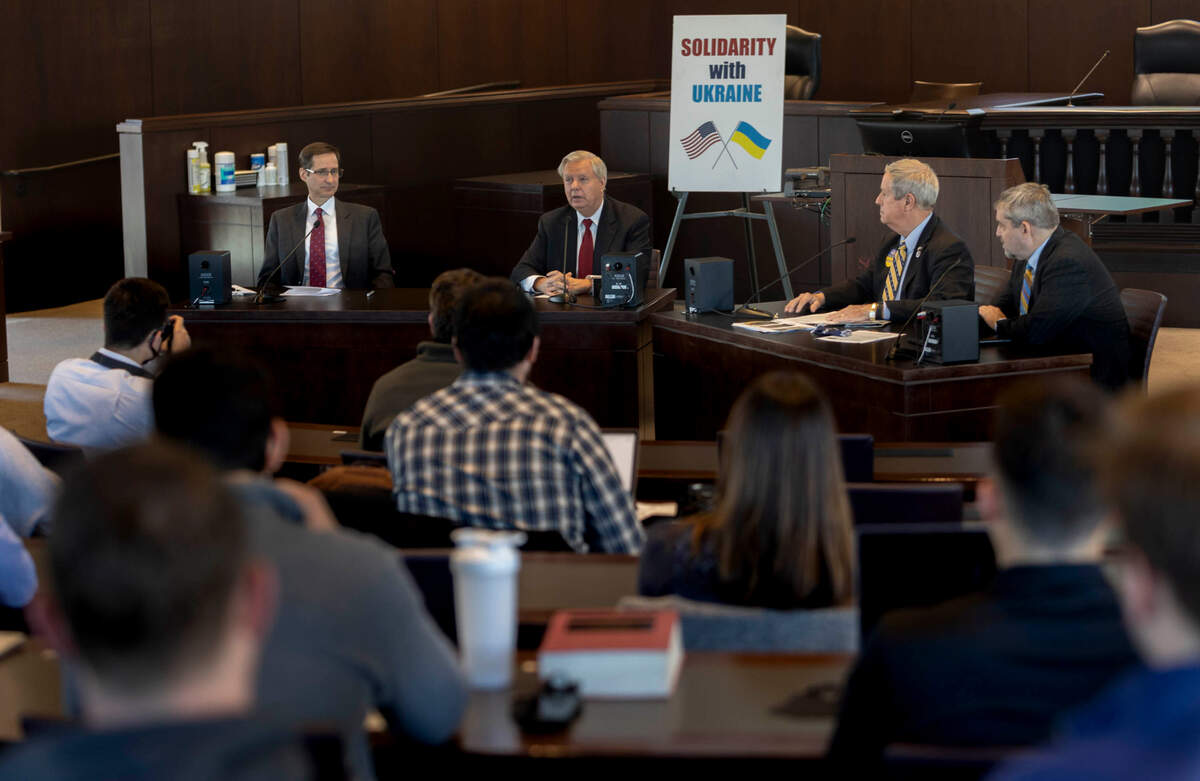
Graham and U.S. Rep. Joe Wilson, R-Springdale, both took part in a roundtable discussion on Russia’s invasion of Ukraine and potential war crimes committed by Russian forces at the University of South Carolina Law School Monday.
Graham is part of a bipartisan group of senators to introduce a resolution calling on international bodies to investigate reports of war crimes and crimes against humanity perpetrated by Russia in the Eastern European country.
Russia has been accused of shelling civilian areas during its attack on Ukraine, including a strike on a maternity hospital in the coastal city of Mariupol. Civilians fleeing in established evacuation corridors have also reportedly come under attack.
The United States and other nations have imposed harsh sanctions on Russia since it invaded its neighbor on Feb. 24. Russian banks have been shut out of the international financial system, and Russian oil and gas exports have been curtailed.
But the U.S. and other members of NATO have resisted calls for actions, such as establishing a no-fly zone over the country, which would lead to a direct conflict between U.S. and Russian forces that could escalate into a wider conflict between the nuclear-armed powers.
“This has brought Republicans and Democrats together in a way I haven’t seen before,” Wilson said, noting he’s been part of bipartisan congressional trips to Ukraine as recently as December.
Wilson has introduced legislation for a “Lend-Lease” program with Ukraine similar to how the U.S. supplied its allies in World War II — including, Wilson noted, Russia. He would also offer asylum to any Russian soldier who defects from Putin’s army, and pay them up to $100,000 for any Russian military equipment they turn over to Ukraine in the process.
The Midlands congressman is also working to add a bust of Ukrainian President Volodymyr Zelensky to the U.S. Capitol, where the defiant leader would join the likes of Winston Churchill.
Monday’s event was sponsored by USC’s Rule of Law Collaborative, which in the past has worked to train Ukrainian judges and lawyers in how to develop and defend a Western-style legal system in the fledgling democracy.
The collaborative’s deputy director Steven Austermiller visited the eastern city of Kharkiv, where many residents identify as Russian but are now putting up dogged resistance to the invading forces.
“That’s changed because of an effective democracy, transparency, a free press, free elections and a fair judicial system,” Austermiller said. “It’s not perfect, but they feel that this is a place worth defending.”
Graham stressed the need to hold Putin accountable for the violence inflicted on Ukrainians.
The U.S. is working with British intelligence to identify and “name and shame” Russian units and commanders responsible for attacks on civilians, Graham said.
But Joel Samuels, the collaborative’s executive director, was skeptical that a body such as the International Court of Justice could effectively hold Russian leaders accountable. “Any decision of the ICJ has to be enforced by the (UN) Security Council,” Samuels said, “and Russia has a veto.”
Graham, on the other hand, said the international order depends on Russia’s aggression failing and being effectively punished. If not, China could apply the same strategy in Taiwan, while Iran’s leaders will see how Ukraine agreeing to give up its Soviet-era nuclear arsenal opened the path to invasion and go in a different direction with their own nuclear program.
Wilson and Graham held out hope the war could undermine Putin’s domestic standing and led to democratic change. Wilson noted there was once widespread skepticism that Germany or Japan could become truly democratic before they became stable and prosperous democracies after World War II.
Graham said any effort by China to help their Russian allies evade international sanctions should cause the U.S. to impose secondary sanctions on Beijing.
“If (Putin) is still standing at the end of this, it will be a dark chapter in the history of Western civilization,” Graham said.
This story was originally published March 14, 2022 at 1:59 PM.
.jpg)