
DOGE is popular among SC politicians. Here’s why the buzz will continue in 2026.
The phrase “DOGE South Carolina” may not have made sense a year ago, but its turned into a common refrain among candidates and state lawmakers that will likely continue through the 2026 elections.
While cutting government spending, reducing agencies and dismantling regulations have long been Republican priorities, the Trump administration’s efforts this year inspired some South Carolina lawmakers. Others say the new state DOGE policies are duplicative of existing oversight and fraud detection efforts.
Republican lawmakers unsuccessfully tried to push through several bills this year related to agency oversight and cutting regulations. Gubernatorial and attorney general candidates have hammered the importance of DOGE efforts in the state during campaign speeches and interviews. Plus, a wealthy businessman in the Isle of Palms says he will put millions into legislative and statewide campaigns that promise to implement a variety of DOGE plans.
The terms DOGE and government efficiency have different meanings to different people including placing existing Republican priorities under this new term. Reducing spending, dismantling agencies, cutting regulations, eliminating the income tax, using artificial intelligence to find duplicate rules and firing public employees have all been labeled as DOGE efforts by South Carolinians.
Under President Donald Trump and Elon Musk, the so-called “Department of Government Efficiency,” often known as DOGE, broadly cut federal staff, grants and other agency programs this year. State governments, including South Carolina, quickly attempted copycat efforts.
Many state governments haven’t taken the federal government’s approach of making broad cuts. Jenni Owen, a professor at Duke’s Sanford School of Public Policy, said a more methodical approach is a good idea. Owen previously worked in North Carolina Gov. Roy Cooper’s administration.
“I think it’s reasonable to look at what people do and whether it’s the best possible use of skills and experience and funding,” Owen said. “Do I think wholesale chopping of people and programs and functions without carefully looking at the purpose of the people and the money and skills and everything else is the way to approach it? Definitely not.”
Lawmakers try to copy DOGE in South Carolina
South Carolina lawmakers made multiple attempts to enact DOGE-like policies this year. House Majority Leader Davey Hiott, R-Pickens, cited sunsetting regulations and passing a balanced budget as successful government efficiency efforts this year, although passing a balanced budget is required by state law.
Hiott said government efficiency is a priority for the House Republican Caucus. Efforts to cut taxes, regulations and unnecessary funding will continue in future legislation. However, Hiott believes “waste” in South Carolina doesn’t compare to federal agencies.
“We don’t have a whole lot of waste when it comes to state agencies,” Hiott said.
State lawmakers proposed twin DOGE-inspired bills. The bills, sponsored by Hiott and state Sen. Stephen Goldfinch, R-Georgetown, would have created a commission of nine appointees, without any members of the legislature. The commission would be tasked with finding ways to increase efficiency in the state government.
“My entire professional career, including my legislative career, has been focused on fighting the bureaucracy,” Goldfinch said in a July 8 interview with The State, the day after he announced his 2026 campaign for attorney general. Goldfinch has pushed against the state’s beachfront management regulations while in the General Assembly.
Neither bill passed, but a budget item that would have funded a similar committee to investigate “wasteful government spending” in two state agencies under the auspices of the Legislative Audit Council did. Gov. Henry McMaster vetoed the item, arguing the plan was duplicative of existing oversight programs. Another pair of bills, sponsored by state Rep. Jeff Bradley, R-Beaufort, and state Sen. Tom Davis, R-Beaufort, would have created a commission to evaluate and recommend reducing regulations by 25%. Those bills also didn’t pass this year. Bradley, chairmen of the Artificial Intelligence and Cybersecurity committee, has also spoken about using AI to cut duplicative regulations.
South Carolina has several existing mechanisms to detect waste and fraud. The Inspector General’s office, the Office of the State Auditor and the Legislative Audit Council all perform oversight duties.
State Sen. Margie Matthews, D-Colleton, called the DOGE committee bills repetitive of the Legislative Oversight Committee’s role during a February Senate Finance committee meeting. State Sen. Greg Hembree, R-Horry, also raised the possibility of strengthening existing mechanisms, rather than creating a new committee at the same meeting.
”If we’re just doing this to look good to the rest of the nation, let’s call it what it is and not waste our time on this bill,” Matthews said during the meeting. “There are a lot of things we in finance can do rather than just try to mirror the Trump-Elon Musk stuff.”
Governor candidates make DOGE pitch
DOGEing the state has already been a talking point for gubernatorial candidates.
Republicans Lt. Gov. Pamela Evette, state Sen. Josh Kimbrell, U.S. Reps. Nancy Mace and Ralph Norman and Attorney General Alan Wilson have all announced their candidacies for governor. All candidates talked about government efficiency or DOGE efforts in their kickoff speeches, often promoting the use of AI to get those priorities done. Republican candidates also spoke about eliminating the income tax.
Candidates have used DOGE as an umbrella term to describe several of their stances throughout their early campaigns.
“I was thinking about DOGE before I had ever heard the term DOGE,” Wilson told reporters during a Republican fundraiser Saturday. “I’m only using DOGE now because after Donald Trump got elected, it seemed to be the new word of the day.”
Democrat gubernatorial candidate Mullins McLeod also said he would “decrease government size” on his platform page. State Rep. Jermaine Johnson, D-Richland, is exploring a run for governor and has posted on social media about his openness to using AI for government efficiency efforts. Johnson blamed the opposite party for existing “inefficiencies,” since Republicans have controlled the statehouse for over 20 years.
“For over twenty years, South Carolina has been under Republican control,” Johnson said in a texted statement from a policy director. “If systems are broken, opportunities missed or inefficiencies ignored, they are responsible.”
A political action committee called DOGESC has a legislative agenda aimed at slashing regulations and dismantling state agencies. The PAC will back statewide legislative candidates who align with its mission and oppose candidates who do not, according to its website.
Rom Reddy, a businessman and Isle of Palms property owner, formed the organization. He said he would pour $2.5 million into funding campaigns in January, according to a news release. The PAC plans to raise another $2.5 million, according to the release. That means there could be $5 million on the table for South Carolina candidates. Reddy had contributed $450,000 to the political organization between the beginning of the year and the end of June, according to its IRS filing for MyVoiceSC, which is how the PAC is registered.
In early June, Johnson posted about wanting to meet with Reddy.
Reddy has previously fought with South Carolina environmental regulators after he was fined $289,000 for an illegal seawall in the Isle of Palms, a case that is now in administrative law court. The businessman fired his lawyers right before the hearing and represented himself earlier this year.
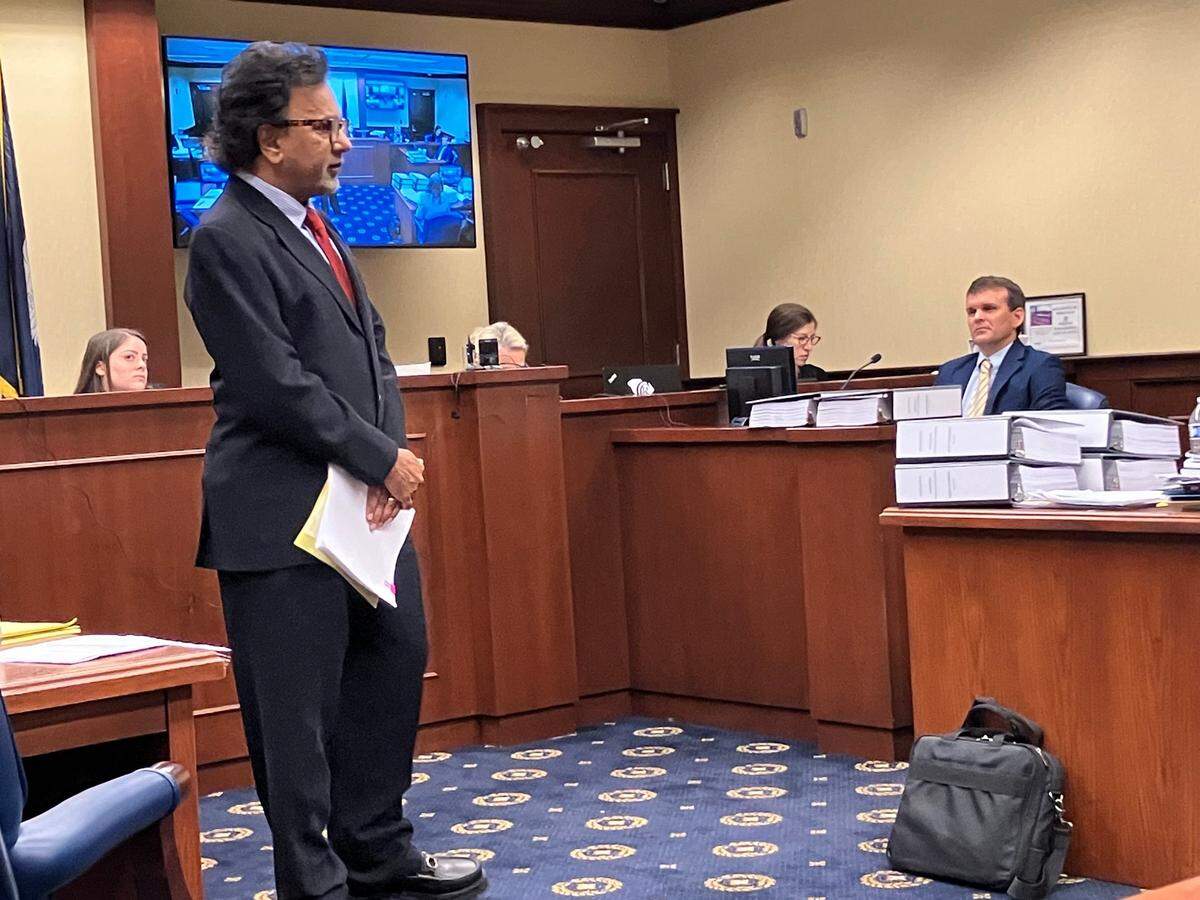
He outlined his own vision of government efficiency at an event Thursday. The organizations’ goals are to cut the state’s regulations in half, integrate AI into every part of the government and move 25,000 jobs into the private sector. Reddy also wants candidates to eliminate the state income tax and establish a “trust fund” for South Carolinians that would be dispersed on July 4 and December 25, the U.S. and Jesus’s birthdays.
His group’s agenda, published before the event, asks candidates to commit to implementing Reddy’s plan “without compromise.” DOGESC will document whether candidates unequivocally back its agenda, Reddy said.
First Circuit Solicitor David Pascoe joined Reddy on the stage Thursday evening. Pascoe, who switched from the Democratic to Republican party this year, is expected to run for attorney general. He has so far raised nearly $124,000. Reddy had not donated to Pascoe’s campaign as of the most recent Aug. 6 report.
“I want to see every one of you making a difference, and every one of you saying you are going to go there and you are going to vote for the people who basically said they’re going to support our agenda,” Reddy said during the Thursday event.