
‘That’s my peace and quiet.’ SC landowner protections pitted against pipeline needs

Rhonda McAlhaney and her husband, Jay, host family dove hunts with their four grandchildren, all boys, on their properties in Hampton Counties. McAlhaney also does conservation work, including prescribed burns and leaving the old timber uncut. She is 63, retired, and has lived in Hampton County her entire life.
Across the swamp, her 90-year-old mother lives on three tracts of land that have been in the family for over 100 years, McAlhaney said.
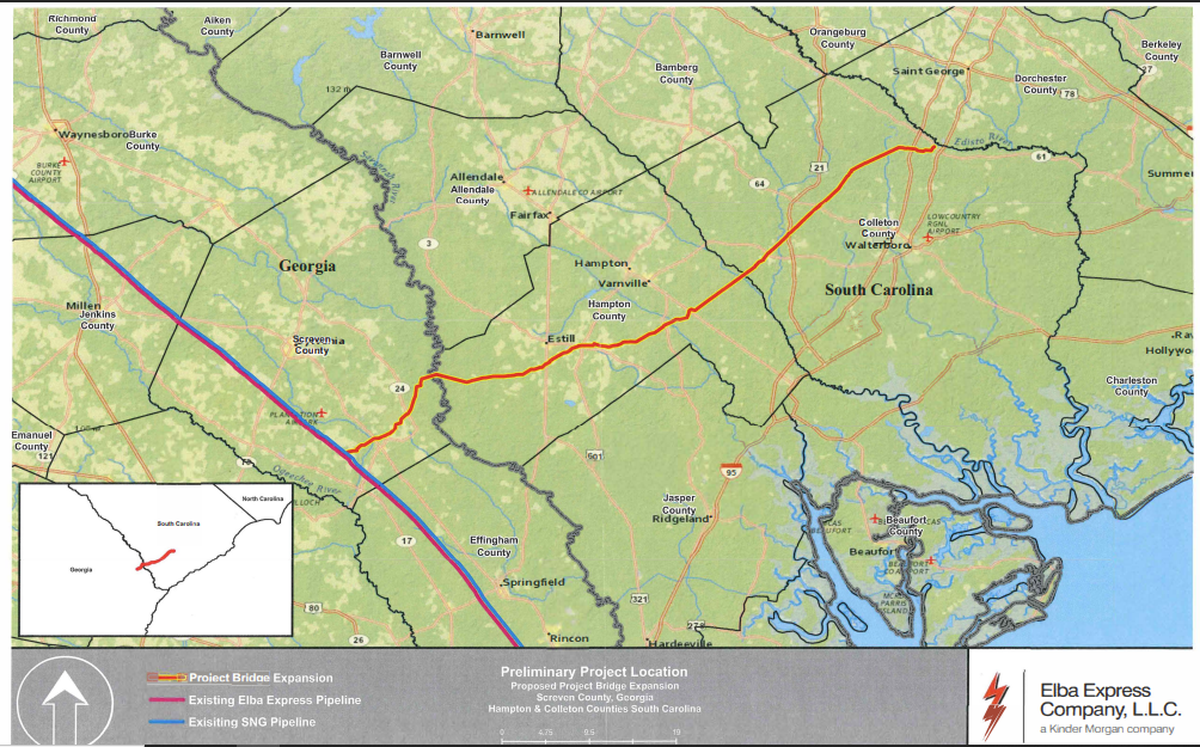
Under no circumstances does McAlhaney want an underground pipeline built in her or her mother’s backyards. But plans for a pipeline to serve a natural gas plant in Colleton County runs right through the properties.
“This is property that’s been handed down,” McAlhaney said. “It’s generational property. It means something to us.”
With plans to build a 71-mile natural gas pipeline in the Lowcountry underway, a debate about the rights of property owners in its path is growing in South Carolina.
The $431 million pipeline, which will be built by Kinder Morgan, would serve a proposed 2,200 megawatt natural gas plant in Colleton County, which will be built and co-owned by utilities Santee Cooper and Dominion Energy.
The pipeline will run underground through private properties in Hampton and Colleton counties. To build it on landowners’ properties, Kinder Morgan will either have to purchase the land with the owner’s consent or seize it through eminent domain, a policy that allows the government to take property when it benefits the public.
State Sen. Shane Massey, R-Edgefield, wants to pull eminent domain privileges from private pipeline companies. If his prefiled bill passes as written, the legislation would not allow private pipeline companies to seize private property, which could become a barrier for finishing Kinder Morgan’s project if it meets resistance from landowners.
“I think we ought to give more protection for private property ownership, such that a big utility or a pipeline company doesn’t hold the hammer of eminent domain over their head in order to essentially steal the property,” said Massey, the Senate’s Majority Leader.
He said the Canadys natural gas pipeline project prompted him to file legislation restricting eminent domain authority.
Kinder Morgan declined to comment on Massey’s bill, but the company wants to reach mutual agreements with 100% of landowners instead of legally seizing the properties, said Allen Fore, Kinder Morgan’s vice president of public affairs. The current route isn’t set in stone, and it could change based on environmental factors and resistance from property owners, Fore said. The company is currently refining its route by talking to property owners and community members.
“We have some flexibility in these early stages, but the more we refine the route and get to compatible arrangements with the majority of the landowners, the less flexibility we have to move,” Fore said.
If passed, it wouldn’t be the first time South Carolina restricted Kinder Morgan from using eminent domain to build a pipeline. In 2016, lawmakers put a moratorium on private pipeline companies’ ability to seize property. At the time, Kinder Morgan was planning to build a petroleum pipeline through the western part of the state. Just days before Gov. Henry McMaster signed the bill, Kinder Morgan suspended its Palmetto Pipeline project in South Carolina and Georgia. The 2016 eminent domain ban was scheduled to expire in 2019.
Pipeline company seeks permission
Jake Gohagan, a 34-year-old construction worker, said he wouldn’t let Kinder Morgan even survey his property in Hampton County. Since his great-grandfather quit farming, Gohagan said his family has restored native plants and conducted prescribed burns in the last 30 to 40 years on the property.
“We’ve done extensive work to try to bring it back to its natural form, and now I’ve got a pipeline that’s on the horizon that’s basically saying you’re going to have to do this, whether you like it or not,” Gohagan said.
Among other conservation and safety concerns, Gohagan said the pipeline would disrupt cypresses, yellow poplars and longleaf pines on the property, which won’t be replaceable in his lifetime.
“Timber is not replaceable,” he said. “It’s taken hundreds of years for it to get the look that it’s got now. And if they come through and rip it up? It’s never going to look the same.”
To prepare for its application for permits with state and federal agencies, Kinder Morgan has spent the last few months nailing down the final path for a pipeline. The company sent letters to 203 landowners, covering 249 tracts, in late September requesting access to survey their property, according to Fore.
Representatives with the company have also met with landowners, government officials and community members, Fore said.
The pipeline will serve a planned $5 billion natural gas plant in Colleton County, which will be located on an old coal plant site. Kinder Morgan plans to begin construction on the pipeline in 2029, Fore said. Before that, the company will have to receive approval from agencies, including the Federal Energy Regulatory Commission and state environmental agencies.
To determine the final route of the pipeline, Kinder Morgan is considering practical barriers, such as existing power lines. They are also taking into account landowners that won’t willingly agree to constructing the pipeline on their property.
“That’s why this takes a little more time,” Fore said. “It’s because we are going to have to do a lot of kitchen table conversations, and are, to fully make sure folks understand.”
The company is happy with the progress of contacting landowners so far, Fore said. At this point, Kinder Morgan has received responses from about 60% of landowners, he said. He would not say the number of properties that have declined access because he doesn’t think “they’re indicative of where we are in the process.”
A proposed route was obtained by environmentalists and confirmed by Kinder Morgan in August. The map shows the pipeline cutting across the Georgia border, across Hampton County and ending at the Edisto River in Colleton County.
The project has drawn scrutiny from environmental groups, who worry the pipeline would touch potential future portions of the ACE basin, a large nature preserve around the Ashepoo, Combahee and Edisto rivers.
What’s next?
Gohagan likely won’t be persuaded into allowing Kinder Morgan to construct the pipeline in his backyard. Even if environmental concerns were handled, he doesn’t want to deal with people doing construction and maintenance on his land.
“As a private landowner, that’s my peace and quiet,” Gohagan said. “When I go out there, I don’t have to deal with anybody that I don’t want to because it’s mine.”
Gohagan is not confident Massey’s proposed bill would protect his property because the federal government has the authority to supersede the state.
If banning eminent domain authority for private pipeline companies isn’t politically feasible, Massey still wants to provide additional protections for property owners like Gohagan. Protections could include ensuring landowners have more notice and ability to negotiate without an expensive lawsuit.
“If you’re going to have it, we’ve got to give landowners more of a fighting chance than what they have,” Massey said.
Earlier this year, state lawmakers passed the “South Carolina Energy Security Act,” which included permission for Dominion and Santee Cooper to work together on the Canadys natural gas plant. It also stripped some regulation for energy projects, including pipelines, to speed up the permitting process. Massey voted against the bill.
Some protections for landowners impacted by pipelines were stripped out of that bill before it passed. The included: pipeline companies would have to inform property owners that could be impacted by eminent domain of the project and contact information for utility and state regulatory staff.
Massey says there may be more of an appetite from some in his chamber to put more guardrails on the pipeline companies in January.
“I think there’s going to be interest in providing additional protections for private property rights, but we’ll see whether there’s enough,” Massey said.
In mid-December, Gohagan received another letter from Kinder Morgan, according to a picture he texted The State. The letter said Kinder Morgan would ask for legal access to his property for surveying, if he did not agree to let them survey on his own.
“Please note if we do not reach an agreement with you in the near term, we will be forced to apply to the Court for access as provided by law,” the letter to Gohagan read. The letter clarified surveying the tracts did not give Kinder Morgan access to build the pipeline on his property.
McAlhaney and her mother received a similar letter for their properties, she said.
“So again, we will return the survey permission slip and deny access,” McAlhaney said.