
80 years after Auschwitz was liberated, survivors’ stories echo across Columbia | Opinion
Eighty years ago, on Jan. 27, 1945, Soviet soldiers liberated Auschwitz and began to document its almost unimaginable horrors. Some of those who survived the murder of more than 1 million people at that Nazi concentration camp would later record their stories, lest any of us forget. Some are from South Carolina.
Here are two from SCETV and the South Carolina Council on the Holocaust interviews in the 1990s.
Ben Stern was born in Poland in 1924, the youngest of four siblings. Students occasionally beat him as a schoolboy because he was Jewish, but “the horror began” in 1939 when he was 15.
He was rounded up with other boys and forced to lie on the ground in a courtyard and pick up cigarette butts with his mouth as Germans with billy clubs stepped on him and bloodied his face.
He and his family were put in a ghetto and within months, the others were taken away. A man was shot in the head in front of him. He heard talk of camps but haltingly remembers, “I didn’t know what ‘Auschwitz’ meant, and I didn’t know. I didn’t know what ‘extermination camp’ meant. I knew about — they told me, but I didn’t visualize it, or I couldn’t conceive — I didn’t — I couldn’t understand what it meant.”
In 1943, a crowded cattle car took him to Auschwitz and stopped at its gates to Hell: “I got numb. I lost — literally I lost the feeling. I didn’t feel anything. I was — my — I vividly remember that I got — around my heart, it was just like somebody put extreme heat, and then I felt like, literally, like somebody would electrocute me, like I’d been electrocuted.
“And then I stood there, and of course, we were waiting until daylight. When daylight came, they opened the doors. They slid the door open, and that’s all you’ve heard is, ‘Raus! Raus!’ Just ‘Get out of here! Get out of here!’ in German.
“And I had to crawl over quite a number of people because we had some dead bodies. But you didn’t know they were dead because they were vertically squeezed. They couldn’t fall, and they were — they starved from, either from the heat, from malnutrition. I guess from no food, from not drinking. I guess from no water. And that was where we got out.”
They walked for a mile and stopped at a large room with what looked like shower heads.
“I felt like we’re going to death,” he said. “And it was just a matter of opening the faucet to see if water comes out or gas. And again, luckily, we turned the faucet, and I saw water, and we started washing ourselves.”
Death was all around him, every day, every breath he took.
“When I was in Auschwitz, needless to say that every minute, every second was just a matter of, when am I going into the crematoriums because this wasn’t a hidden thing,” he said. “It was right in front of me, looking at the fire… You smelled the bones and smelled the flesh of human bodies. So that was no — you couldn’t mistake that for anything else.”
And you couldn’t escape it, either.
“That was the daily routine, with the experience of watching the crematoriums and partly listening to cries and screams. And I don’t know. I guess you want to — I would like to say that I get used to it, but you never get used to anything like this because you get numb. You get completely inhuman. You lose your feelings, and that was agonizing because I would spend there till, till the end of ’44, when the Russians start pushing back the Germans from the East Front back to the west, and they, they transferred us — I was shipped, and I raised my hands to God then, saying that this is something, you know, that I can get out of this place, which I would never believe, you know, because you don’t get out of Auschwitz.”
By a series of miracles, he made it from one day to the next, one place to the next. He survived the Holocaust that stole so many other lives, and he eventually began to call Columbia, South Carolina, home.
He also began sharing his story even though it gave him nightmares. The impossible happened: He had people to share it with. He married on June 16, 1946, and at the time of his interview, he had four children and nine grandkids with a 10th on the way.
“We made a life in Columbia,” he said. “I am here, and I don’t mind having nightmares after my story in order that the future generations can benefit from it.”
***
Jadzia Stern was born in Poland in 1929. She was 12 when she boarded a boxcar for Auschwitz. As she did, a Nazi shot a young mother and the mother’s baby in front of her.
The Nazi shot the baby first.
“I was numb,” she said, echoing Ben’s word. “I wasn’t hungry no more. I must have not eaten, three or four days. And the journey from the ghetto to Auschwitz took two nights and two days. And we couldn’t sit; standing room only. Sometime you would just stoop down. And all I could think is the killing of the baby and the killing of the young mother, and that’s the first killing I’ve ever seen.”
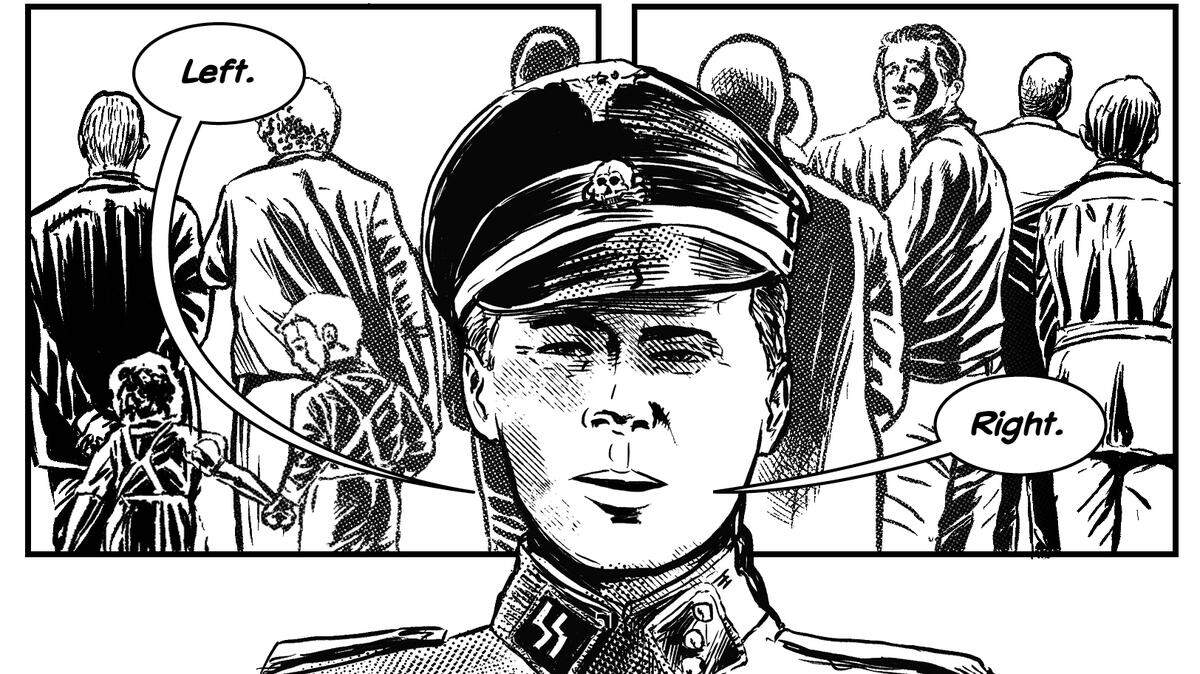
Upon arrival, she saw Nazis sitting on tall stools with dogs by their sides and choices to make.
“And with just — with one finger would determine your destiny. It would determine if you go to the good side or to the bad side. The good side meant going to Auschwitz and work there. To the bad side meant you’re going to be gassed and to the crematorium. So I — when it was my turn, I was avoiding standing before him because usually, people came down with their families. I was left alone, and I didn’t know what to do, if he’s going to send me — if I was old enough to be sent to work, or he’s going to send me to the left side. Turned out the left was bad, and the right was good. I was so many times in bad predicaments, but from that day on, I said, I’m not going to go willingly to the bad side. When it was my turn to come, the Nazi said, ‘Forward,’ and I stood. He must have sent me to the bad side because the people start yelling to me, ‘Little girl, run to the other side. You don’t belong here. Run!’ And I ran from the bad side to the good side.”
She remembers more running. Once, on her way to the bathroom, she saw a sunflower on the other side of the wire fence and stooped down to pick it from the ground. A Nazi saw her, and started shouting and shooting at her. She ran for her life, the flower in her hand.
She remembers the awful color of the sky.
“You can see the smoke every day,” she said. “The skies were red, and the smoke was red too.”
She survived the same way Ben Stern did: one day at a time. Soon they had more in common than tragedy.
Ben and Jadzia met after Auschwitz and married in Europe before coming to South Carolina together.
She said at first she “stuck out like a sore thumb” in Columbia and “was always sad.”
“I remember the lady in Beth Shalom, Belle Jewler, she said, when I used to bring my little girl to Sunday school, she always called me the little girl — the little lady with the sad eyes. I was so sad. I was that sad. But my happiest years were when I raised my children. I have four wonderful children.”
Her children grew, as children do, like sunflowers, became a series of miracles of their own, with children of their own. The family became a chain that Auschwitz, for all its horrors, couldn’t break.
She concluded her interview with words for her family, but really words for all of us.
“I want to say something to my dear, beloved children and grandchildren and great-grandchildren. When there are no more Holocaust survivors to testify of the evil of the Jewish Holocaust — because in Auschwitz, the best of humanity were murdered by the Nazis — you will make me proud, dear children, if you will stand up to any form of defamation of Jewish people, and there’s one more thing. I know I’m asking a lot.
“While you’re at it, speak also for other minorities because I believe in you, and we come from a decent and rich heritage, and we believe in justice and brotherhood for all people. And if you remember this, I will smile at you.”