
For SC Democrats, rebuilding party ‘is a long process’
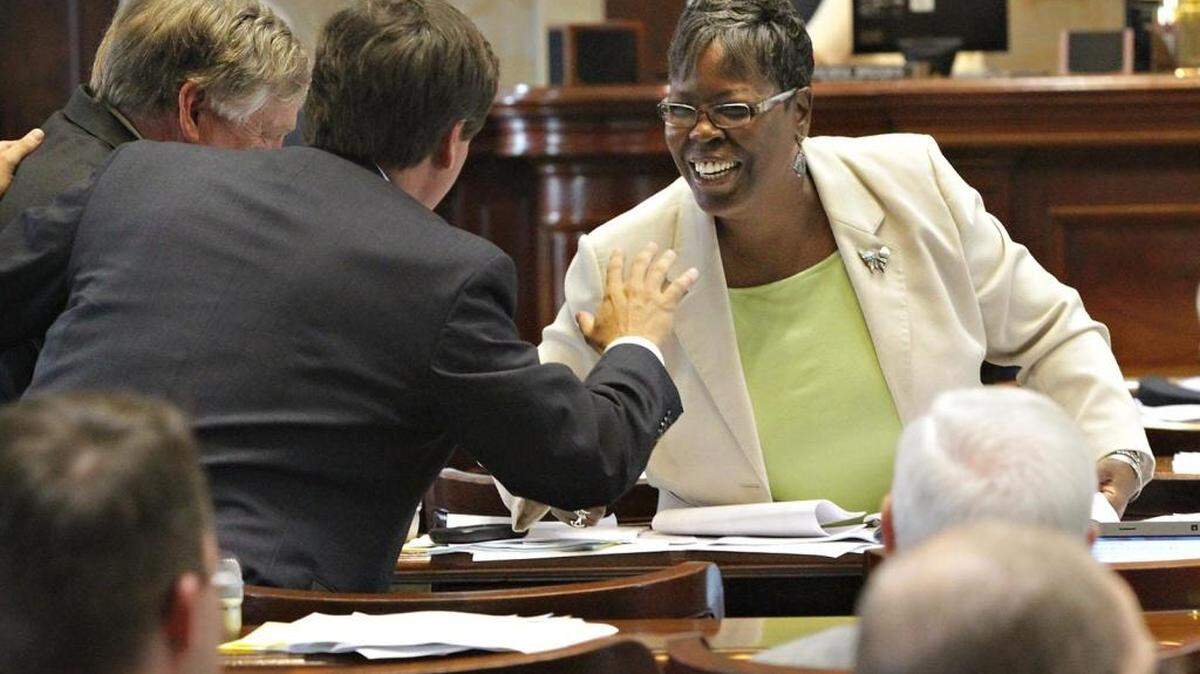
The party of Thomas Jefferson and Andrew Jackson is on a mean losing streak in South Carolina.
Fifty years removed from utter domination of S.C. politics, Democrats now hold none of the state’s 11 constitutional offices or U.S. Senate seats, cling to minorities in the S.C. House and Senate, and control just one of the state’s seven U.S. House seats.
South Carolina has not picked a Democrat for president since 1976. Its voters last elected a Democratic U.S. senator in 1998. And in 2014, the Democratic candidate for S.C. governor suffered the party’s worst loss for that position in 24 years.
Now, a party still trying to recover from losing its base of white conservatives has other issues to worry about: struggles with recruiting good candidates, S.C. voters’ aversion to the Democratic brand, and the sheer number of white voters in a state where race often defines party affiliation.
“I don’t remember a point in our history when the S.C. Democratic Party was less competitive,” said Boyd Brown, a former Democratic state representative and a superdelegate to this summer’s Democratic National Convention.
I don’t remember a point in our history when the S.C. Democratic Party was less competitive.
Boyd Brown
former Democratic state representativeThe party’s problems are hardly unique to South Carolina. Across the South, Democrats have struggled since Democratic President Lyndon B. Johnson signed the Civil Rights Act in 1964.
In some states, including Virginia and North Carolina, Democrats have made headway in restoring two-party politics.
But the road to that recovery has been agonizingly slow in South Carolina.
Here, some Democrats and observers say the path forward will be a long slog that includes bringing young and moderate voters into the fold and, ultimately, waiting on the state’s demographics to change.
The fall of Southern Democrats
Today’s S.C. Democratic Party is a far cry from the force that dominated S.C. politics for nearly 100 years after Reconstruction.
Democrats held the S.C. governorship from 1876 to 1974. They held every seat in the S.C. House of Representatives from 1900 to 1961.
In all 12 elections from 1900 to 1944, Democratic presidential candidates received at least 87 percent of the vote in South Carolina. Eight times, the Democratic candidate won more than 95 percent of the S.C. vote.
But that was back when white, conservative voters – who since Reconstruction have held the key to S.C. political power – still called themselves Democrats.
That began to change in 1948 when the national Democratic Party adopted a more liberal civil rights agenda.
Starting in the 1960s, Southern white conservatives abandoned the party in droves following U.S. Sen. Strom Thurmond, a former S.C. governor, who in 1964 defected to the GOP, becoming the Deep South’s first Republican senator since Reconstruction.
“It sent the message that: ‘It’s OK to be a Republican,’ ” said political scientist Scott Buchanan at The Citadel.
The hits kept coming for a party not used to losing.
In the 1980s, Republican S.C. Gov. Carroll Campbell waged an aggressive, successful campaign to recruit white Democrats into the ranks of the GOP.
In the 1990s, then-state Rep. Don Beatty, D-Spartanburg, led a redistricting charge. That redistricting gave African-American Democrats more gerrymandered seats in the State House. But, by creating more black majority seats, that redistricting also created more overwhelmingly white districts, precipitating a GOP takeover of the Legislature.
In 1994, Democrats lost the governorship – for the third straight time – along with six of the state’s then-eight constitutional offices and control of the S.C. House. They lost control of the state Senate in the early 2000s.
“They fell asleep at the wheel, and they’re not the only Democratic Party in the South to do that,” said The Citadel’s Buchanan. “Whenever you have a one party with such an overwhelming majority, you get sloppy. You get lazy. The Democrats did not do as much in terms of recruiting. They did not do the basic blocking and tackling of politics, and it caught up to them by the late 1990s.”
They fell asleep at the wheel. ... Whenever you have a one party with such an overwhelming majority, you get sloppy. You get lazy. The Democrats did not do as much in terms of recruiting. They did not do the basic blocking and tackling of politics, and it caught up to them.
Citadel political scientist Scott Buchanan
on the fall of S.C. DemocratsRoadblocks to recovery
The Democratic Party still is trying to recover in South Carolina – as are other state parties across the South.
“We just got lazy and complacent, and we took things for granted,” said state Rep. Gilda Cobb-Hunter, D-Orangeburg. “We didn’t go out there and build a party, continue to build a bench and all of the things that go into effective party organization. We just didn’t do it, and we haven’t done it. We neglected the basics.”
Some Democrats and observers say the party’s problems start with a lack of a clear message on the “breakfast table issues” that matter most to everyday S.C. residents. Too often, some say, S.C. Democrats’ only offering is that they are not Republicans.
“First and foremost, the Democratic Party has a bad brand,” said Bakari Sellers, a former Democratic state representative who unsuccessfully ran for S.C. lieutenant governor in 2014. “For years, we’ve lost that laserlike focus on issues that matter the most to South Carolinians.”
The party is taboo to many S.C. voters, even those whose interests align with Democratic issues, some say.
“I’ve got friends who agree with me on 85 percent, 90 percent of the issues,” said Democratic superdelegate Brown. “But if you asked them if they’re Democrats, they look like you asked if they were lepers.”
Some say the problem centers on candidate recruitment. Less competitive districts due to redistricting and a lack of support from the national party have discouraged candidates from running, they add.
“Even when we do have good candidates, high-quality candidates, people just look the other way,” Sellers said.
Then, there are demographics.
Southern whites are almost as loyal to the GOP as Southern African-Americans are to the Democratic Party, and more than 68 percent of South Carolinians were white in 2015, according to U.S. Census data.
“Until we figure out how to get white, working-class South Carolinians to recognize that they have more in common with Democrats than they do Republican elected officials, I don’t see a lot of of headway toward becoming victorious,” said state Rep. Cobb-Hunter.
Until we figure out how to get white, working-class South Carolinians to recognize that they have more in common with Democrats than they do Republican elected officials, I don’t see a lot of of headway toward becoming victorious.
State Rep. Gilda Cobb-Hunter
D-OrangeburgA path forward?
Democrats and observers say there is no easy cure for the state party’s problems.
Instead, they prescribe an added emphasis on reaching young and moderate voters while waiting for the rapidly growing state’s demographics to change.
That has been a big part of the playbook for other Southern state parties on the rebound.
The 2016 election cycle is the first in which younger millennial voters can – but still might not – outvote baby boomers. Millennials are more diverse and liberal, especially on social issues, than are baby boomers and older generations, though they also have more of an aversion to party affiliation.
Reaching younger voters while they are up for grabs – before they grow older and more conservative – is key in a state that typically votes Republican by a 55-45 margin, said Winthrop University political scientist Scott Huffmon.
“It’s letting millennials know what the issues are, why they’re important to them and why the Democratic Party is the better party to support on this issue,” Huffmon said. “You have to be able to do that in a way that everybody can grasp quickly.”
It’s letting millennials know what the issues are, why they’re important to them and why the Democratic Party is the better party to support on this issue. You have to be able to do that in a way that everybody can grasp quickly.
Winthrop University political scientist Scott Huffmon
An August poll, commissioned by the S.C. Democratic Party, fueled Democratic optimism on that front.
According to that poll, Democratic presidential candidate Hillary Clinton trailed GOP nominee Donald Trump by just 2 percentage points in South Carolina and led 41-36 among voters younger than 65. However, subsequent polls have shown Trump pulling away to a wider S.C. win.
Democrats hope that changing demographics – the state’s Hispanic population is small but rising rapidly, for example – and the aging out of older, staunch conservatives will give them a chance in the next few election cycles.
In the meantime, hammering home the party’s stances on issues that affect South Carolinians every day is crucial to attracting new voters, said Jim Hodges, the last Democratic governor of South Carolina.
“They’ve got to hone in on good jobs, education, the environment and affordable college,” Hodges said of his fellow Democrats. “Those are the keys for every corner of the state.”
They’ve got to hone in on good jobs, education, the environment and affordable college. Those are the keys for every corner of the state.
Jim Hodges
S.C.’s last Democratic governor, on his fellow DemocratsOther Democrats also call for more consistent outreach to voters to explain that message.
Democrats have depended too heavily on African-American voters and specific parts of the state, Rep. Cobb-Hunter said. She added convincing white voters that Democrats agree with them on taxes, education and health care is paramount.
S.C. Democrats also have petitioned the national party for help.
“If we invest in the infrastructure in the state, if we invest in the messaging mechanism in the state, if we train the young people in this state, then we can compete,” S.C. Democratic Party chair Jaime Harrison said.
Democrats differ on how long it might take to rebuild.
Harrison estimates six years might be enough. Sellers said he would not rule out “catching lightning in a bottle in a couple of years.”
Others say a major pendulum swing could take longer.
“Rebuilding and rebranding the party, no matter the party, is a long process,” said Amanda Loveday, the S.C. Democratic Party’s former executive director. “You can’t do it overnight.”
Avery G. Wilks: 803-771-8362, @averygwilks
Democrats in Southern states
South Carolina is not the only Southeastern state where Democrats have lost power. A look at how Democrats are faring in the Southeast, ranked by the percentage of the seats that Democrats hold in each state’s legislature:
40%+
Kentucky: 44.4 percent of state legislature, 12.5 percent of the congressional – U.S. Senate and House – delegation, two of seven state constitutional offices
30-40%
Mississippi: 39.1 percent of state legislature, 16.7 percent of congressional delegation, one of eight state constitutional offices
Louisiana: 38.9 percent of state legislature, 12.5 percent of congressional delegation, zero state constitutional offices
South Carolina: 37.6 percent of state legislature, 11.1 percent of congressional delegation, zero state constitutional offices
Virginia: 37.1 percent of state legislature, 38.5 percent of congressional delegation, three of three state constitutional offices
North Carolina: 35.9 percent of state legislature, 20 percent of congressional delegation, six of 10 state constitutional offices
Florida: 33.1 percent of state legislature, 38 percent of congressional delegation, zero state constitutional offices
Georgia: 33.1 percent of state legislature, 25 percent of congressional delegation, zero state constitutional offices
Less than 30%
Alabama: 29.3 percent of state legislature, 11.1 percent of congressional delegation, zero state constitutional offices
Tennessee: 22.7 percent of state legislature, 18.2 percent of congressional delegation, zero state constitutional offices
SOURCES: USElections.com, Ballotpedia
This story was originally published September 18, 2016 at 11:29 AM with the headline "For SC Democrats, rebuilding party ‘is a long process’."