
Midlands hospital is growing fast. But they promise locals won’t see a change
Anyone who regularly drives down U.S. 378 can’t help but be aware of Lexington Medical Center. The imposing hospital dominates the local skyline right off Interstate 26, and has since it opened as a county hospital in 1971.
But that stability hides a transition that’s underfoot.
Lexington Medical Center has long been more than a local hospital, and last fall announced it was rebranding as Lexington Health to reflect the growing network of physician practices and urgent cares that fall under its umbrella across the Midlands.
That announcement was quickly followed by the news the renamed not-for-profit would see its first new CEO in a decade starting next year.
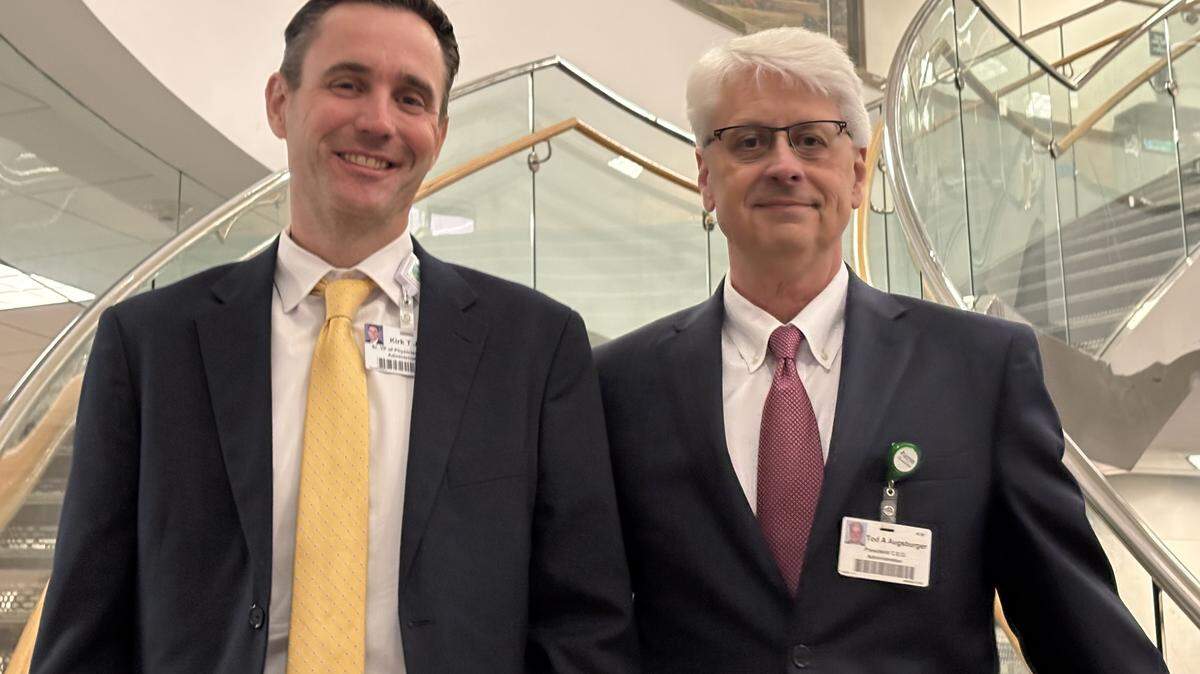
When current chief Tod Augsburger hands things over at the beginning of the year to Kirk Jenkins, now Lexington Health’s senior VP over the physicians’ network, he will bequeath something bigger than the 125-bed facility it opened as more than 50 years ago.
But speaking to The State, both executives emphasized that Lexington Health’s community focus is one thing that won’t change.
“We are one of the few proudly remaining local and independent health care systems,” Augsburger said. “We think that’s a big difference.”
While Lexington Medical Center transitioned away from being a county-run hospital in 2020 to escape certain government restrictions and state pension liabilities as its network grew, the hospital system is still overseen by the county as a key public service.
“Our structure prohibits us from merging, selling, doing anything with another organization without Lexington County Council’s approval,” Augsburger said, and draws a direct comparison local patients will be familiar with.
“That’s unlike what happened with Palmetto Health and Prisma. In fact, our county council saw that and said, ‘We don’t mind if you want to be a private not-for-profit to compete better in this tough world, but we don’t want to lose our health care system,’ which is what happened in Columbia,” he said. “No offense, but that’s run out of Greenville.”
Prisma Health was formed in November 2017 after Midlands-based Palmetto Health and the Greenville Health System merged to create the largest health system in South Carolina with 18 hospitals — three of them in the Midlands at Prisma Health Richland, Prisma Health Baptist and Prisma Health Baptist Parkridge.
That was followed in 2021 by the Medical University of South Carolina buying the former Providence hospital on Forest Drive, along with Providence Northeast off Farrow Road and the Kershaw Medical Center in Camden.
In a crowded local health scene, Lexington Health hasn’t stood still. The system now includes a 607-bed teaching hospital, six community medical and urgent care centers, nearly 80 physician practices and more than 9,000 health care professionals.
Jenkins, a local who was born at Lexington Medical Center, has overseen some of that expansion, working with Lexington Health’s physician network since 2013.
“One of the things we’ve been focused on that I think is unique, relative to a lot of health systems over the years, is our expansion of primary care,” he said. “We’ve had a stated goal for many years to try to provide convenient primary care access close to where our community members live and work.”
Jenkins said Lexington Health has worked to combine those primary offices with specialty care in heart health, cancer, surgery, orthopedics and other specialty offices around the Midlands.
“As the community has grown out in every direction, we follow that community growth,” he said.
As that growth continues, Jenkins expects Lexington Health to continue to add locations and services, hoping to meet their patients where they live even before they have moved into new neighborhoods. Lexington Health made the decision to open a primary care office northeast of Columbia in 2021 that now sees tens of thousands of patients in a year.
“Now we now have cardiology, pulmonology, orthopedics, general surgery, podiatry, to name a few” in that community, Jenkins said.
Meanwhile, the growth in urgent cares across the Midlands has given patients access to health care without clogging up emergency rooms. Augsburger said Lexington Health now sees 200,000 urgent care patients a year, on top of the 90,000 regularly seen in the ER.
While Lexington Health will definitely expand, Augsburger said he sees it staying centered on the Midlands.
“Could we spread out a little bit? I guess it depends if we felt like we’re meeting our mission here first,” he said. “But the first and foremost commitment is to Richland and Lexington counties. We wouldn’t want to spread ourselves too thin. And thankfully, we’ve had plenty to do right here.”
Even as the Lexington-centered organization sees the growth in the Midlands of Prisma Health and MUSC, the Lexington Health CEO doesn’t see the other health care systems as competition.
“For better or worse, there’s a lot of health care need in our community,” Augsburger said. “It’s not really competition as much as there’s plenty of people for us to serve. Both organizations are great organizations. They’ve got good leadership. We complement each other more than we compete.”
But Lexington Health’s focus on the local community is represented, Augsburger said, in a survey in the trade journal Modern Health Care, which ranked Lexington Medical Center as the most family-friendly health care system to work for in the country.
“We’re not perfect, we screw things up, but it’s local people making decisions for local people,” he said.
He wants the organization to maintain that kind of small-town feel, where the people his doctors treat, and who work for Lexington Health, are also their friends and neighbors.
“If you want to be anonymous at the end of the day, you’ve worked hard and you just don’t want to bump into your patients, go to Atlanta. Go to New York,” the CEO said. “I want you to want to make a difference in your community, and I want you to bump into your patients at Publix or Lowe’s.”
This story was originally published November 3, 2025 at 5:00 AM.
.jpg)