
‘The cool side of the river’: Art helps drive revitalization of Cayce, West Columbia
Cayce and West Columbia are using art to refresh key parts of their cities, attract public and private investment, and make their cities more appealing to residents and visitors. But can they succeed while avoiding the pitfalls bigger cities have struggled with?
The idea is that by devoting space and money to the arts, these cities can become magnets for new business, growth, tourism and revenue.
“When you bring art, culture, activity and good infrastructure to a place, then private development will follow,” said Fred Delk, development guru and executive director of the Columbia Development Corp.
Cities are not only believing in the proven benefits of public art, but they are also trying different strategies for injecting communities with culture.
In Cayce, where several vacant buildings line the former and future heart of the city, council members recently voted to create an Arts Design Overlay District. The designated area is on State Street, from Poplar Street south to Frink Street, and on Frink Street from State Street to Foreman Street.
A district seemed like a natural fit because it allows the city to change rules in the area without combing through all ordinances and making major changes, mayor pro-tem Tara Almond said.
Softening the rules can make the area “favorable to artists” and more pedestrian-friendly, city manager Tracy Hegler and planning and development director Carroll Williamson wrote in a memo to city council.
The city will allow residential uses in areas that would otherwise be zoned as commercial, letting artists have the live-work spaces they often want. The city will place “no restriction on the size” of signs it requires on commercial buildings, and it will allow buildings to be built closer to the road right-of-way, with no parking requirement, according to the memo.
“We want a place where artists can actually buy a building, renovate it, do their art, live in it,” Almond said. “We don’t ever want them to be priced out.”
Smaller cities can learn from Columbia, where the arm wrestling between private investment, government and the arts has resulted in more than a few losses. The Vista, for example, has largely been drained of the art it used to have, according to Delk. And most recently, the nonprofit Tapp’s Arts Center was forced to move out of its prime, palatial Main Street location because of a lack of city, county and state funding.
This pattern is all too familiar to artists like Clark Ellefson and Eileen Blyth.
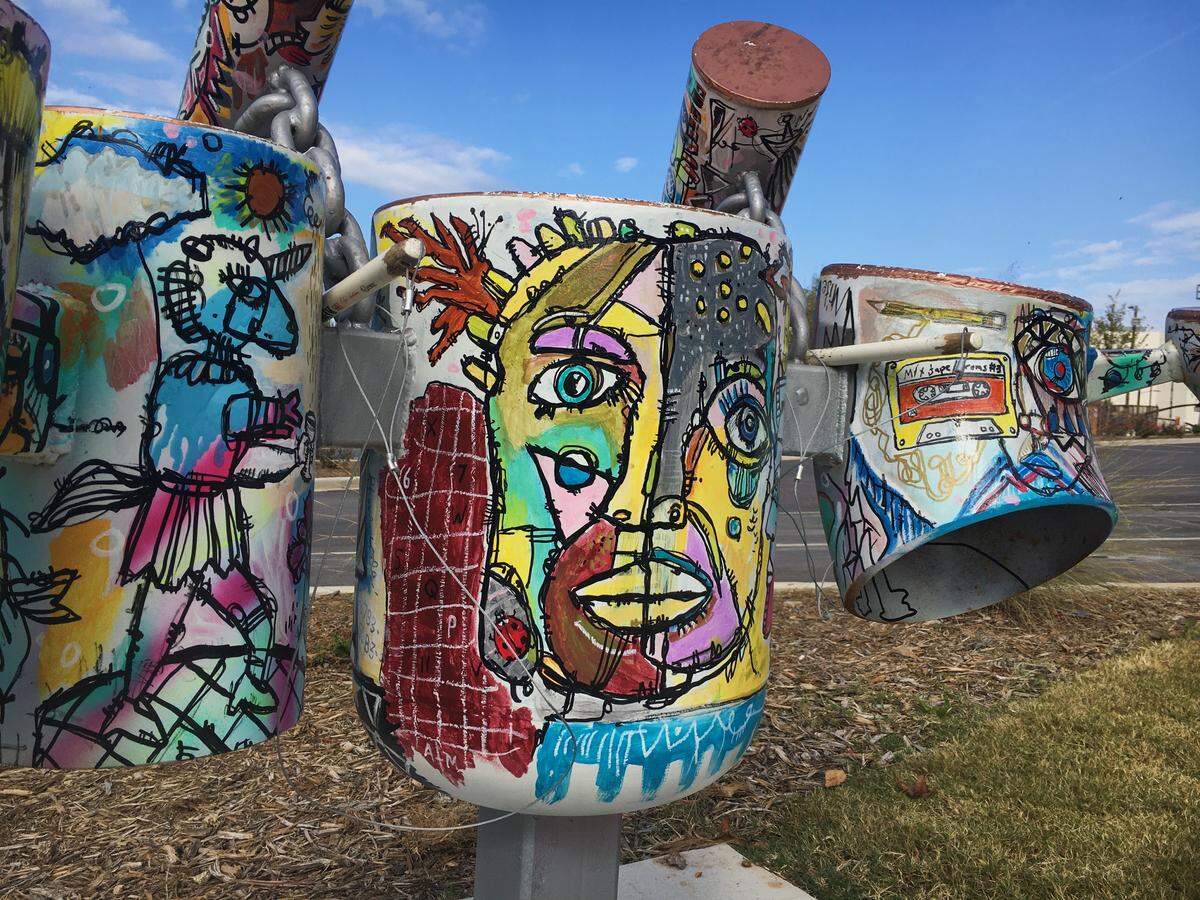
Blyth’s first venture into the world of public art was creating the drum benches on Columbia’s Main Street (on the sidewalk in front of Drip) and in West Columbia’s Interactive Art Park. The pieces are multicolored sets that offer pedestrians a whimsical opportunity for music-making.
Blyth was part of Vista Studios, a group of about a dozen artists who worked in a space on Lady Street before they were nudged out. She said she is hopeful that Cayce and West Columbia will find ways to retain and reward artists for their labor, though she is skeptical because she has seen the opposite come true before in other places.
“What happens is that we bring the people and then they push us out,” she said.
Early in his career, Ellefson, artist and owner of Lewis & Clark, was priced out of his Vista space at the intersection of Lincoln Street and Lady Street. He was also run out of a building on West Columbia’s State Street by code enforcement officers, he said. In 1992, Ellefson and his business partner, Jeff Helsley, bought some property and started Art Bar, the psychedelic, glowing bar and music venue on Park Street.
Ellefson is widely considered one of the first creatives to venture into the Vista, helping to kickstart a new wave of interest in the area.
“It’s energy, it’s tourism. It creates all kinds of other activity around it. Creative businesses, they also have creative energy about them and that just makes other things happen,” Ellefson said.
Cities large and small across the country have attempted their own versions of “creative placemaking,” said Lee Snelgrove, executive director of One Columbia for the Arts. So when organizations such as his — which finds opportunities for public art — want to convince leaders to prioritize and fund art, it’s not such an uphill battle anymore, he said.
“It’s getting easier in the sense that it’s more apparent that that’s a national-level conversation,” he said. “When you’re being advertised to as a tourist to another destination, you’re probably going to hear about what cultural amenities they have.”
Art means more than painted canvases and sculptures, too. The Midlands counties are home to multiple theaters, professional dance companies, filmmakers, culinary artists, musicians, writers, photographers and all kinds of other inventive people.
Being ‘more nimble’
Venetia Sharpe, a Cayce-born artist who has owned Sharpe Creations Studio and Gallery on Frink Street since 2012, said she is “actively soliciting” other artists to move into the area now. She and her husband, John Sharpe, have often had to travel to markets, such as Columbia’s Soda City Market and Craftsmen’s art fairs, to sell their wares. They’re excited to stay put.
“The ceramics get heavy after a while,” she said. “We were always hoping that people would finally come to us.”
The Sharpes were two early members of the Cayce Arts Guild, a group of about 60 residents and artists who promote arts in the city.
Cayce is also working on a grant-funded “art lot” on State Street that will be home to green space, multiple sculptures by local artists and seating. It may seem to some like too small a project to have a major impact — it’s not, say, a large art museum — but Delk said he’s seen how powerful even one artist can be in transforming a community.
Plus, cities like Cayce and West Columbia are smaller and “more nimble,” and seemingly willing to experiment with new ideas, so they’re promising, said Delk, who was one of the brains behind Stormwater Studios, an artist collective on Pendleton Street in Columbia.
In his 35 years as an economic catalyst sleuth, Delk said he has watched art turn middle-of-nowhere places into attractions, morphing deserted areas into something like The Vista, one of eight state-designated cultural districts.
Americans for the Arts, a national organization that promotes the use of arts as an economic driver, defines a cultural district as a “well-recognized, labeled, mixed-use area of a city” that works as an anchor for growth.
In 2014, the South Carolina Legislature amended the law to permit the South Carolina Arts Commission to formally recognize cultural districts. The other districts are Beaufort, Bluffton, Florence, Greenwood, Lancaster, Rock Hill and Spartanburg.
Though in South Carolina there are no set, state-level financial incentives for cultural districts, cities get bragging rights and a marketing boost by being state-designated zones for arts and culture, according to Snelgrove. And in the future, the state-run program could grow to include added benefits, such as tax incentives or cohesive street signage in all of the districts.
A ‘direct benefit’ to local businesses
West Columbia’s interest in using public art as an impetus for growth began in 2015, according to city manager Brian Carter.
Local artist Karl Larsen created a version of Candy Chang’s “Before I Die” wall that was placed near the riverwalk for four months, Carter said. Visitors could write on the wall what they wanted to accomplish before their lives ended.
“It was eye-catching and very engaging and when we removed it, that absence was felt and we knew that there was an opportunity to start introducing more public art projects,” Carter said.
Since that first experiment, West Columbia has been laser-focused on breathing new life into the area around its riverwalk, including State Street and Meeting Street, portals to Lexington County. The city invested in renovations, additional parking and the Carraway Enabling Park for children with disabilities to play in. It is actively trying to attract new businesses to the area, too, after some closures earlier this year.
One of the city’s signature projects was its Interactive Art Park, which is essentially a parking lot on Meeting Street surrounded by playful, colorful art and featuring a gazebo under which artisans sell their goods on the weekend.
Much of the art in West Columbia’s park is musical, and it requires visitors to break the usual barrier between art and viewer, to touch, hit and play with the objects instead of just admiring them.
“If we can create an engaging experience, where somebody is parking in a parking lot that is unique and fun and engaging, but then they are spending their dollars at a local restaurant or local retailers, that is a direct benefit to our local businesses,” Carter said.
One of the businesses that stands to gain from the appeal of technicolor murals (by local artist Christine Lufty), music-making sculptures and string lights is Frame of Mind, Mark Plessinger’s eyewear shop. His store is on the same State Street strip as New Brookland Tavern, a longtime grungy music venue, and Terra, which is consistently rated one of the best restaurants in the Columbia area.
Plessinger moved across the river to West Columbia several years ago after being priced out of Columbia.
He opened his shop on Columbia’s Main Street in 2007, when there wasn’t much around, he said.
To fill extra wall space in his store, he invited artist friends to showcase their work, and encouraged neighboring vendors to join. Together, they developed what became First Thursdays on Main. In a few years, his little monthly celebration of arts and culture had swallowed up all of Main Street, “from the State House to city hall,” he said. It generated buzz and excitement, including from businesses and other arts institutions.
In the 2010s, Tapp’s Arts Center moved into the former Tapp’s department store building on Main Street. Then came the Nickelodeon Theater and Mast General Store, just down the street from Columbia Museum of Art, a linchpin that opened its doors on Main Street in 1998.
With the area booming, Plessinger’s landlords decided to sell the building that housed his shop but he couldn’t afford to buy it, he said. He watched his creation, which drew many eyes and feet to Main Street, blossom into something bigger than him.
“I helped build it and it built so much that I couldn’t afford it,” Plessinger said.
This is one of the central conflicts of arts-inspired growth, according to Plessinger, and one cities such as West Columbia and Cayce will need to address: Commerce has a tendency to tamp culture, although culture makes places ripe for investment in the first place.
So does a massive project like the Brookland development scare him? A bit, Plessinger said, but he sees his role differently now. He thinks of himself and other artists as community builders, people who enrich the spaces they inhabit but who are not necessarily a permanent fixture.
West Columbia, with help from Plessinger and other local artists, has begun hosting multiple arts events throughout the year. The most kooky is Kinetic Derby Day, a street parade featuring homemade, human-powered vehicles. Art on State, the across-the-river version of First Thursday on Main, occurs every May, and Fall Back Fest takes place the first Friday in November.
The city is not taking Cayce’s arts district approach, but focusing instead on making it easy and attractive for artists to work and live in the city, Carter said. The district could come later, he said.
In April 2016, city council approved an Artisan Manufacturing Ordinance that made it possible for small-scale manufacturing and sales to happen in the same space. That meant artists could create and sell pieces at the same location. The ordinance also opened the door for another form of art, craft beer by The Whig’s Phill Blair, to move into the city, according to Carter.
West Columbia is seeing results. Between August 2018 and August 2019, the city issued 252 additional business licenses, a significant increase from previous years, according to spokesperson Anna Huffman.
While Carter is careful to note that art has not been the only economic driver in West Columbia — city council initiatives, plus the Brookland development, private investment and the lure of the area as a federally designated Opportunity Zone also helped — he said creativity has become a central part of the community.
Arts and culture are special because they create moments of connection like what Carter experienced the first time he saw Auguste Rodin’s bronze sculpture, “The Burghers of Calais,” in Philadelphia, he said.
“As I was looking at that piece, I looked to my left and there was a person looking at the piece who I didn’t know, but who was experiencing the same thing I was. And we struck up a conversation,” he said.
Yes, West Columbia has visions of reviving blighted and underutilized parts of town, but Carter said the city does not want to do that without its artists, or at their expense.
“If we were to ever get to a point where we left our local artists behind or we forgot about folks who were there in the beginning, then we’re missing our mark,” he said.
This story was originally published November 18, 2019 at 5:00 AM.